
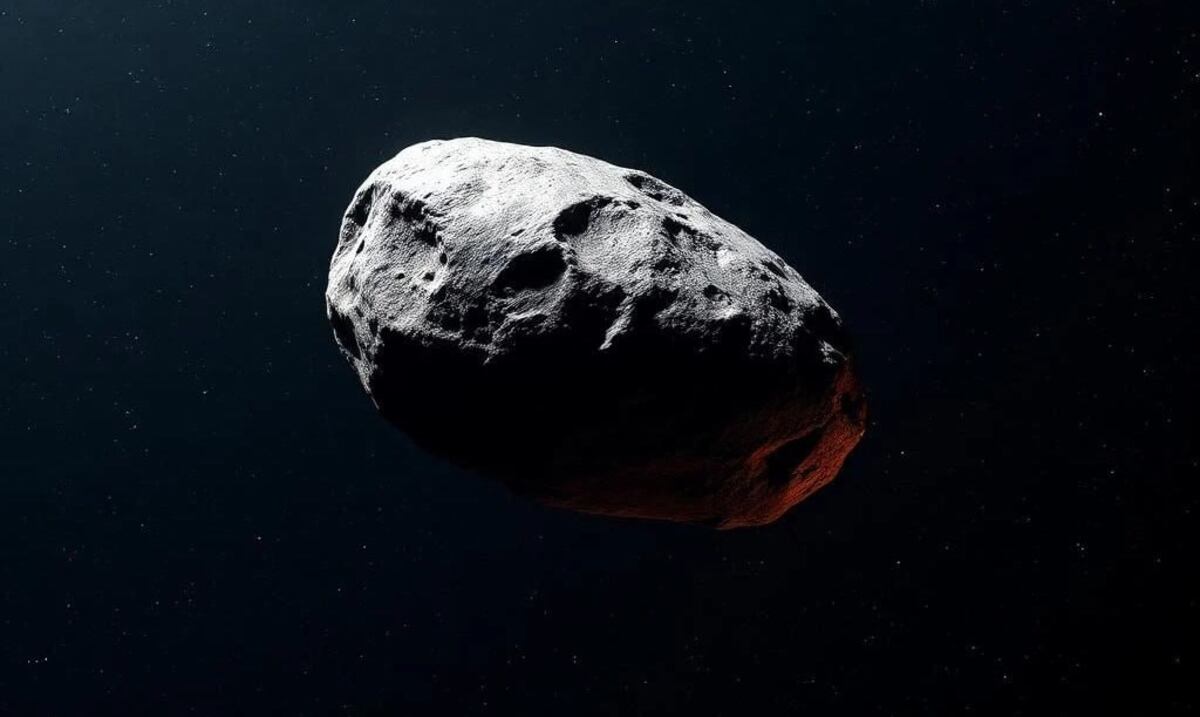
Asteroid 99942 Apophis, identified by astronomers as a relic of the early solar system, is preparing for a historic encounter with our planet. Scheduled for April 13, 2029, this celestial body will perform a flyby at a distance of approximately 32,000 kilometers from the Earth’s surface.
According to official data provided by the POTthis approach is an unprecedented event in recorded human history, since an asteroid of such dimensions did not come so close to Earth in previously known scientific records.
Although the asteroid was popularly called the “God of Chaos”in reference to the Egyptian deity of destruction called “Apep”the US space agency categorically ruled out any danger. NASA was emphatic in ensuring that there is no risk of impact for the Earth or satellites in orbit during the next 100 years.
In fact, scientists consider the flyby to represent an exceptional scientific opportunity. It is a rocky object with an average diameter of 340 meters and a longitudinal axis that reaches 450 meters, dimensions that experts compare to the height of the Eiffel Tower or the length of a professional American football field.
The origin of this object dates back to 4.6 billion years ago, in the main belt between Mars and Jupiter, from where it was displaced to the vicinity of Earth by the gravitational influence of the giant planets. Being an S-type asteroid, composed mainly of silicates and metals such as nickel and iron, its internal structure will be the main focus of research.
During its close passage, the Earth’s gravity will exert twisting, stretching and compression forces on the rock, a phenomenon that could alter its rotation or even cause surface landslides. Observing these responses will allow scientists to understand more deeply the internal composition of these types of bodies close to our home.
The global scientific community is working together to take advantage of this observation window. NASA, through its OSIRIS-APEX mission, redirected the probe that previously visited the asteroid Bennu to meet Apophis in the future, shortly after its closest approach. At the same time, the European Space Agency is developing the Ramses mission, which will accompany the asteroid during its journey to monitor changes in its orbit and structure in real time.
According to the agency’s information, the asteroid currently completes its solar orbit in 0.9 years and is classified as an Aten object. However, after the gravitational interaction of 2029, its trajectory will expand, becoming an Apollo-type object with an orbital period of 1.2 years.
Observation will be possible even from the Earth’s surface for the inhabitants of the eastern hemisphere, who will be able to see it under favorable meteorological conditions without the need for complex instruments.
This event will be monitored through an international network of observatories and high-precision radars, which will accurately measure the variations in its brightness and spatial orientation.. Current technology allows, for the first time in history, to document in detail a phenomenon of this scale. Although the possibility of an impact was ruled out after observations made since 2004, the scientific community emphasizes that the study of Apophis is essential for long-term planetary defense.
Experts maintain that, although in this particular case there is no threat, developing the ability to detect and study nearby asteroids is imperative for our future security, as indicated by the recommendations of specialists in defense against near-Earth objects. The 2029 flyby will mark an unprecedented technical and scientific milestone for modern astronomy.