
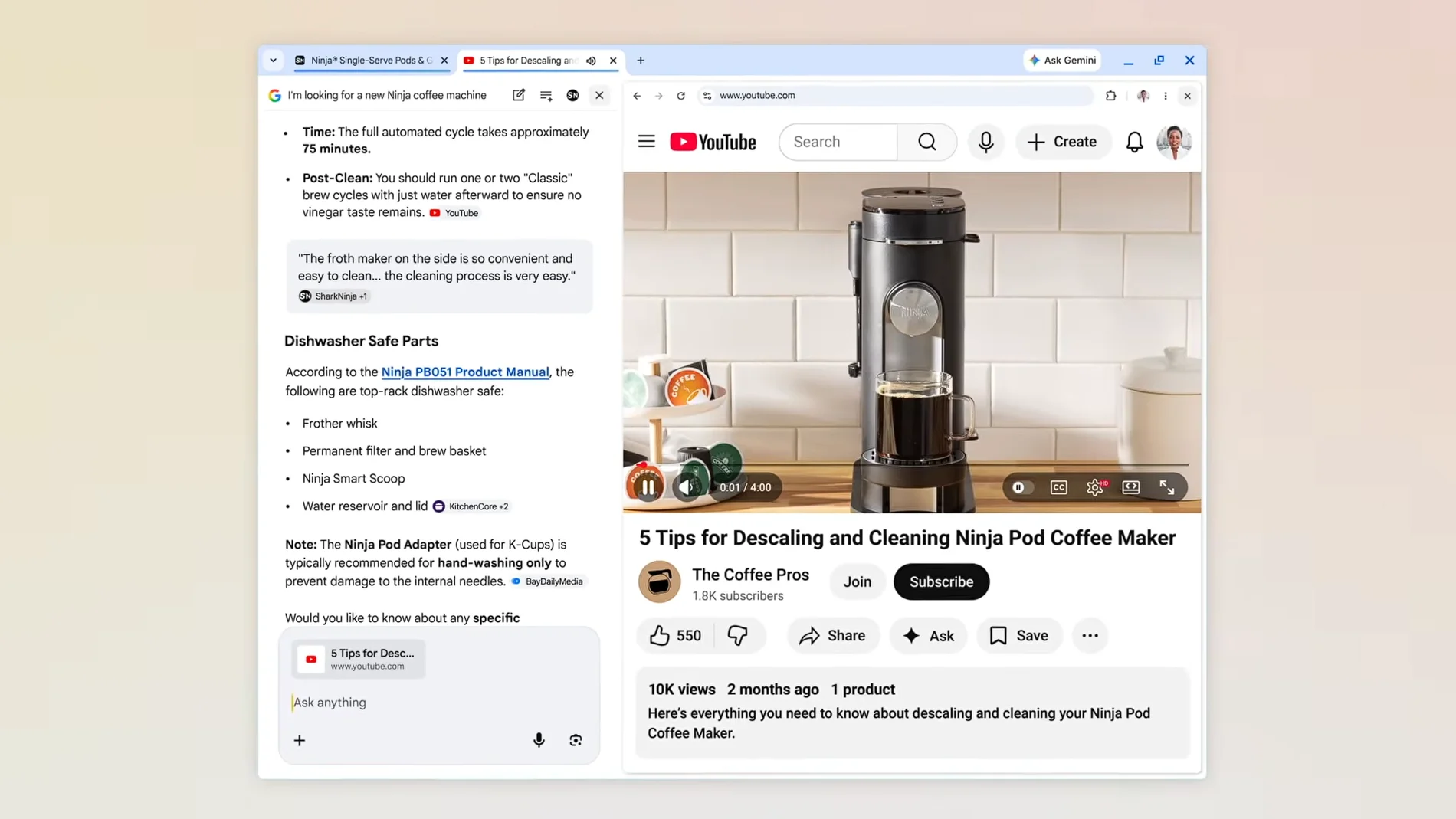
Google has announced an improvement in the AI Mode of the Seeker which, at the very least, will cheer up all the websites that have seen their visits decrease since AI solutions act as an intermediary between the user and the information they seek. Now, when using AI Mode, clicking on an AI-provided link will The page will open in split screen mode next to the ongoing conversation with Gemini. This allows you to maintain the original query thread and, at the same time, navigate between source materials.
Until now, the only thing that AI Mode showed was a module next to the answer, similar to traditional Google results, highlighting some of the sources used to create the answer. Clicking on one of them meant leaving the conversation with Gemini and jumping to a new tab with the content.
AI Mode can also view the web page the user is browsing and is aware of the context of the active page. This allows specific questions to be asked about its contents, as seen in the video below, in which the user asks ‘Is it easy to clean?’ and the AI synthesizes information from the entire page along with its own knowledge to provide an answer.
The button options are also expanded ‘+’ in the search box, since it allows you to add, in addition to images and files, recent tabs to the query to give the AI more context about what to search for. Google adds that tools like Canvas and image generation will also be accessible through the ‘+’ menu.
Google has been aggressively integrating generative AI features into its core products for some time. Last September, the company released what is arguably the biggest update to Finder to date, introducing AI Mode and other agentic capabilities.
Before AI Mode, the company had integrated the AI Overviewseither Views created with AIGemini answers to user queries displayed before search results. Early versions received a lot of criticism for offering inaccurate information, leading many users to search for methods to disable the feature entirely. According to a recent study, AI Overviews give a 90% of correct answers, which, given Google’s scale, means that Search provides 1.3 billion wrong answers every day and 500 billion a year.
The update is now rolling out to users in the United States and global expansion planned ‘soon’.