
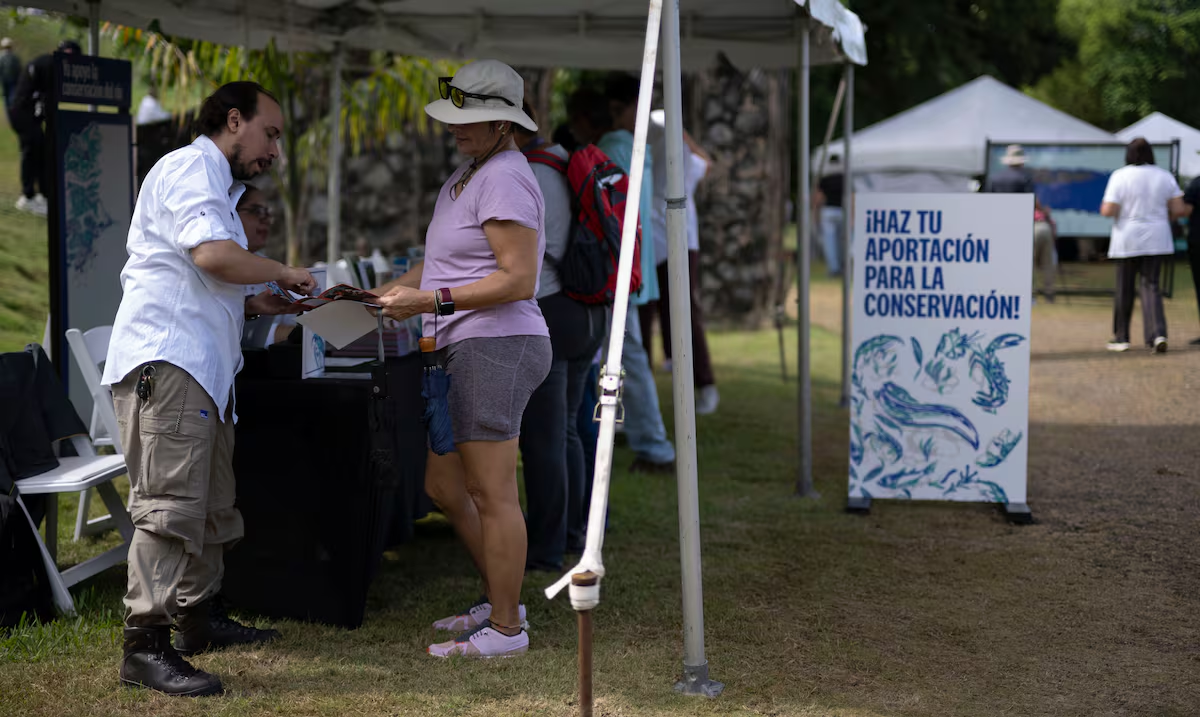
1 / 10 | “We must conserve them”: Para la Naturaleza celebrates a fair in search of rescuing the relationship between people and rivers. The organization Para la Naturaleza (PLN) celebrated this Saturday the 33rd edition of its annual fair, this year with the motto “What the river brings.” – Carlos Rivera Giusti/Staff
Some were protected from the rain by capes or umbrellas; Others did not mind the dew of the downpour and the puddles on the road. Everyone was heading to the same destination: the 33rd edition of the Nature Fairdedicated, on this occasion, to the importance of rivers and their hydrographic basins, held this Saturday at the Old Piedras River Aqueductin the South Botanical Garden in Saint Johndeclared in 2014 as a national treasure of the United States.
This year’s edition, the first For Nature (PLN) celebrates in person since the pandemic COVID-19carried the motto “What the river brings”as a bet on reconnecting people with these important bodies of water.
“For decades, if not centuries, we have been changing our relationship with rivers to a level that we are often ignoring, turning our backs on rivers and failing to see their importance, both for human life and for animal life. So we understood that it was a good time to talk about rivers and for the entire population to become friends with rivers. Human beings have always had an important relationship with rivers; civilizations, cities are created around rivers or bodies of water that are fed by rivers. Our entire existence has been based on rivers and for the moment we have forgotten about them, so that relationship (the goal) is to rescue it,” he expressed. Fernando Lloveras San Miguelpresident of PLN.
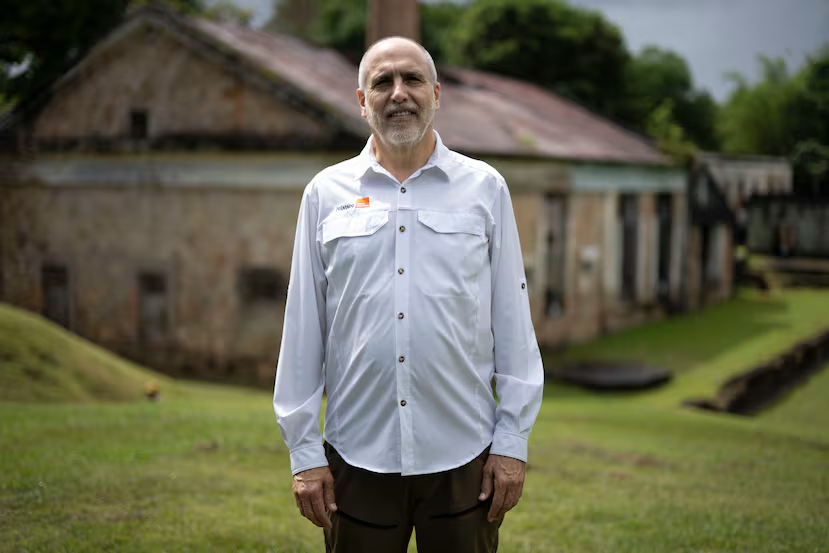
The activity, which would last until 4:00 pm, was attended by people of all ages and families with their little ones who enjoyed exhibitions, workshops, talks, movie listings, as well as information tables about the rivers, the hydrographic basins and the Old Aqueduct of the Piedras River, which provided drinking water to the city of San Juan for more than 80 years.
Attendees also enjoyed stations with fresh products, art, plants, coffee, crafts, foods – such as sancocho –, books and natural remedies. One of the snacks available was Aliyana14, the mind behind a cold-pressed juice business made with local ingredients.
Among the people who attended the fair were Lucila Rosario Gutiérrez82 years old, and Irma Nydia Santiago71. The two retired teachers from Carolina They took advantage of the occasion to learn more about rivers, compost, the value of protecting the environment and betting on food security.
“We must raise awareness about the love of planet Earth, the conservation of the environment, the propagation of edible plants in case of an emergency. Everything comes from outside and it is good to have the home garden, its little plantain bush, even if it is even in pans; I have a bush of yuccas,” Santiago shared, laughing, remembering that he maintained a home garden in his classroom. “That should not be lost, it should be encouraged,” he stated.
“(Events like the fair) are important so that citizens are aware that we are an island and everything comes to us by sea. Imagine if one day something happens and we do not receive what is coming. We have to learn to plant and know the trees, the plants, which are medicinal, which are edible. Also, know the importance of bodies of water and that we must conserve them“Keep them clean, don’t throw garbage,” said Rosario Gutiérrez.
PLN’s activity occurs in the midst of the continuous debate on the canalization of the Piedras River, rejected by surrounding communities due to its environmental impact, while its promoters insist in the work.
The first source of drinking water for the capital city, designed and built throughout the 19th and 20th centuries, is today an urban forest and green lung in the center of San Juan. PLN began the work of protecting and restoring this aqueduct in 2004 under a usufruct with the University of Puerto Rico and, in 2018, it was acquired, becoming a place of historical preservation and conservation open to the public. The structure has been part of the National Register of Historic Places since 2007, as well as the National Trust for Historic Preservation as of 2014.
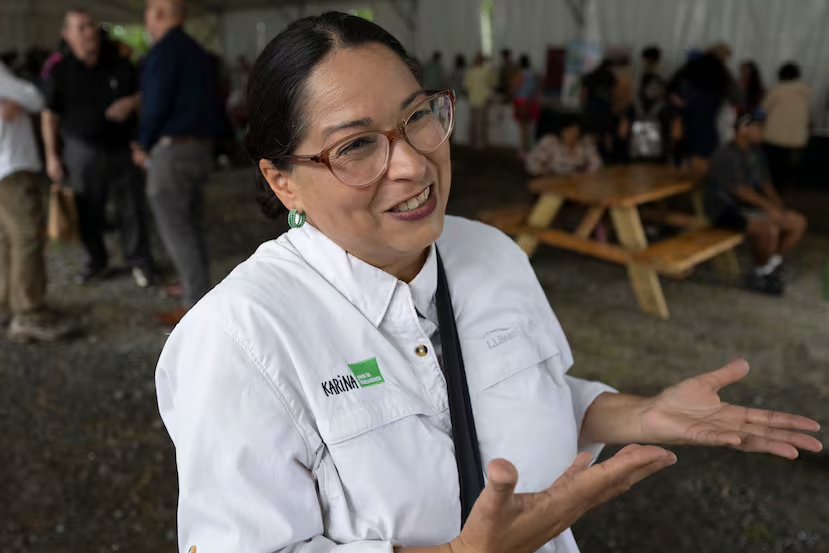
“The only metropolitan and urban river we have in Puerto Rico begins in San Juan and ends in San Juan, unlike other large rivers, which we have over 200 rivers in Puerto Rico, but this one (Piedras River) is unique to San Juan”explained the biologist Karina Rodriguezenvironmental interpreter of PLN, highlighting that they seek to protect the only meander – each of the curves that describes the course of a river – that remains of the Piedras River, from about 20 that it had. These curvatures prevent sediment on the coast, allowing the coast-mountain relationship, in addition to enabling the production of many species – such as shrimp –, the accumulation of nutrients, minerals, planting and an “invaluable production” of trees.