
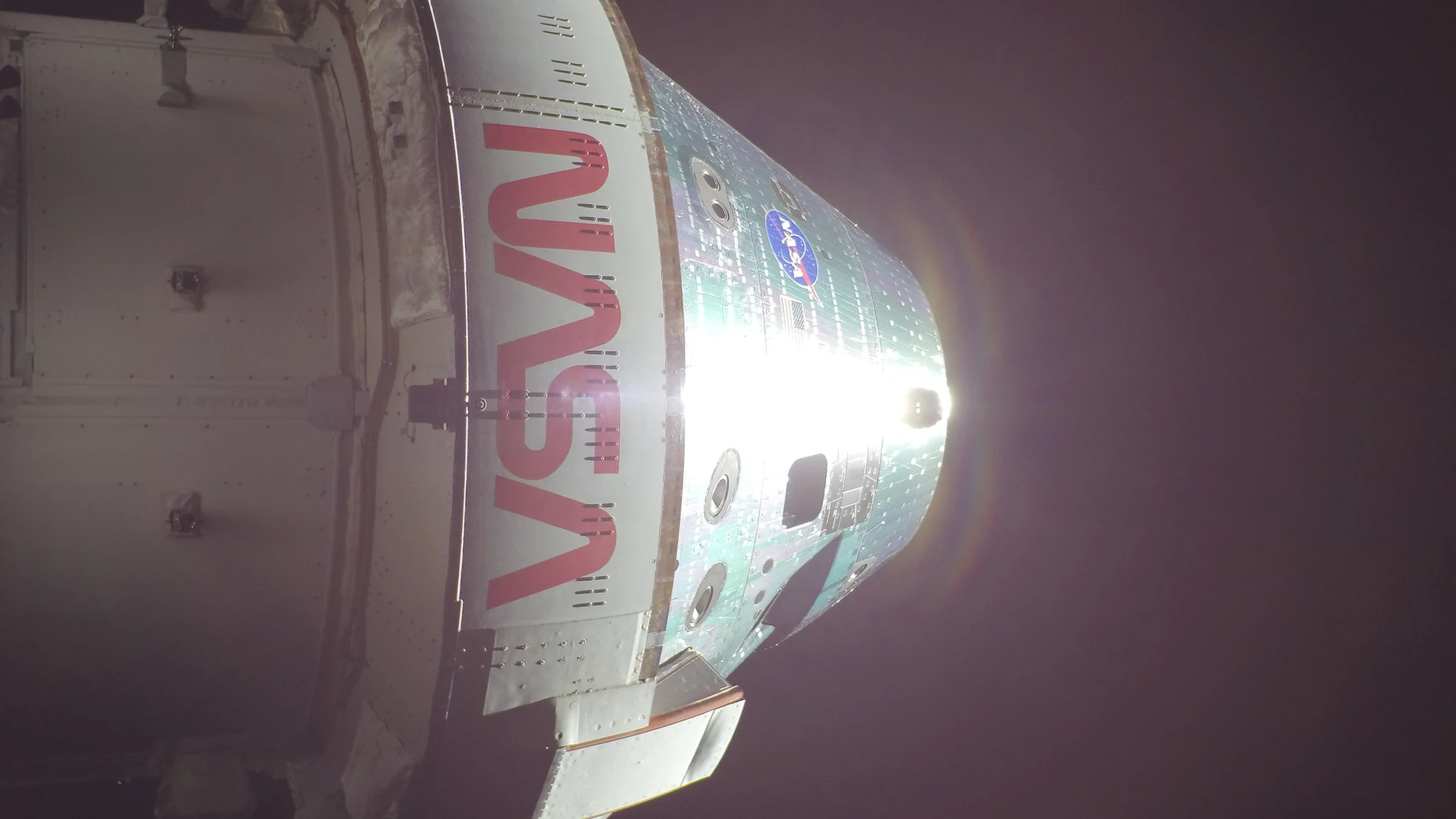
Artemis II is on its way to becoming one of the biggest hits of the POT in decades. Except for minor incidents, such as problems with the space capsule toilet Orionall the objectives are being met, failing to overcome the most critical moment of the mission, when the astronauts re-enter the Earth’s atmosphere at more than 38,000 kilometers per hour and with the spacecraft enduring temperatures higher than 2,700 °Cin the early hours of Saturday. That is why the surprising request that the Mission Control performed to the crew during the fourth day of Artemis II.
‘We have a small request for you. With this orientation that we are using for the thermal exposure, we’re getting sun on our window coverings and we’re a little worried about them getting too hot. We would like to ask you to please remove the window coverings. We understand that this will give you a lot of clarity in there and we want to encourage you. to wear a t-shirt in the cabin or something similar, if necessary, to block that sunlight. But the covers will help us with the temperature restriction in the windows,’ they told the astronauts, who immediately put on the shirts.
This raises two questions. First, how is it possible that in a ship that has been developed for two decades and has cost 24 billion dollars have to resort to such a prosaic solution. And second, why is it a concern that the windows get too hot from the Sun? if they are designed to withstand the hellish temperatures of reentry.
For the first we have no answer, but the second does have an explanation and has to do with how the Orion windows are constructed. Each one of them, six in total, counts with three panels. The exterior, made from fused silicais the one that must withstand the extreme heat of reentry and in no case will it be affected by an increase in temperature from the inside.
The other two panels are acrylics and not glass, as has been tradition at NASA, a change that has allowed the weight of all the windows to be reduced in more than 90 kilograms.
‘Historically, glass window panels have been part of the pressurized structure of spacecraft that maintains cabin pressure to keep astronauts alive, and have also provided thermal protection during re-entry into Earth’s atmosphere. But the problematic thing about glass is that it is a poor structural material.. If loads are applied to it, it loses strength over time, and if it receives a knock or nick, its strength decreases dramatically. The spaceflight environment is one that, unfortunately, exploits precisely those vulnerabilities‘ said Lynda Estes, head of the Orion window subsystem at NASA’s Johnson Space Center in Houston, to USGlass magazine on this issue.
Acrylic panels are essential for keep the ship pressurizedbut much less resistant to heat, since its softening point is around 100 °C. With the inner covers deployed, there is a risk that accumulate heat from exposure to solar energy and bring the acrylic panel closer to its limitso NASA has preferred to avoid it.
As to whether the temperatures that the exterior fused silica panel will withstand can affect the acrylic interiors, the answer is noat least for the brief time that reentry lasts, about fourteen minutesand under normal conditions.