
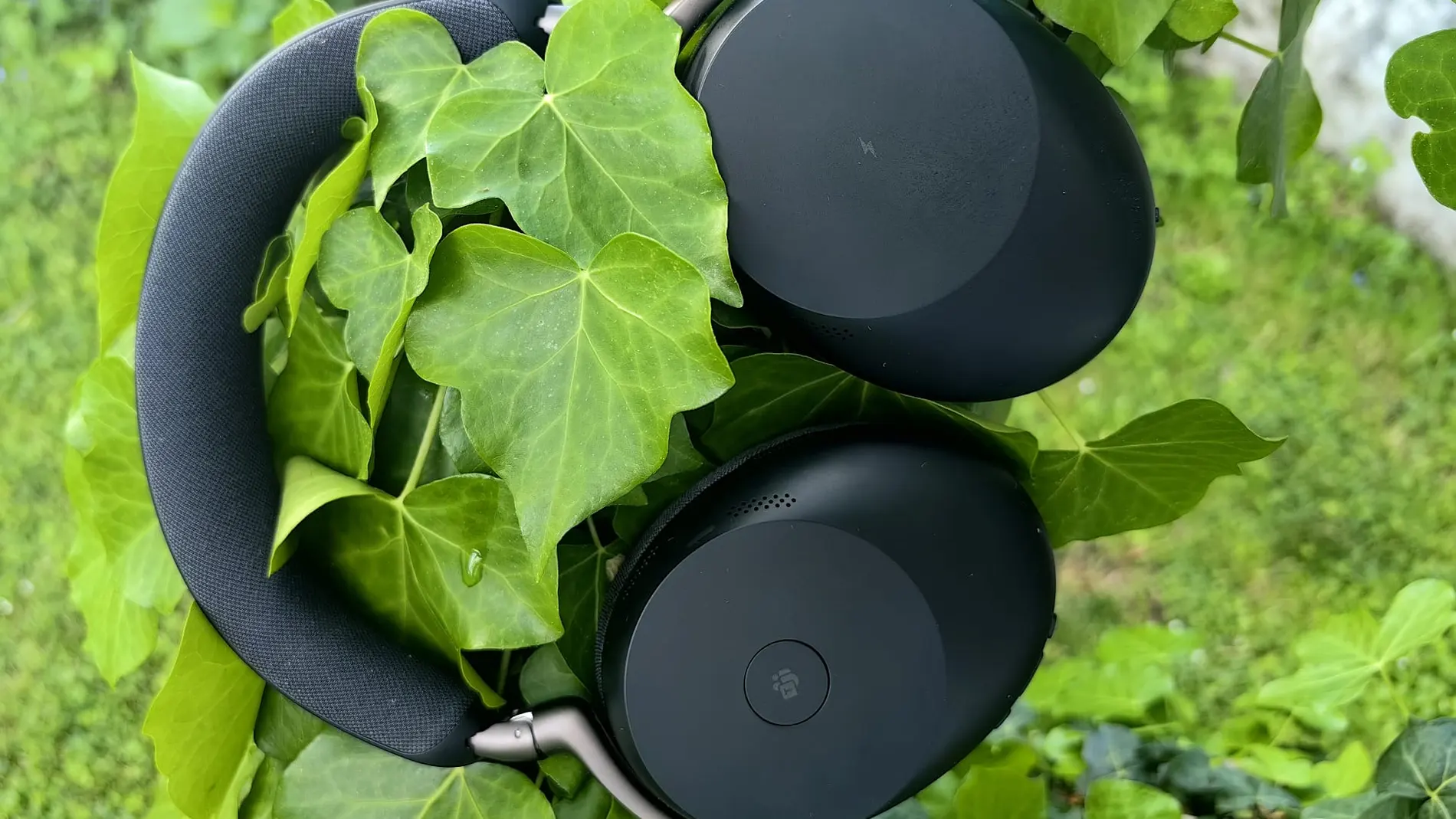
There are headphones that are used to listen to music and others that are designed to work. The border is the microphone that sticks out and reveals the imposter. Then the Jabra Evolve3 85 arrives and the categories that we previously thought were forged by fire melt away. These headphones were born with the intention of redefining what hybrid work and free time sounds like and how you experience it.. Do they get it? Let’s go with it.
It is not a cheap model (569 euros), nor does it pretend to be. From the first moment it is clear that this is a device designed for those who spend more hours talking than listening, more time in meetings than on playlists. His proposal is direct: maximum call quality, absolute comfort and a layer of artificial intelligence that, rather than being added, is integrated into the experience.
The first thing that catches your attention is what is not there. For years, professional headphones have carried as their flagship that microphone arm that reveals a video call from meters away. Here it disappears. Instead, Jabra has poured much of its voice processing experience (inherited from its hearing division) into developing ClearVoice.a system that uses a deep neural network trained with more than 60 million sentences. The result is almost counterintuitive: six hidden MEMS microphones, distributed throughout the structure of the headset, which are capable of separating the voice from ambient noise without the need for any visible element.
And it works. In real environments, with background noise, the voice remains clear, stable, and recognizable. It’s not just an incremental improvement: Jabra has done with calls what Sony did with noise cancellation, becoming a reference. Therefore, If our ecosystem is divided between Zoom, Teams or Meet, this headset has been designed to behave as the axis of the food chain. But there’s more: it can work together with any AI and, when equipped with Clear Voice, the human-AI “dialogue” becomes a much more fluid exchange, the fastest I had experienced so far.
The design accompanies that intention. The Evolve3 85 are up to 35% thinner than their predecessor and are the lightest over-ear headphones in their category, weighing around 220 grams. They fold up into a travel case so thin that when I held it, my first impression was that it was empty. Another aspect that demonstrates the care in the design and the intention that has been put into them. It is obvious that it is not the first version, nor even the third: it has gone through many stages of real use, until reaching this evolution.
An example? The light that signals that we are on a call is visible from any angle, which avoids that uncomfortable choreography of gestures to indicate that we are on a call. It’s a small detail, but telling: someone has thought about how these headphones are used, not just how they sound.
That same logic appears in less visible, but equally important, aspects. The pads and battery are replaceable, which is unusual even for products in this price range. It’s not just a question of durability; It also responds to increasingly demanding legislation regarding repairability. And, above all, it introduces an idea that is beginning to be rare in technology.: that an expensive device should last.
Regarding noise cancellation, The Evolve3 85 incorporates an adaptive ANC system that adjusts to the environment and works in both calls and audio playback. It works well in the office or at home, creating more than enough concentration space for most scenarios. But here one of its limits appears: it does not reach the level of benchmarks like Sony, but it aspires to a medal.
Something similar happens with sound. The profile is balanced, clean, with a clear emphasis on voice intelligibility. Podcasts, calls or spoken content sound especially good, with correct spatiality and without artifice. However, in music, certain concessions are perceived: the treble is somewhat clipped and the level of detail does not compete with premium consumer-oriented headphones. It is not a defect, but a choice. These headphones don’t want to be audiophile; they want to be useful.
Where they do shine without discussion is in autonomy. The battery reaches figures that They border on the exaggerated: up to 120 hours of playback and around 25 hours of calls. But more important than the number is the experience: five minutes of fast charging offers about five hours of use. It is the type of data that, on a day-to-day basis, makes the difference between continuing to work or stopping. And it also includes wireless charging.
Added to all this is connectivity designed for working from home or in the office. It takes thousandths to connect with all the usual applications and the most obvious assistants. It has multiple connections and goes from a computer to a mobile phone and then to a tablet with just a gesture.
Verdict:
In Spain, about 3 and a half million people work remotely according to official data. The technology and design of the Evolve3 85 makes this option simpler and, at the same time, efficient. They are not headphones, they are an investment, in the same way as the power of a computer or the reliability of an internet connection.