
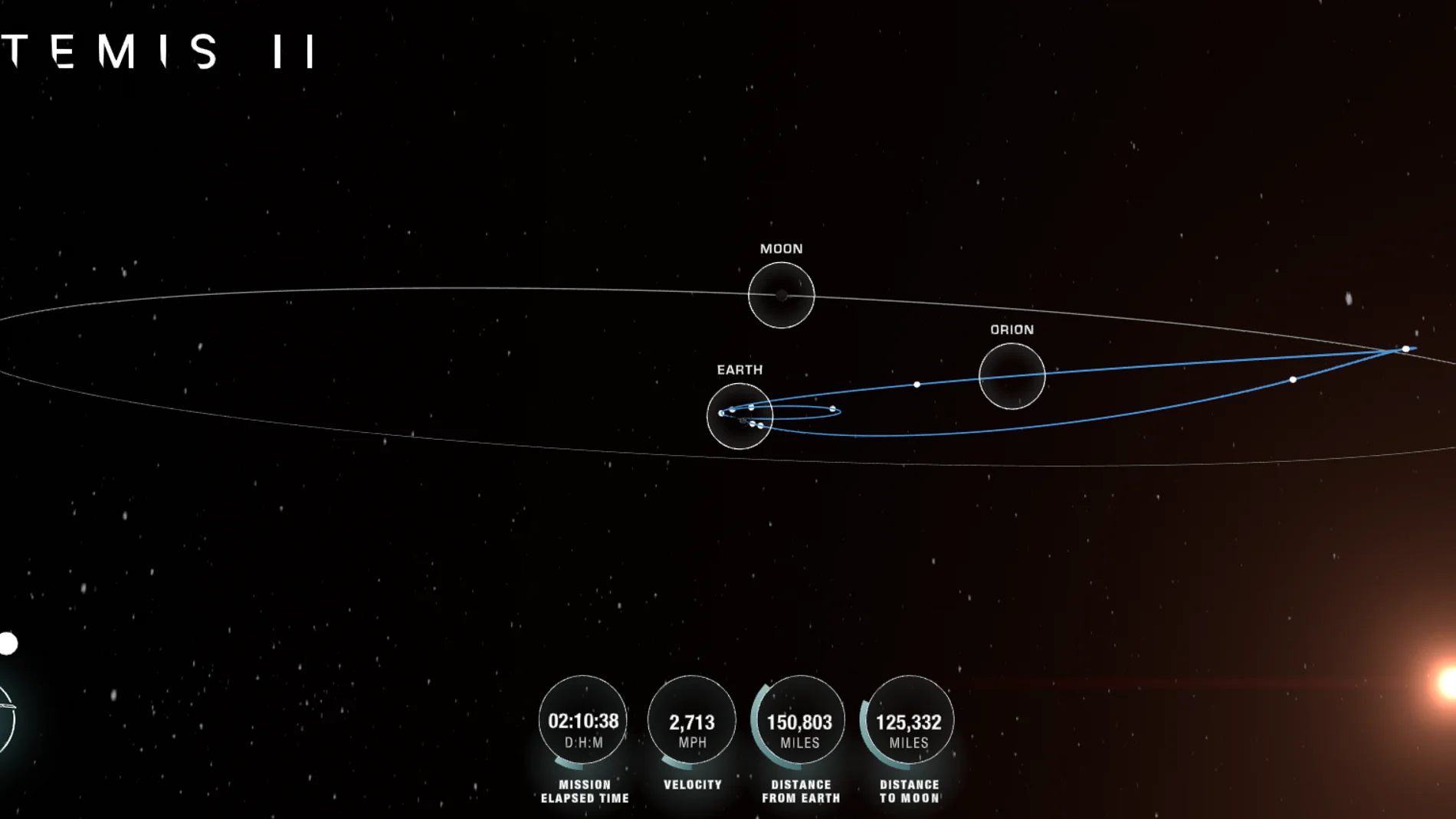
While the Artemis II Mission is showing us How technology has changed since the times of Apollo and Geminiadvances are not just focused on suits, fuel, ship design or onboard computing power. There is something new in this mission. For the first time since the early years of the space race, We will not only see a ship take off heading to the Moon. We can accompany her. Know, almost in real time, where you are, what you are doing and how far you are from Earth.
The Artemis II mission not only marks the return of humans to deep space. Also It inaugurates a different way of experiencing exploration: minute by minute. For decades, pursuing a space mission was passive. We depended on specific images, on short broadcasts, on statements. Now, the experience is different.
The central tool is AROW (Artemis Real-time Orbit Website), a system developed by NASA that allows you to view the trajectory of the Orion spacecraft live. CoIn it you can see the exact position of the ship with respect to the Earth and the Moon, its speed, the distance traveled and the milestones of the mission. It is, in a way, like following a flight… but at hundreds of thousands of kilometers high. And with one important difference: there are no commercial routes or repeated schedules here. Each trajectory is unique.
But the experience doesn’t stop there. NASA has integrated this system into its own mobile application, which allows you to carry the mission in your pocket. From there, you can not only track the position of the spacecraft, but also explore contextual information: from former Apollo landing sites to scientific data about the Moon.
There is even augmented reality functions that allow you to “point” your phone and visualize where Orion is in the sky. It is an almost physical way of connecting with the mission. And to this is added the live broadcast.
The agency maintains continuous coverage through NASA+, YouTube and other platforms, with images from inside the ship, communications with the control center and constant updates. It is no longer just watching a rocket take off and waiting for official communications. Space travel has become a real-time conversation… almost half a million miles away.
There is also a fundamental aspect, although strange for science: trust. There will be a time when we will not be able to continue the mission. When the ship passes the far side of the Moon, all communication will be interrupted for about 40 minutes. No signal, no data, no images. Just silence.