
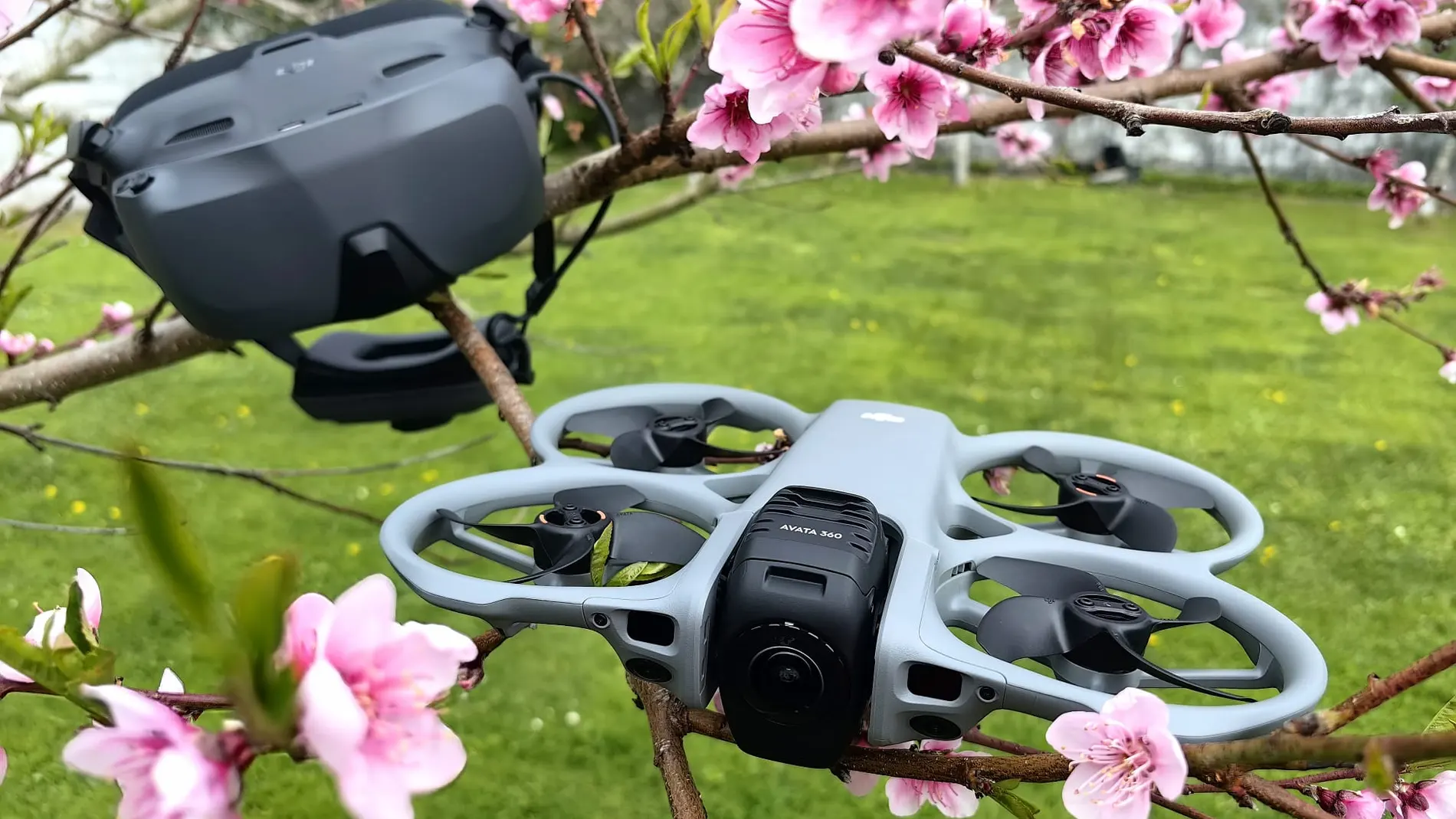
DJI has achieved what it has been pursuing for years: that flying a drone stops being piloted… and becomes inhabited. With the new DJI Avata 360, the company not only updates its FPV linebut rather pushes the concept into more ambitious terrain, where the camera no longer has frames. No limits.
For a long time, drones have been, in essence, flying eyes. Even the most advanced models forced you to choose where to look, to frame in the air as if the sky were an unstable tripod. The Avata 360 breaks that logic with an idea that is simple in appearance, but profound in its implications: record everything, all the time. Not in 4K, not in 6K, but in 8K and 360 degrees, with one-inch sensors that seek more than just resolution: dynamic range and texture.
The result is not only technical, but narrative. A single shot stops being a closed decision and becomes a malleable raw material. The framing no longer occurs during the flight, but afterward. It is, in a certain sense, a phase change: from pilot to editor.
But this leap does not come in isolation. It is the result of a fairly coherent evolution within the Avata series. If the first models were committed to accessibility to FPV flight (acronym for First Person View, that feeling of being inside the drone thanks to the glasses)now the focus shifts to the convergence between immersive experience and audiovisual production. It is no longer just about flying “like in a video game”, but about capturing images that can compete in professional environments.
This is where one of the least visible, but most decisive elements comes into play: intelligent processing. Functions such as ActiveTrack 360° or advanced tracking are not simple aids to the user; They are the manifestation of a broader change in the industry. The drone is no longer a passive tool, but a system that interprets the scene. It detects subjects, anticipates movements, decides (within limits) what deserves to remain at the center of the story.
Avata 360 offers two different lenses that can be exchanged seamlessly. The 360° lens uses 1-inch equivalent sensors that can Capture highly detailed 360° images for 8K/60fps HDR videos and 120MP photos. On the other hand, the single lens mode allows creators to use the classic Avata recording style in 4K/60 fps. In total, it allows flights of up to 23 minutes on a single battery charge and a range of up to 20 km, an extreme rarely seen in a drone of this weight and these qualities.
This is especially noticeable in how the automatic modes are integrated with the FPV aesthetic. Traditionally, immersive flight required skill, reflexes and a certain tolerance for error. Here, however, the machine softens that learning curve, allowing even novice users to generate complex movements, with turns, skids or changes in perspective that previously required hours of practice. Artificial intelligence does not replace the pilot, but it does take weight away from technique to leave more room for intention.
In parallel, the O4+ transmission system extends the range and stability of the signal, something critical in FPV flights where any cut breaks the illusion. Omnidirectional obstacle detection adds a layer of safety that until recently was difficult to combine with the agility of this type of drone. And details like replaceable lens or high-speed internal storage point to more everyday useless dependent on accessories and closer to a tool ready to work.
This, in practice, translates into enormous advantages: 42 GB of internal storage and high-speed transfers: With 42 GB of internal storage, it is possible record 30 minutes of 360° video in 8K without a microSD card. And with Wi-Fi 6 high-speed transfer, 1 GB of video can be transferred to the DJI Fly app in 10 seconds at up to 100 MB/s. But the game really begins when you use the DJI Goggles and have eagle vision.
However, perhaps the most interesting change is not in the specifications, but in the mental model it proposes. The Avata 360 is not just a drone that records in 360 degrees; It is a device that blurs the border between capturing and creating. Where once there was a clear line, first you fly, then you edit, now there is a continuum in which both things are intertwined.
The question, then, is not whether this drone is better than the previous one. It is, in almost every measurable way. The relevant question is another: what type of images does it make possible. Avata 360 seeks to revolutionize what we want to tell from the air.