
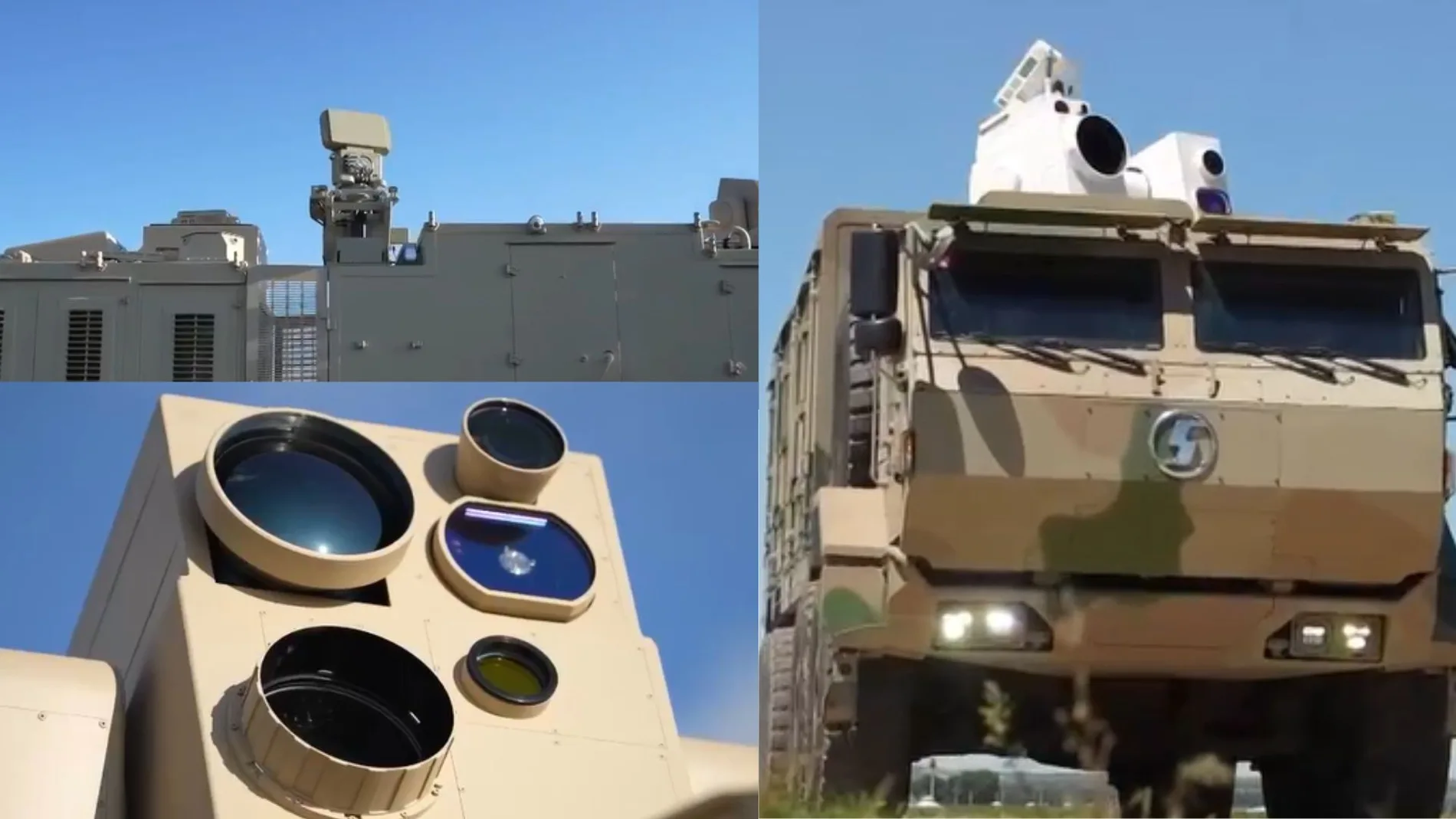
For decades, shooting down an object (drone, missile, plane…) in the air implied something almost inevitable: shooting another object. Missiles, projectiles, shrapnel. A physics based on shock. But in recent years it has begun to another logic emerges: destroy without touching. That is what the new laser systems represent that China has just presented. And they do so at a time when the problem is no longer shooting down a plane… but hundreds of drones.
The starting point is simple. Modern drones are small, cheap, difficult to detect and, above all, abundant. They can fly low (between 50 and 80 meters), right in areas where many traditional radars have blind spots. And that completely changes the equation: Using a million-euro missile to destroy a low-cost drone is no longer sustainable.
This is where the laser comes in. China has presented two different but complementary systems: Guangjian-11E and Guangjian-21A. And the interesting thing is not only that they use directed energy, but that they represent two different ways of understanding combat.
The first, the Guangjian-11E, does not necessarily destroy. It interferes. Blinds sensors, cuts communications, disorients. It is what in military language is called “soft kill”: neutralize without exploding.
The second, the Guangjian-21A, does opt for direct destruction. A high-energy laser that concentrates power on a point for a few seconds to heat, weaken or literally burn key components of the drone: its structure, its circuits or its propulsion system.
And here the first important idea appears: a laser does not “hit”. Delivers energy. Unlike a projectile, which depends on its trajectory and speed, a laser acts by accumulating heat at a specific point. If that energy exceeds the resistance of the material, failure is the result. There is not necessarily an explosion, but rather thermal collapse. That allows something new: extreme precision.
But it also introduces a key condition: time. The laser needs to keep the beam on the target for a few seconds. And that requiresvery advanced tracking, stabilization and control topics. That is why these systems are talked about not only as “weapons”, but as networks.
The two types of lasers developed in China integrate electronic scanning radars and infrared sensors that allow targets to be detected, tracked and classified even when they emit little signal or try to hide. Besides, They are connected to each other through data networks that share information in real time, shortening the cycle between detection and response as much as possible.
To this they add another advantage that explains the global interest in this type of technology: the cost. A laser, once deployed, has an extremely low “price per shot.” There is no ammunition to replenish, only energy. In a scenario where drones can appear in swarms, this radically changes the economics of combat and defending is no longer prohibitively expensive.
But not everything is as clean as it seems. Lasers have significant physical limitations. The atmosphere disperses the energy, rain or dust reduces its effectiveness, and distance is a critical factor. It is not the same to concentrate energy at a hundred meters as at several kilometers. That is why these systems are designed, above all, for short-range defense.
Despite this, it is a profound change. The system Guangjian demonstrates that it is no longer dependent on intercepting drones with very costly measures: sensors, connectivity networks and a direct energy source are enough to respond.