
Faith is not foreign to football either. The history of the beautiful sport is full of stories and legends that link the beautiful sport with religion and some deserve to be remembered these days. When footballers score a goal they usually look at the sky, kneel and open their arms – in true Jude Bellingham style – as if they were the chosen ones. They are also seen making the sign of the cross or praying as they jump onto the playing field. The communion with their fans is almost mystical and sometimes their triumphs or impossible comebacks are just a matter of faith. Football is ultimately a religion full of beliefs and gods where the ball runs between the human and the divine.
We are in the midst of Holy Week, a time of faith and reflection. Beliefs that for some go beyond a simple period of time to become something that marks your life. Faith is part of our society, our culture and also of Sports. Football holds countless stories that have marked Spanish society and politics but also anecdotes that link the beautiful sport with religion and especially with Holy Week. Many footballers are brothers and there are several Sevillian brotherhoods that have a close relationship with the city’s teams. But if there is a history that is worth remembering these days is that of the “Christ of footballers” found in the Cathedral of Buenos Aires and who has one of his most fervent devotees in Pope Francis, as was Diego Armando Maradona.
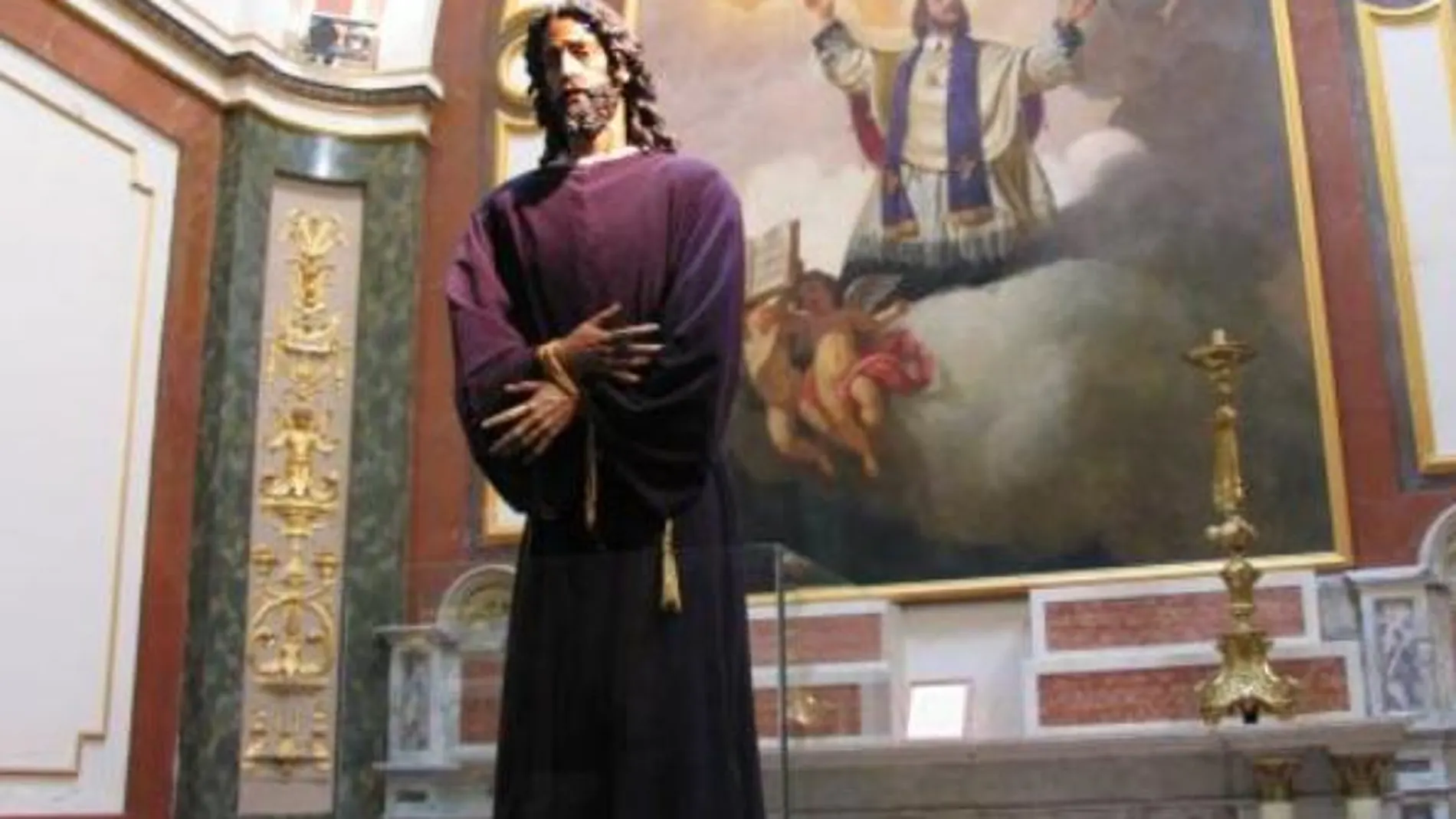
And this Christ has very Spanish roots, specifically from Seville and hence his unique secret. The Christ of Love, found in the Church of El Salvador, processions on Palm Sunday in Seville but his Argentine brother does it every Good Friday through the streets of Buenos Aires.
Its origins
The footballers Scotta and Bertoni, after winning the 1978 World Cup in Argentina, played for Sevilla and also one of ‘Luisito’ Álvarez Duarte’s close childhood and Salesian College friends, midfielder Pablo Blanco.
It was through the latter, like Scotta and Bertoni, who had just scored 16 goals each in the League, They commissioned the sculptor and image maker Álvarez Duarte to carve a Captive Christ in the image of the Christ of Great Love so that a piece of Seville could be in Buenos Aires.
Bertoni went to Fiorentina and the gunboat Scotta to his country’s Railway, but his order was made and in 10 months of being in the sculptor’s workshop, he already had it. It was an impressive carving of a Captive with a height of 1.87 meters carved from Lebanese cedar. Both footballers never wanted to reveal what the order cost them because what is important to them is its devotional value.
Other Argentine world champions also collaborated in this initiative, such as goalkeeper Ubaldo Matildo ‘El Pato’ Fillol, Olvaldo Ardiles, Alberto Tarantini and ‘El Matador’ Mario Alberto Kempes, so there are plenty of reasons to be known as “The Christ of Footballers”.
A piece of Seville
The image was transferred from the San Pablo Airport in Seville to the Buenos Aires Airport by an Argentine Air Force plane and, since 1981, it has been venerated in the Buenos Aires cathedral and processions on Good Friday through the capital of Argentina among the devotion of faithful and football fans.
Once in the temple of the Argentine capital, the Christ was blessed by Monsignor Keegan – who was amazed by the Christ of Great Love during a visit to Seville – and, since then, he has been prayed for there and in the streets. Not only the people prostrate before him but also the one who was in those years cardinal of Buenos Aires and today Pope Francis, Jorge Bergoglio, who also shared with Scotta the passion for San Lorenzo de Almagro.
Despite the relatively brief period that both were in Seville, Scotta (1976-1980) and Bertoni (1978-1980) were marked by the city and this sculpture is proof of this.
But this Christ keeps another secret inside: the sculptor Luis Álvarez Duarte, who died in 2019, engraved a Sevilla FC shield inside the sculpture commissioned by Scotta and Bertoni – who were then footballers for the Nervionense team – But the artist, who was from Betis, could not hold back and also recorded that of the team of his loves.
Football and Easter united by the passion for colors.