
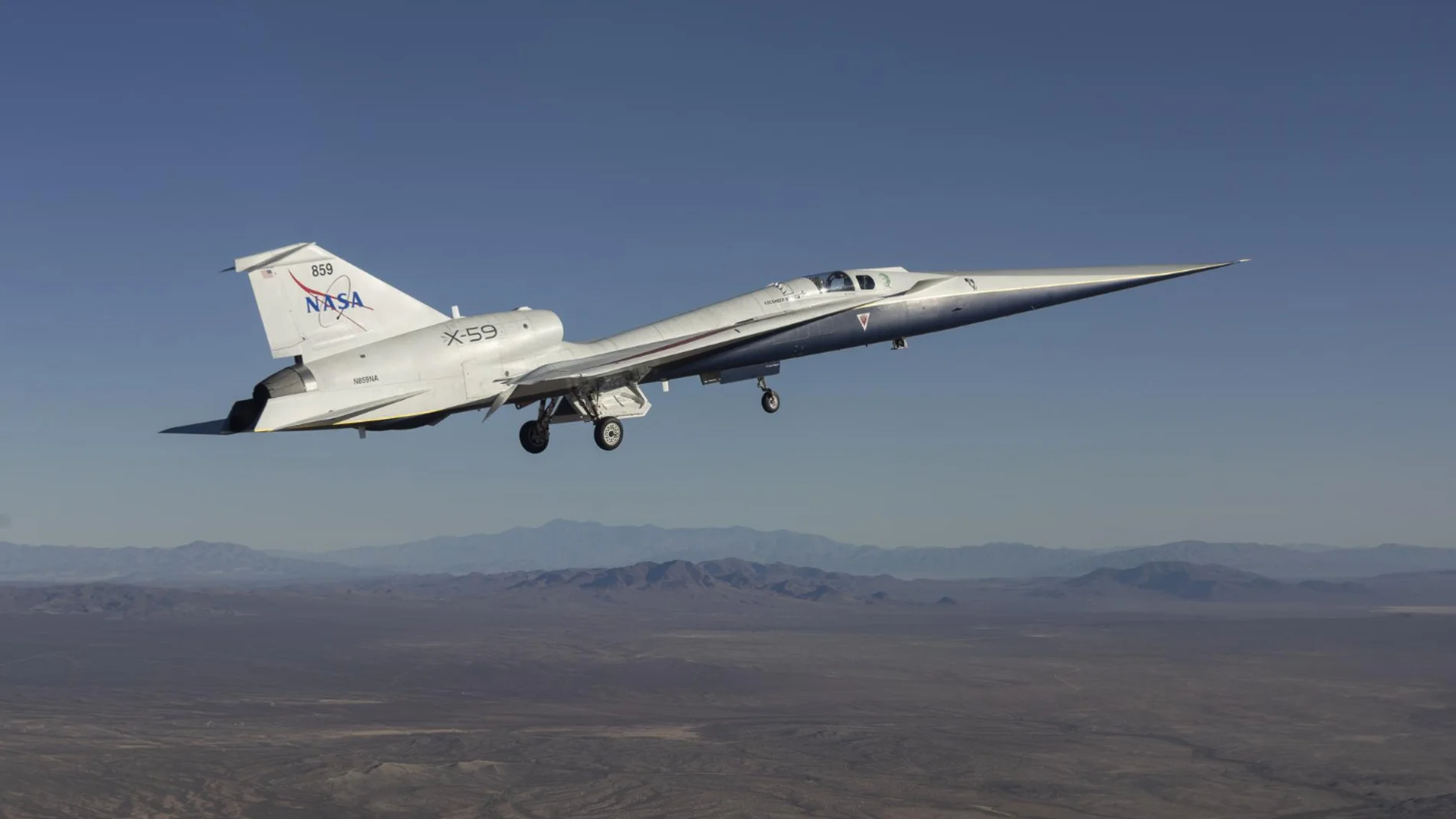
For half a century, flying faster than sound has been, in practice, a forbidden luxury on land. Not because of lack of technology, but because of noise. When an airplane breaks the sound barrier, generates a shock wave, the famous sonic boomcapable of shaking windows and altering life on land. It was one of the reasons why icons like Concorde disappeared from the skies.
Since then, supersonic aviation has lived in a kind of limbo: possible, but restricted. Now, NASA wants to change that story with a seemingly simple, but technically complex idea: turn that “boom” into a whisper.
The protagonist of this attempt is the X-59, an experimental aircraft developed together with Lockheed Martin within the Quesst program. At first glance, the X-59 looks like something out of science fiction. Its fuselage is extremely elongated, with a sharp nose reminiscent of a swordfish. But that form is not aesthetic: it is pure physics.
The design redistributes the shock waves generated when exceeding the speed of sound, preventing them from concentrating into a single explosion. Instead of a roar, The goal is to produce a much softer “thud”, almost imperceptible from the ground. That little acoustic nuance could have huge consequences. Because if noise stops being a problem, so do the restrictions.
In this sense, the X-59 has already taken a key step: its first flight took place at end of October 2025 (although it was made public in November), marking the return of a manned experimental aircraft of this type after decades. But that initial flight was just the beginning.
In this new phase, the plane is prepared for a series of progressive tests, in which the pilots will gradually expand the limits: more speed, more altitude, more complexity. The objective is not only to prove that it can fly, but to understand how it behaves in real conditions and, above all, validate its key promise: flying at supersonic speeds without generating an annoying boom.
Some of these tests will begin with what engineers call “flight envelope expansion”: controlled flights in which the plane will gradually approach its target speed, around Mach 1.4, and altitudes that are close to 20,000 meters.
The upcoming test of the X-59 is part of precisely that process. More than a single spectacular moment, it is a step in a carefully designed sequence. Each flight adds data: about stability, aerodynamic behavior and, especially, how these modified shock waves propagate. To do this, NASA not only observes from the ground. It uses tracking aircraft (such as F-15 fighters) that fly alongside the X-59, measuring its acoustic emissions and performance in real time.
Everything is oriented towards a very specific goal: collect enough evidence to change the rules of the game. The sad part, so to speak and for aviation fans, is that the X-59 will not carry passengers. In fact, It is not a commercial prototype, but a laboratory with wings. Its mission is to convince regulators, governments and international organizations that supersonic flight over land can be compatible with everyday life.
Therefore, in later phases, the plane will fly over different communities to study how people perceive this new type of sound. These data will be key to redefining the regulations that currently prohibit this type of flights. If the program is successful, it would allow the design of new commercial airplanes with transcontinental flights that last half as long. And the second test will take place tomorrow.