
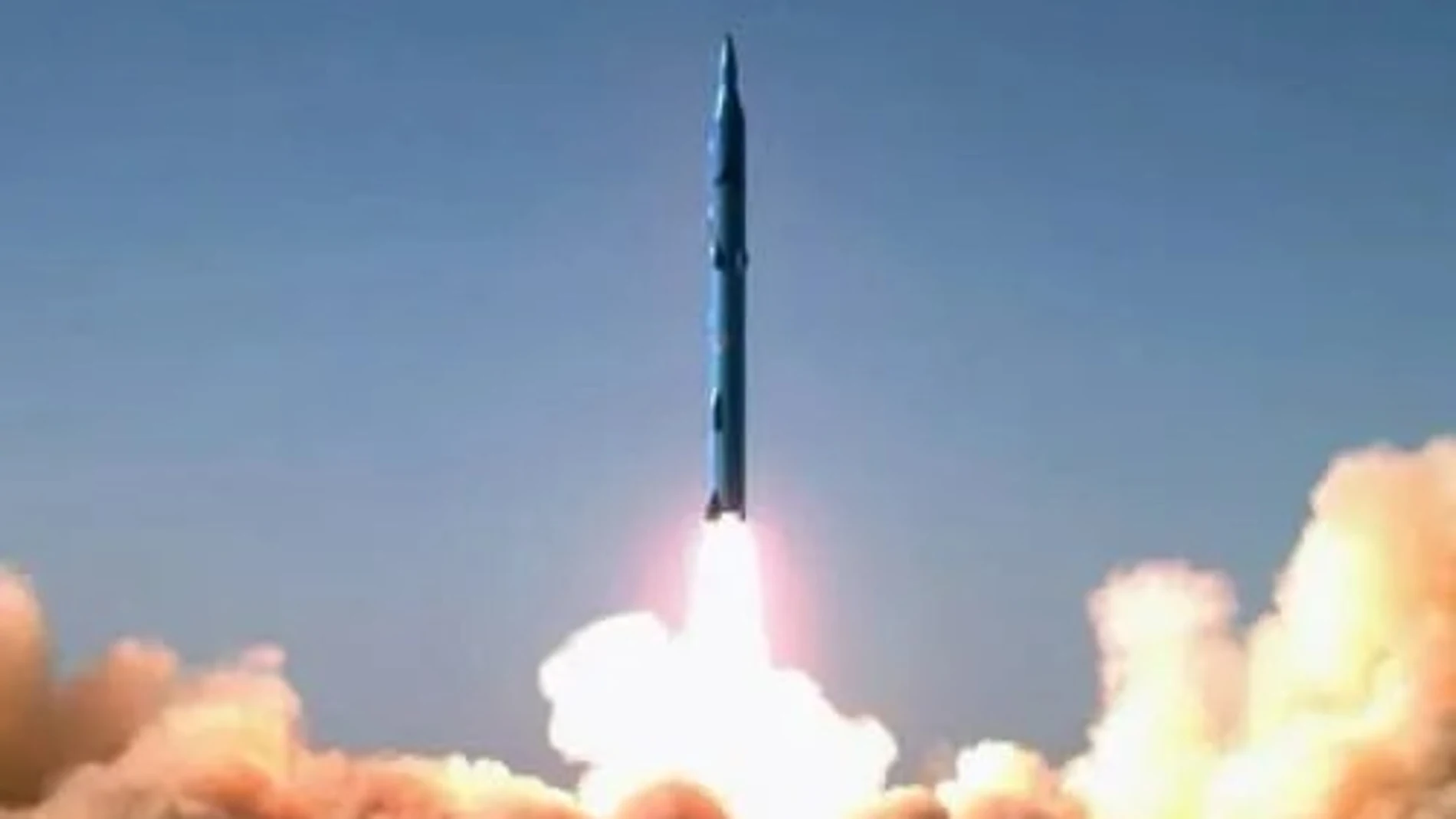
Iran has confirmed the use of its medium-range ballistic missile (MRBM) Sejjil-2 as part of the 54th wave of their operation True Promise-4which took place last Sunday in the context of the conflict with Israel and USA. Tehran assures that it is the first time it has used this missileaccording to the EFE agency, but there were already reports of its use in the conflict against both countries last June, when the operation was carried out. Midnight Hammer to destroy Iranian nuclear production capabilities. It is not clear if it is the same version of the Sejjil.
The Sejjil is one of Iran’s most advanced domestically developed ballistic missiles. It is an MRBM of two stages and solid fuelwith an estimated range of about 2,000 kilometersallowing you to attack targets at all Middle Eastincluding Israel, from Iranian territory.
According to the Missile Threat website of the Center for Strategic and International Studies (CSIS), the missile can carry a payload of about 700 kilogramsmeasures around 18 meters and has a launch weight greater than those 23,000 kilograms.
It is classified as a road mobile systemwhich increases its strategic value. Mobile launchers allow it to be quickly moved, fired and relocated, reducing its vulnerability to attack.
The ‘dancing missile’ and its maneuverability
Sejjil is often called ‘dancing missile’a nickname related to his ability to maneuver during flight. Detailed specifications remain classified, but these types of systems may incorporate trajectory adjustments or reentry maneuvers, which makes it difficult to intercept.
This matters because missile defense systems depend on the prediction of flight paths. Any maneuver in the intermediate or terminal phase reduces the probability of interception, especially against echelon defenses; that is, multi-layered anti-missile systems that attempt to intercept a projectile at different phases of its trajectory.
Why is it important that it be solid fuel?
What really distinguishes the Sejjil from other Iranian missiles is its solid fuel propulsion system. Older systems, such as the series Shahabdepend on liquid fuel that must be loaded before launch, a slow process that increases the risk of detection. Instead, solid fuel missiles are stored ready for launchallowing rapid deployment with minimal preparation time.
This reduces warning time for adversaries and significantly improves survivability. It also aligns Iran’s capabilities with modern missile doctrines, in which solid-fuel systems predominate for their speed of response and operational flexibility.
Iran began developing the Sejjil in the late 1990s and its first successful test was carried out in 2008. Other later ones, in 2009demonstrated improvements in range and guidance.
Over time, the system evolved into one of Iran’s most advanced MRBMs, although until now it had largely remained a strategic asset. Its use in the current conflict represents a turning point, as it indicates that Systems previously reserved for deterrence are being operationally deployed.
Variants and future developments
The version used in recent attacks is the Sejjil-2, a version with better guidance and, possibly, lower radar visibility. There are also unconfirmed reports of a Sejjil-3 most advanced in development, which could extend the missile’s range to about 4,000 kilometers. It would have three stages and a total weight of 38,000kg.