
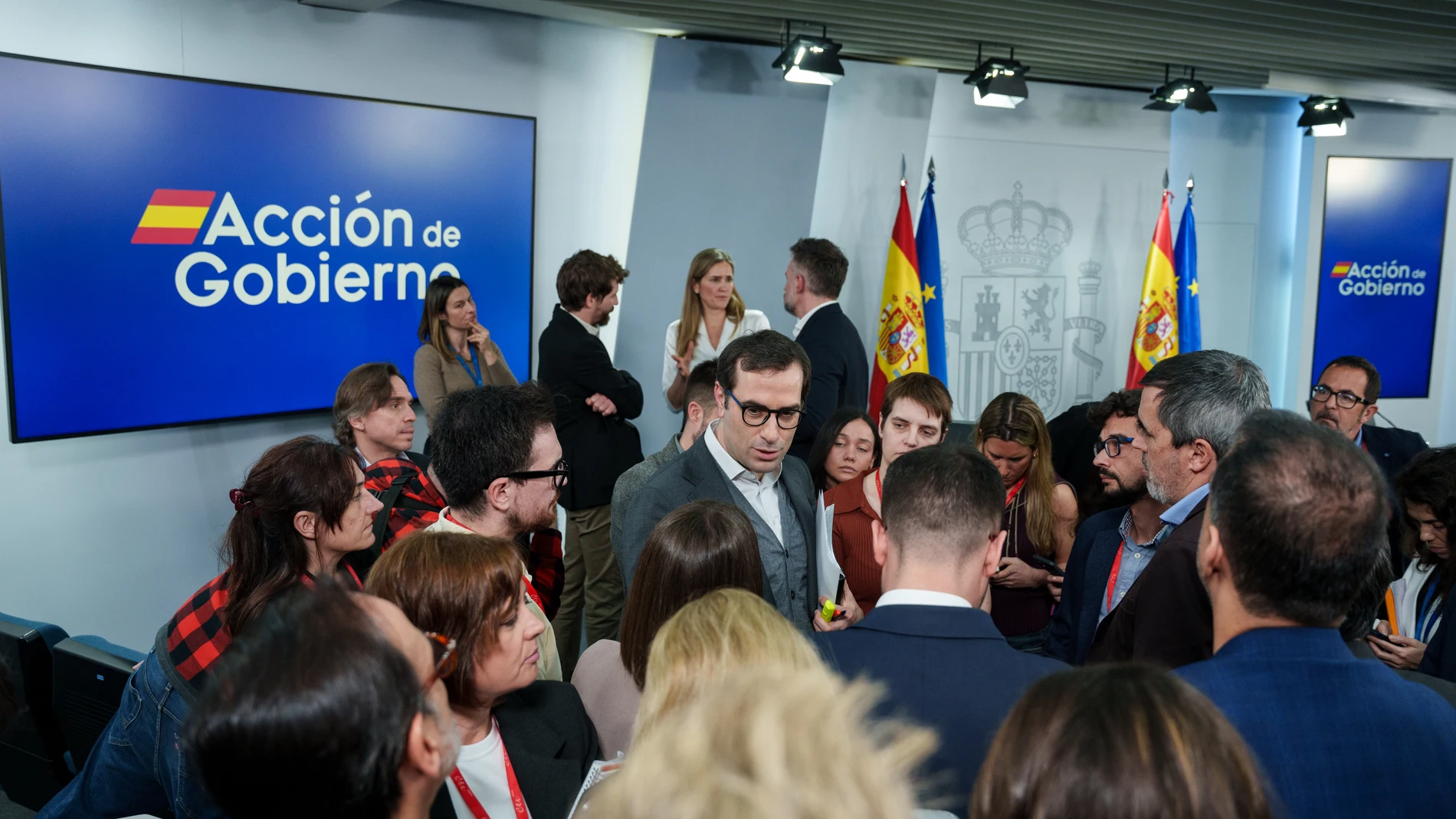
For some time now, some PSOE ministers, the most important ones, have put on a bad face when asked about the anger of Add. In three years of cohabitation, there have been numerous clashes between both parties in Moncloa. But as the general elections approach, the clashes are more virulent. The small partner does not want the big one to eat him.
The Executive approves today, in an extraordinary Council of Ministers, the controversial decree with measures to alleviate the economic effects of the war in Iran – especially, the increase in prices at gas stations and fertilizers, which have become between 40% and 50% more expensive. The president, Pedro Sánchez, took it upon himself on Wednesday to warn Spaniards of the “extreme seriousness” of the situation caused by the conflict in the Middle East. The socialist leader used a new exceptionality to bury his commitment to present the General State Budget to Congress before the end of March.
Now, Sánchez’s number one priority is decree of course, whose negotiation has once again brought the PSOE into conflict with Sumar and the rest of the left-wing parties, because they all demand that it include measures such as the anti-eviction moratorium or limitations on the rental price, either with caps as happened during the war in Ukraine, or with the “freezing” of rents when contracts are automatically renewed. But the socialists, as sources from Moncloa and the Ministry of Economy have reported in recent days, have no intention of including any provision on housing in the decree.
Furthermore, yesterday in the European Council the framework with which the Government has played was finished. Although it is not ruled out that these measures will be put together in a parallel decree to prevent the opposition, with PP, Vox and Junts in the lead, from overthrowing him. The socialist side of the Government insists that there are no numbers in Congress to support the measures demanded by its allies. And the PSOE wants a significant majority in the Chamber to, among other things, convey the feeling of exceptionality that Sánchez already conveyed in Moncloa together with the Ukrainian president, Volodímir Zelenski.
In Moncloa a maxim is imposed: to prevent the rise in energy prices from filtering into the shopping basket. That is the point of no return that can make things difficult in the middle of the electoral campaign in Andalusia. For this reason, the plan will focus on the most exposed sectors – transporters and agri-food – with tax cuts to lower their energy bill, while ruling out wide-ranging measures such as the generalized fuel bonus or, for now, a reduction in VAT on food. The Executive, predictably, will opt for a surgical intervention: less spending, more tax adjustment and room to escalate if the crisis worsens. The obsession is to convey the message that the Executive, despite not having accounts, “protects” the prices.
In parallel, the Government will recover part of the framework of the previous shield social –prohibition of supply cuts and social bonus–. And it is preparing incentives for the energy-intensive industry, along with structural reforms to accelerate renewables, self-consumption and the electrification of the vehicle fleet. There will be, for the moment, no Iberian exception or large labor deployments, although the tools are ready. The message is clear: containment and prudence as long as the crisis does not fully hit employment or consumption, with an eye toward reacting if prices cross that red line.
Socialist boredom
The hard core of power in the Council of Ministers is tired of the comings and goings of their colleagues. «Oh, the left to our left… Those who are inside (the Government) do not want to leave. And those who are outside want those who are inside to leave…”, comments an important member of the Executive with a feeling of boredom. All the sources consulted on the socialist side of the Government agree that it is up to its allies to follow their internal processes and decide what to do.
“If they want to leave, let them leave,” concedes a source with weight in Moncloa. However, the truth is that in Sumar there is enormous reluctance to leave Moncloa, even though an increasingly important sector of the United Left, especially in Andalusia, is fueling the debate; pressing. These are those who once challenged Enrique Santiago for the general secretary of the PCE. But neither in the case of the commons nor in that of Más Madrid has there been a reflection on the matter.
And all because the reality, according to government sources, is that the problem of the left of the PSOE is not its membership in the Government. «If it were that, it would be easy to solve: leaving. But if we did, they would have the same problem: the construction of a political project and a space that is in crisis, in the decline of the project that was 15M,” explains a government source familiar with the internal issues on the left.
The PSOE admits that until the Andalusian elections are held, which will define the decline of the legislature, its left-wing partners will make a lot of noise and this will sneak into Moncloa. «Our left in Andalusia It is powerful. Izquierda Unida has a strong presence there. And they are the ones who are asking to leave the Government, so during the campaign they are going to go after us with a machete,” concedes a member of the socialist executive. For this reason, in the PSOE they are beginning to get tired of so many threats of a breakup.
In any case, the output of Huntsman of Moncloa will also mark a before and after in the reconfiguration of power in the Executive. Sánchez will predictably maintain his scheme of vice presidencies headed by women. But without the Minister of Finance, “number two” of the PSOE, the truth is that Sumar and his parties will have more capacity to set the agenda in case it is finally Carlos Body, the Minister of Economy, who takes the reins of the ministry. It should be remembered that Corps is a technocratic minister, without a socialist card.
In any case, both the PSOE and Sumar are already in a dynamic pre-election. The president’s partners, in fact, do not completely trust him. No matter how much Sánchez reiterates over and over again that the elections will be in 2027, there are those in Sumar who believe he can press the button. And that Moncloa’s persuasion team is giving clues, such as the hyperactivity on social networks of the president and some of his ministers.
Meanwhile, the debate on the future leadership of the left. On April 9, ERC spokesperson Gabriel Rufián and Podemos MEP Irene Montero will share the stage with the former leader of the Commons Xavier Domènech to rehearse something more than a debate: an attempt to reconstruct a fragmented political space. Moncloa trusts Rufián to unite the entire left. In the PSOE they know that this space, divided and in permanent competition, penalizes more than it adds.
Therefore, in addition to trying to garner all the useful votes possible, the socialists hope that someone will be able to excite those who under no circumstances are willing to take the lead. ballot of the PSOE.