
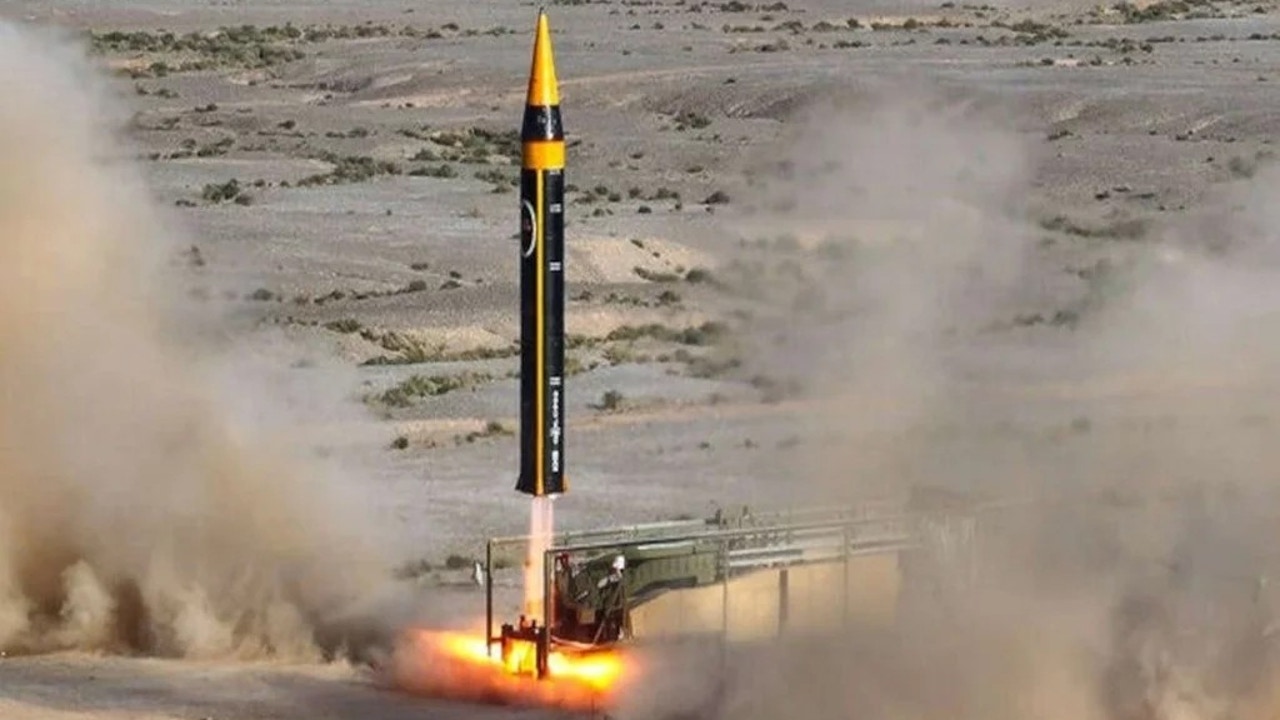
He Islamic Revolutionary Guard Corps (IRGC) of Iran has stated this Monday that it launched missiles ‘Khyber’ against high-level positions of the Israeli Government and Army. Israel has confirmed impacts, although without identifying the weapon used and denying that one of them occurred in the office of the Israeli prime minister, Benjamin Netanyahu. In any case, and even according to the IRGC’s words, it is difficult to know what overcame the effective Israeli air defenses. because the Khyber name has been associated with different types of missiles.
Tasnim News, a media outlet affiliated with the IRGC, described the weapons as ‘Khyber missiles’, which are also known as Kheibar (both names are transliterations of the same Arabic name خيبر), while other information describes them as Kheibar Shekan or even as hypersonic missiles, Army Recognition reports. This inconsistency complicates the analysis and may be deliberate, since it seeks to project greater deterrent capacity.
Kheibar Shekan
The Kheibar Shekan, introduced in 2022, is considered a third-generation solid-fuel medium-range ballistic missile (MRBM). According to available estimates, it would have a range of about 1,450 km and it would combine satellite-assisted guidance with maneuverable warheads to gain precision and, at the same time, make it difficult to track for interception.
Solid fuel favors mobility and shortens preparation times, something key to launching waves with the aim of saturating the high layers of anti-missile defense. Analysts emphasize that missiles of this size can move and hide more easily and shoot from different pointsforcing the defender to spend expensive interceptors on quick-fire sequences.
The maneuver in the terminal phase complicates the takedown even more, since reduces the probable circular error (its accuracy at impact) and introduces uncertainty in the final trajectorytesting the agility of the Israeli defensive system.
Launching at high volumes increases pressure on systems Arrow and Patriot of Israel, which have limited interceptor inventories and must make critical decisions about whether to engage the target early or wait for later phases.
Khorramshahr-4
Kheibar or Khyber is also the name that Iran gives to the missile Khorramshahr-4. In that case, we are talking about less volume saturation and greater payload and flexibility of use.
The Khorramshahr-4 was presented in 2023 and is attributed a range of about 2,000 km and a heavy warhead. Its hypergolic propellant would allow the missile to be kept charged for prolonged periods, reducing launch preparation to minutes.
This improves responsiveness and survivability against preemptive attacks. Furthermore, mid-phase navigation could correct trajectory outside the atmosphere, maintaining accuracy even under countermeasures. A heavy payload, combined with rapid availability, raises the threat on fortified targets with fewer launches.
Iran’s advantage lies in quantity, deployment in positions that are difficult to neutralize, and the variety of types of missiles. The country maintains the largest missile arsenal in the regioncombining MRBMs, maneuverable warheads and decoys to create defensive dilemmas. The ambiguity about its missiles favors that purpose.