
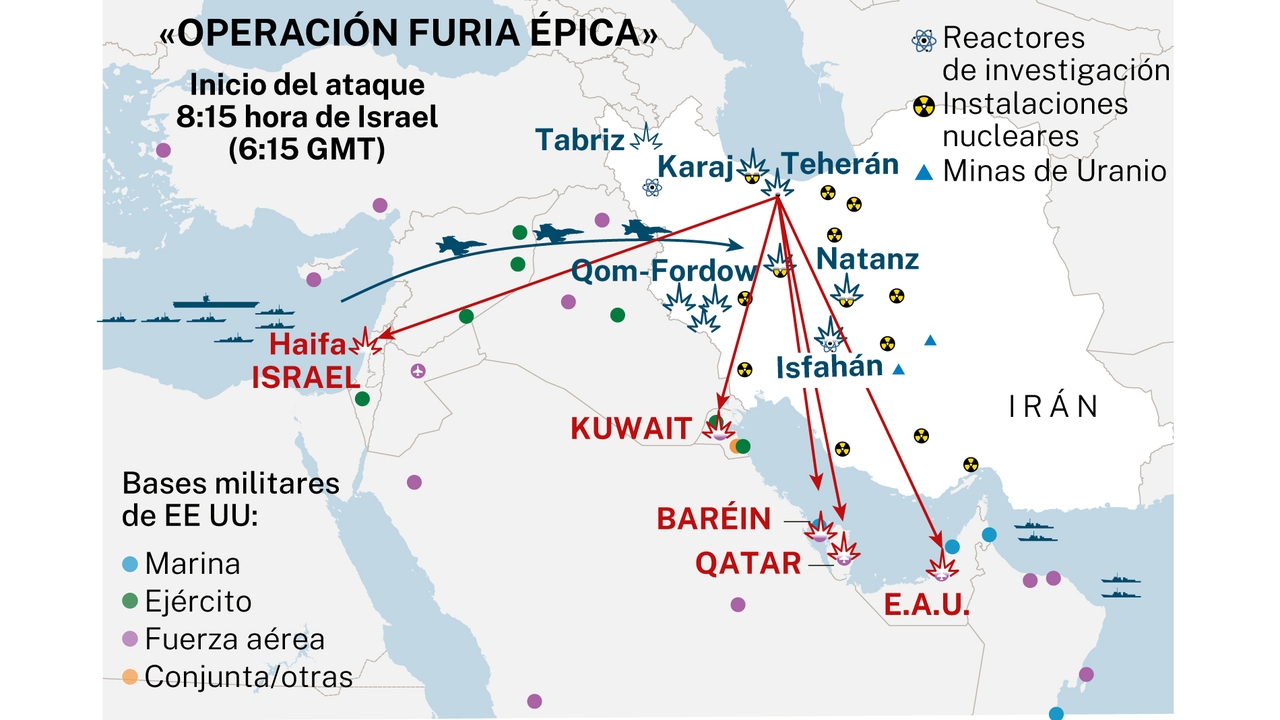
The joint offensive launched by the United States and Israel against Iran It was not an impulsive act or a last-minute reaction. According to military analysts and specialized press reports, the operation – called Epic Fury in the American environment – was the result of months of strategic planningintelligence coordination and political evaluation in a context of growing regional tension.
Far from focusing solely on conventional military installations, the operational design responded to a different logic: hitting critical nodes of the Iranian security structure and send a message of direct deterrence to the core of power in Tehran.
Sources cited by international agencies such as Reuters and American media agree that the planning was based on a prolonged joint intelligence work. Communications interceptions, satellite tracking and analysis of movement patterns of senior officials were part of the process prior to decision-making.
The objective was not only to evaluate nuclear or ballistic capabilities, but to understand the regime’s command architecture: how it operates, where it meets, and what its logistical and operational vulnerabilities are. This accumulation of information allowed Washington and Tel Aviv reduce uncertainty before authorizing an action of high political and military risk.
In the days before the attack, the region registered movements that now make more sense: repositioning of aircraft, increase in logistics flights, reinforcement of defense systems in bases in the Persian Gulf and unusual coordination between American and Israeli command centers. It was not a symbolic deployment, but rather the construction of an operational architecture designed to function in a specific time window.
A leadership meeting?
Some initial versions indicated that the attack coincided with the simultaneous presence of senior Iranian leaders in the same location. However, so far, the main international agencies have not independently confirmed that the entire political and military leadership was gathered in a single place at the time of impact.
What is certain is that the attacks were directed against facilities linked to the Iranian command structure and sensitive areas in Tehran and other strategic cities. Iranian authorities have assured that the supreme leader, Ayatollah Ali Khamenei, and the President Masoud Pezeshkian They were not hit and were taken to safe locations.
The absence of confirmation about a joint meeting does not alter, however, the strategic background: the design sought to maximize the effect on the chain of command and the perception of vulnerability within the regime.
Change of operating pattern
Another element that caught the attention of analysts was the choice of moment. Israel has traditionally carried out operations of this type at night, taking advantage of the darkness as a tactical advantage. On this occasion, the decision broke with that pattern.
This change suggests confidence in the precision of the available intelligence and a calculation intended to surprise defensive doctrines accustomed to another type of schedule. It was not an indiscriminate bombing, but a precision operation that sought to minimize collateral damage while sending a strong strategic message.
The attack came after weeks of indirect contacts between Washington and Tehran over the Iranian nuclear program. Although there were signs of dialogue, the talks did not lead to a concrete agreement. In parallel, The buildup of regional tensions and the exchange of public warnings raised the perception that the diplomatic channel was running out.
The United States also had to gauge the international impact of its decision. European allies have called for containment and a return to negotiations, while actors such as Russia have condemned the operation. Military planning, therefore, was accompanied by a complex diplomatic calculation.
Psychological warfare and deterrence
Beyond the material effect of the attacks, security analysts agree that the psychological component was central. When an adversary demonstrates the ability to penetrate defense systems and reach sensitive facilities, the impact is not limited to physical damage. In highly centralized regimes, the perception of vulnerability can erode internal trust and alter power dynamics. The operation aimed, in part, at that dimension: demonstrating that even spaces considered safe can be exposed.
However, that same calculation carries risks. Tehran responded by launching missiles and drones against US and Israeli positions in the region, widening the escalation. The possibility of indirect retaliation through Iran’s regional allies remains an open variable.
The operation marks a new threshold in confrontation between the United States, Israel and Iran. The military cooperation demonstrated reflects a level of strategic integration that transcends specific actions and demonstrates a willingness to act jointly in the face of threats perceived as existential.
If the objective was to alter the psychological and strategic balance in Tehran, the message has been clear: deterrence is no longer limited to public statements, but can materialize in high-precision coordinated operations.