
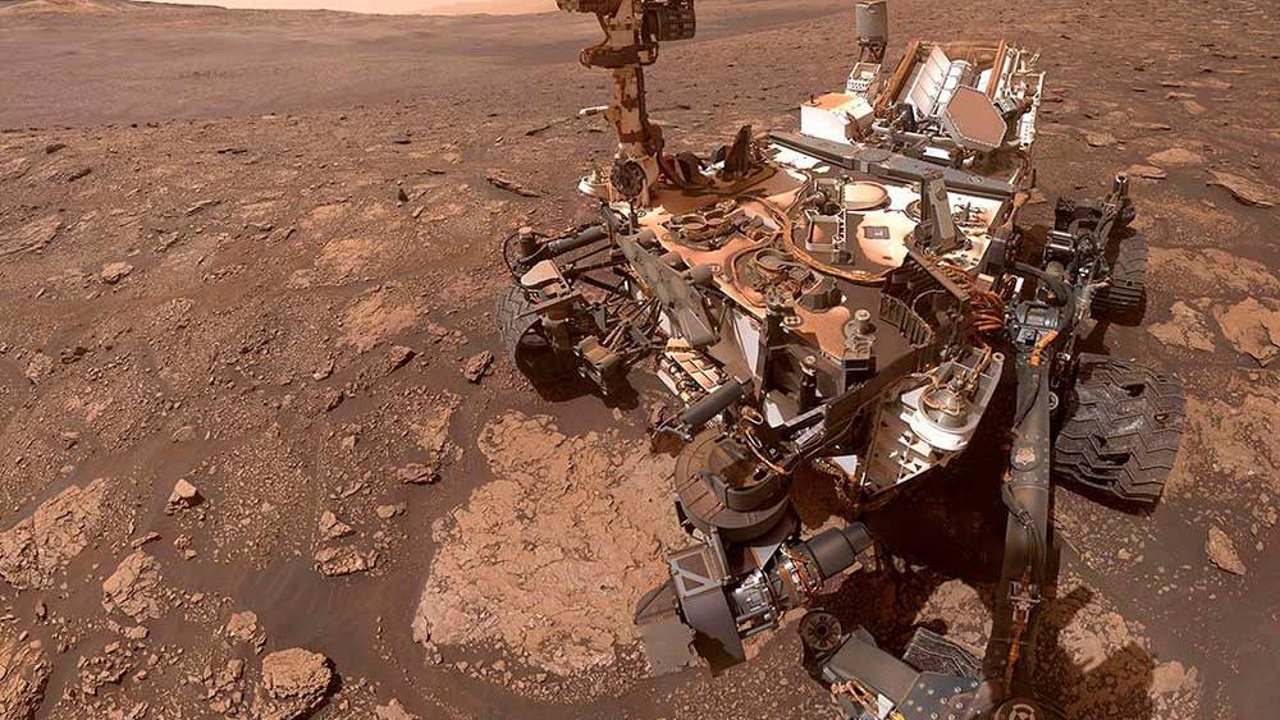
When we think of Mars, the image that comes to mind is that of a red desert, cold and dry, with winds of dust and a thin atmosphere. But beneath that seemingly inert surface chemical secrets are hidden. Many.
For years, rovers exploring the red planet have detected traces of organic compounds, carbon-based molecules that form the basis of life on Earth (the first of them detected in 2014 thanks to Curiosity), although always with caution: the presence of organic matter does not prove life by itself.
The “problem” is that organic compounds are not exclusive to living organisms: they can be formed by geological or chemical processes without biology involved, such as reactions in the presence of hot water or the fall of carbon-rich meteorites. However, a study published in Astrobiology suggests that certain organic molecules found in Martian rocks are too abundant to be explained by those “non-biological” processes alone.
The study, led by Alexander A Pavlov of NASA’s Goddard Space Flight Center, is based on the analysis of data obtained by the Curiosity rover in Gale Crater. There, in a formation known as Cumberland, detected long-chain organic molecules that are part of the alkane family, compounds widely present in terrestrial organic chemistry and often associated with fatty acid residues.
These molecules represent the largest organic compounds found so far on Mars, and its detection by Curiosity marked a milestone in the exploration of the neighboring planet. Previous analyzes had already identified simpler organics, but these long-chain alkanes are more complex and, on Earth, are usually associated with biological processes and structures typical of living beings. So far, every time NASA has announced organic compounds on Mars, scientists have made clear that this does not prove the existence of past or present life.
What makes Pavlov’s team’s study different is the combination of several tools: laboratory experiments, mathematical models and Curiosity’s own data to “rewind” the chemical history of the Martian rock. The idea is to estimate how much original organic matter would have been present before Martian cosmic radiation degraded it over millions of years. The authors estimate that, before radiation exposure, the concentration of these compounds could have been hundreds or even thousands of times higher than currently detected.
This level of concentration indicates the study, cannot be easily explained by known non-biological sources such as the arrival of carbon-rich particles from space, the deposition of atmospheric aerosols or common geological processes. Instead, the working hypothesis that remains on the table is that “some of these molecules could have been produced by an ancient Martian biological system,” says Pavlov’s team.
The authors are cautious and explicitly point out that this result is not proof of Martian life: “We agree with Carl Sagan’s assertion that extraordinary claims require extraordinary evidence,” the study concludes, “and we understand that any alleged detection of life on Mars will necessarily face intense scrutiny. Furthermore, in practice, with the standards established in the field of astrobiology, we note that the certainty of the detection of life beyond Earth will require multiple lines of evidence. However, Our approach has led us to estimate that the Cumberland shale contained high concentrations of long-chain alkanes incompatible with some known abiotic sources of organic molecules on ancient Mars.. “Thus, it is not unreasonable to hypothesize that an ancient Martian biosphere would be capable of producing this level of complex organic enrichment.”
What does this mean for the search for life on Mars? First, it demonstrates that Mars may have preserved complex organic compounds for billions of years, despite the intense radiation bombarding its surface due to the thin atmosphere. That suggests that ancient Martian environments, such as lakes and sediments rich in liquid water, may have harbored prebiotic chemistry (the chemistry that precedes life) at a higher level of complexity than expected.
Second, it opens the door for future missions to search for more direct biosignatures. Analyze carbon isotopy, molecular structures or even Microscopic microfossils will require more sophisticated instruments than those available on current rovers.
Ultimately, although this study does not proclaim the existence of Martian life, it raises one of the best clues yet that the chemistry of Mars cannot be explained solely by known geological processes. That possibility feeds one of the most profound debates in modern science: whether life, in its simplest form, arose in more than one place in the solar system.