
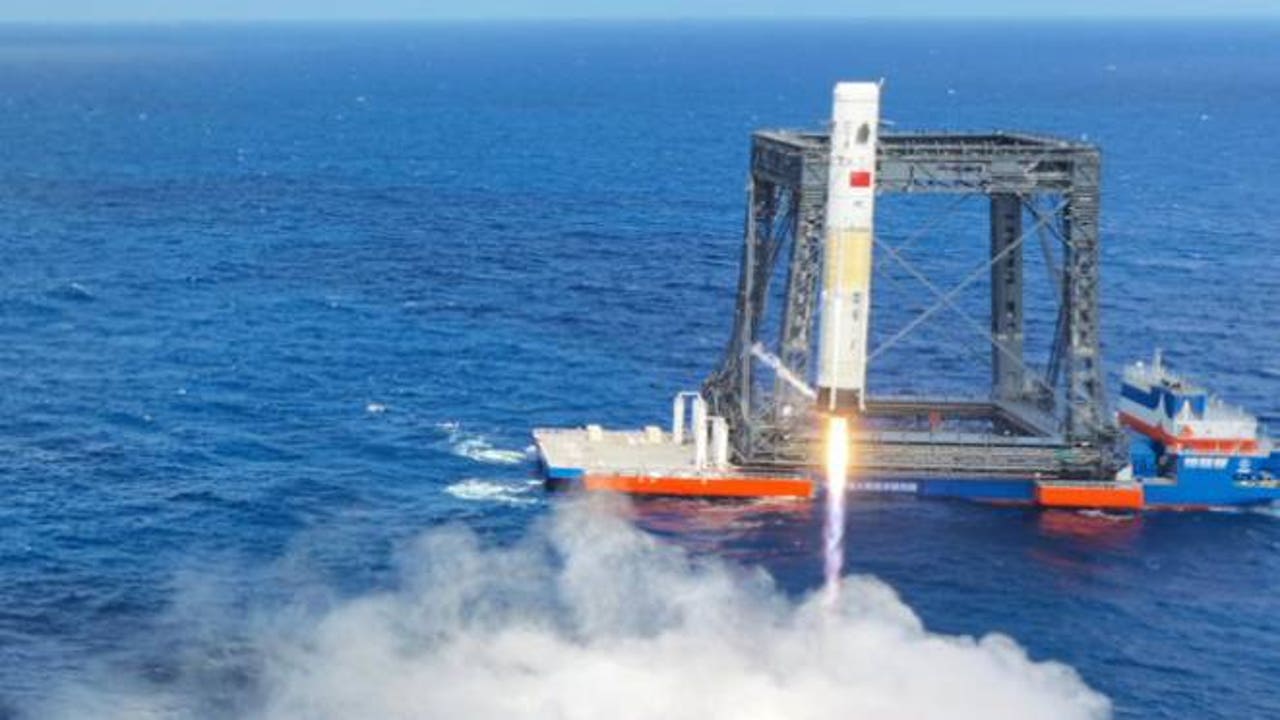
China has made ‘significant progress’ in its program to take astronauts to the Moon in 2030 with the first controlled splashdown of the Long March 10 rocket booster. This rocket, currently in development, along with the space capsule Mengzhouare key elements of China’s lunar program, which continues to progress apace.
The test, carried out this Tuesday from Wenchang Space Centeron the island of Hainan, had among its objectives test Mengzhou security systemwhich allows the capsule in which Chinese astronauts will travel to the Moon to detach from the rocket in the event of a malfunction.
For this demonstration of the abort or escape system, the China Manned Space Agency (CMSA) used a scaled-down version of the rocket and a test version of the Mengzhou spacecraft, with no one on board. Just over a minute after takeoff, already in the stratosphere and when the rocket reached the moment of maximum aerodynamic pressure, known as Max-Q, abort engines separated the capsule from the booster, simulating a successful in-flight escape. The Mengzhou ship then deployed its parachutes and landed offshore off Hainan Island.
This test is common when developing rockets and is also performed by the POT and SpaceX. What is new is that Long March has been designed to be reusable and also demonstrated the progress of the CMSA in this regard.
The booster continued to ascend without the manned capsule and entered space powered by its engines YF-100 to then re-enter the atmosphere, restart its engines and nail a landing in the South China Sea, right next to the recovery barge. This uses a system of cables to trap the propellant, something it could not do this time due to a failure of the rocket to deploy its grid fins with which it controls the direction when landing. For that reason, A controlled landing was chosen next to the recovery platform, something that was achieved.
‘The first stage of the rocket and the ship’s return capsule landed safely in the designated maritime area in accordance with procedures,’ the CMSA said. ‘The test successfully verified the functional performance of the ascent and recovery phases of the first stage of the rocket, as well as the escape and recovery of the spacecraft under conditions of maximum dynamic pressure’he adds.
Did you expect the Long March 10 first stage to perform like this today? https://t.co/MPS2Rk7DQ2pic.twitter.com/gDj4B5UJIh
—CNSPACE (@CNSpaceflight) February 11, 2026
The Mengzhou ship will be the vehicle with which China will transport astronauts from Earth to the vicinity of the Moonwhere the crew will transfer to a lunar landing module to descend to the lunar surface. After a brief stay on the Moon, the astronauts will take off and dock again with the Mengzhou capsule to return home.
The CMSA states that the Mengzhou spacecraft will also serve the Chinese space station in low Earth orbit, replacing the capsule Shenzhou in use since the 1990s. The Mengzhou capsule can accommodate ‘multiple reuses’according to the space agency. On missions to low Earth orbit, Mengzhou will carry crews of up to seven astronautswith smaller teams on lunar missions.
Mengzhou, which means ‘ship of dreams’ in Chinese, is scheduled for its first orbital test flight later this year. The ship will take off on a rocket Long March 10A and will dock with the space station Tiangong in low Earth orbit. The Long March 10A, optimized for flights to low orbit, will consist of a single reusable first stage combined with an upper stage. He Long March 10 full size, with 21 engines and 92 meters highwill have the capacity to place loads of up to 70 tons in low orbit and enough energy to propel the 26-ton Mengzhou spacecraft towards the Moon.