
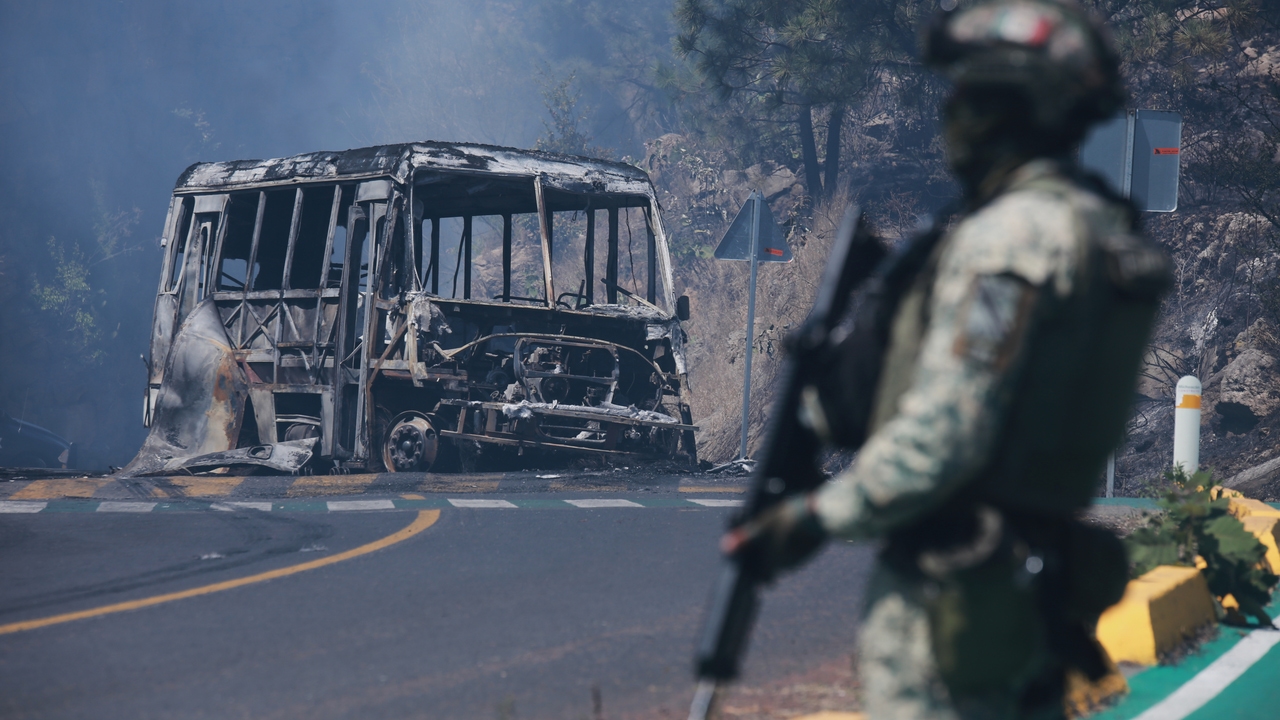
Mexico faces an escalation of violence, with fires and blockades, in at least 16 of its 32 states, after the death this Sunday of one of the most wanted bosses, El Mencho, leader of the Jalisco New Generation Cartel (CJNG), in an operation with US intelligence, amid growing pressure from Washington to combat drug trafficking.
Nemesio Rubén Oseguera Cervantes, alias El Mencho, 59, died while being airlifted to Mexico City by federal forces.s after an operation in the municipality of Tapalpa, 130 kilometers south of Guadalajara, capital of Jalisco (west), carried out with the support of information from the United States, according to the Mexican Defense.
The operation in that rural area led to a armed confrontation in which the military repelled an attack, leaving seven alleged members of the CJNG dead -including the leader himself-, two detainees and the seizure of high-powered weapons and armored vehicles, including rocket launchers, according to the Army.
In response to the action, the so-called ‘narcoblockades’ began in different parts of southern Jalisco, the birthplace of the CJNG, with vehicles set on fire and roads closed. The state government activated the “code red” and suspended public transportation in some areas and in-person classes on Monday.
The reaction spread to neighboring states such as Michoacán, Colima and Nayarit (west), and later to Guanajuato, Aguascalientes (center), Tamaulipas, Baja California (north), Guerrero and Quintana Roo (south), where blockades, fires to vehicles and businesses – including branches of the government’s Banco del Bienestar – were reported.
Canceled flights, suspension of classes, road blocks
In Puerto Vallarta (Jalisco), one of the main tourist destinations in the country, flights were canceled, while throughout the state the governor suspended massive events, including the concert of the American singer Kali Uchis in Guadalajara, one of the host cities of the 2026 World Cup.
Until now, At least 16 states have reported blockades and riots, also including Puebla, Querétaro, State of Mexico (center), Veracruz, Oaxaca and Chiapas (south).
In addition to the seven hitmen killed in the operation in Jalisco, four others died in Michoacán, according to Governor Alfredo Ramírez. There are also 22 detainees in Jalisco, Michoacán and Guanajuato, according to official data.
While classes have been officially suspended in the states of Jalisco, Nayarit, Michoacán, Colima, Querétaro, Guanajuato, Baja California and in the Isthmus of Oaxaca region.
In the rest of the country, the National Autonomous University of Mexico (UNAM) did not suspend classes, although it reported that it will not apply absences to students who cannot appear due to “mobility problems” in some regions and faculties.
The alert was extended to the Mexican capital with the transfer at the end of the afternoon of El Mencho’s body from the hangar of the Attorney General’s Office (FGR)escorted by federal forces to the agency’s forensic services in Mexico City, where identification tests and official expert reports will be carried out.
For her part, President Claudia Sheinbaum called on the population to remain “informed and calm” and recognized the armed forces for the operation that led to the dejection of the CJNG leader.
The Mexican Defense confirmed that the operation had “complementary information” from the US, within the “framework of bilateral coordination and cooperation.”
The dejection of El Mencho occurs in a context of growing Washington’s pressure against Mexican cartels last year declared them “terrorists”. The United States accused him of leading a “reign of terror” in Mexico and destroying “countless lives” with fentanyl trafficking, and offered up to $15 million for information leading to his arrest or conviction.
Under his command, the CJNG expanded its presence in Mexico and strengthened drug trafficking routes, including fentanyl to the United States, which placed it among the most wanted drug traffickers in both countries.