
It is not at all common to enjoy almost live images of an Iberian imperial eagle confronting a fox to prevent it from disturbing it while it is taking a bath. Surprising and beautiful, the video from the YouTube channel, Directo Natura, has been gone viral for showing an unusual scene. The fox also seems surprised, who in the end gives in to his stubborn opponent.
The eagle finally achieves its goal, taking a bath, and while it wets its feathers, now calm, it reveals its youth to the spectators. The specimen in the images is a teenager: “Although you can see that he has a significant size and claws,” explains Laura Castro Noval, head of the Habitats and Protected Species Area. of the Community of Madrid. The colors of their wing feathers, less dark than those of an adult, or the absence of the characteristic white spot on their shoulders – very useful for identifying them in flight – reveal their immaturity.
The images were recorded in Madrid and serve as an excuse to talk about the state of the population in this region which, although it may be surprising, boasts of being the one with the highest density of Iberian imperial eagles. «We have more than a hundred couples, which means more than one couple per 100 square kilometers. That is why we talk about density, since the surface of Madrid is small,” says Castro.
A conservation success
The Iberian imperial eagle is, along with the Iberian lynx, one of the great examples of success of conservation programs in Spain. The two species are endemic to the Iberian Peninsula and in the late 1970s they were on the brink of extinction. In the case of the Iberian imperial eagle, in 1974 only 39 breeding pairs were recorded. –about 150 individuals, including juveniles–. The species was plummeting, victim of persecution, poisoned baits or the shortage of rabbit (its favorite prey). In the Community of Madrid there were only 10 couplesas Castro highlights. In 2023, the total number in Spain was already 841 individuals.
In Madrid, «in 2025 we have monitored 97 couples. This means that they are detected pairs that we visit regularly during courtship, laying, incubation and raising the chicks until they fly,” explains Castro. To these we must add a dozen more in Monte de El Pardo, which guards National Heritage, which means more than one hundred ringed pairs. It has been a good breeding year: 82% of the couples has managed to raise and raised 129 chickens. The Community has increased the number of breeding pairs by 12.8% compared to 2024. «When we detect chicks that fall from the nest – sometimes by accident and other times by cainism, since fights can occur between siblings -, monitoring allows us to assess what to do. If the chicken survives, it can be relocated to the nest or transferred to a wildlife recovery center, where it is recovered and later released into the wild,” details the technician.
The exhaustive monitoring of these birds of prey and decades of legal and on-the-ground interventions are the reasons that have allowed the recovery of this impressive eagle, the second largest after the golden eagle, with a wingspan from wing to wing of almost two meters. “This success is due to a combination of factors: the approval of regulations that prohibited hunting and the use of poisons – two of the main causes of mortality of the species – and the work to adapt power lines, avoiding collisions and electrocutions,” clarifies Laura Castro.
The populations in Madrid continue to grow, which allows us to observe this majestic raptor in flight in mountain areas in the north and southwest. They are not high mountain birds, so it is better to approach somewhat lower and open areas. They are currently expanding especially towards the east and southeast of the region. They usually choose tall trees, such as poplars or poplars, to nest, but to hunt – mainly rabbits – they move away from their nests, which makes it easier to observe them in agricultural areas or open grasslands. Even so, it continues to be part of the regional catalog of threatened fauna in the “endangered” category.
Hazelnut and strawberry tree
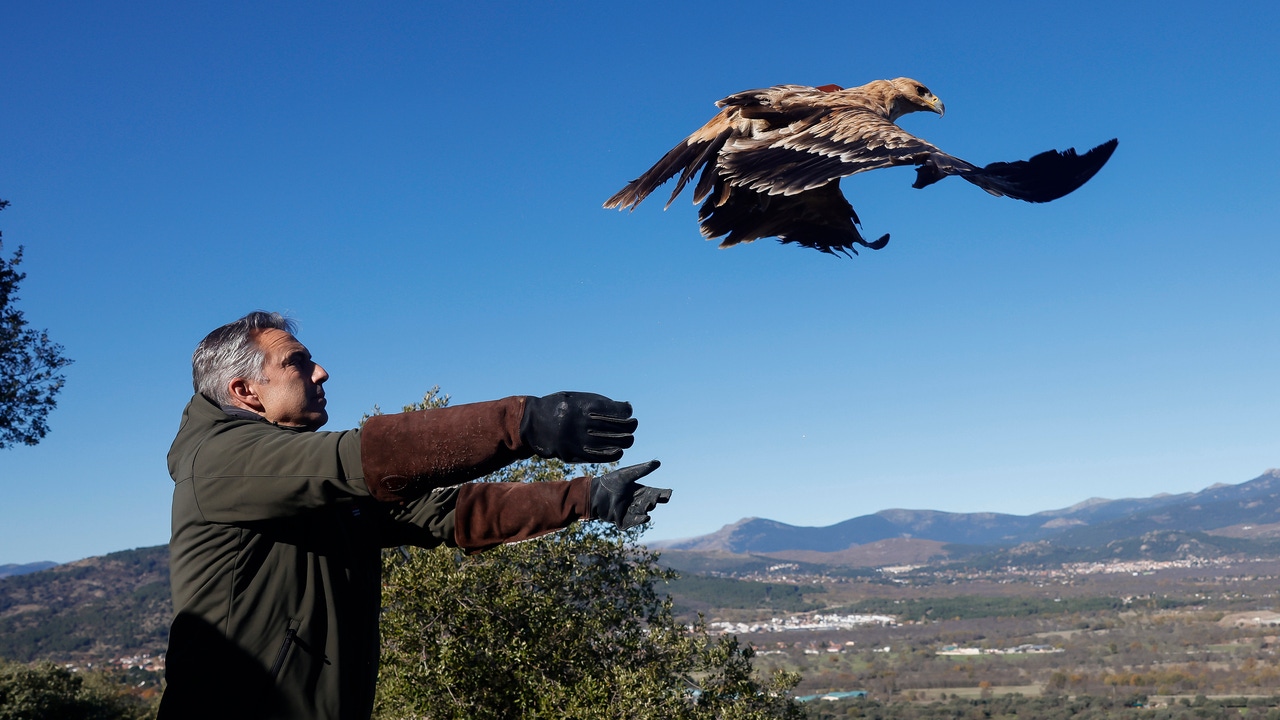
In November 2025, two specimens of the Iberian imperial eagle, Avellana and Madroño, were released in Madrid after spending several months at the Félix Rodríguez de la Fuente Wild Animal Recovery Center (CRAS).
The state in which they were found when they were collected reminds us of the dangers and threats that fauna faces every day. In the case of birds, action continues on power lines that cause enormous casualties or due to shocks or electrocutions. In this center, birds like these practice flight and gain muscle to, in the best of cases, return to their natural habitat.
How to identify the eagle
It is not easy to identify birds of prey, but in the case of the imperial eagle there are two characteristics that make the task easier. Its large wingspan and silhouette mean that it can only be confused with the golden eagle, which is somewhat larger. In addition, adults have a characteristic white spot on their shoulders. Its plumage, once it reaches maturity, is a very dark brown color. The nape and sides of the head, however, are pale. In the case of young birds, the color is brown, with reddish flight feathers. As they become adults, their plumage goes through the “checkerboard” state, in which they show a pattern that mixes pale and dark feathers.
A POPULATED SKY
►If the expression “from Madrid to heaven” is true, it is not surprising that the Community of Madrid is a highly valued destination for bird watchers. In its territory, up to 240 species can be seen, of the nearly 400 that exist in Spain, either as habitual residents or during their migratory periods. Contributing to this wealth is that around 40% of the regional territory has some degree of environmental protection. However, there is still work to be done in terms of conservation.
Birds constitute the largest group of threatened species in the Community of Madrid. The Regional Catalog includes a total of 131 threatened fauna species, which include animals such as the alpine newt, the Iberian lynx, the otter and the eel. About 61 are birds, of which 17 are diurnal.
In addition to the Iberian imperial eagle, other species show positive evolution. Black vulture and griffon vulture populations appear to be improving. The latter, listed as endangered, has gone from 33 pairs in 1989 to more than 250 in 2025, especially in Rascafría, which is home to one of the seven largest colonies in Spain. The red kite, in danger of extinction on a national scale, presents a more favorable situation in the Community of Madrid.
Montagu’s harrier and lesser kestrel populations have also increased, both linked to agricultural environments. To protect the Montagu’s harrier, agreements have been made with farmers to delay or avoid harvesting near the nests. In the case of the lesser kestrel, extra food is provided in the breeding colonies. Finally, the Bonelli’s eagle has improved thanks to the adaptation of power lines, the main cause of mortality for this and other birds.