
Since humans began observing the skies with powerful telescopes, we have learned that comets are not simply “balls of dust and ice” that cross the sky. They are time capsules: ancient fragments that preserve the primordial materials of the solar system and, in some cases, even from star systems other than our own.
This is especially true for 3I/ATLAS, an interstellar comet first detected in 2023. “Interstellar” means that it formed not around our Sun, but in another star, and that it wandered through space for millions of years before being momentarily captured by our gravity. Its trajectory, speed and composition distinguish it from comets originating in the solar system.
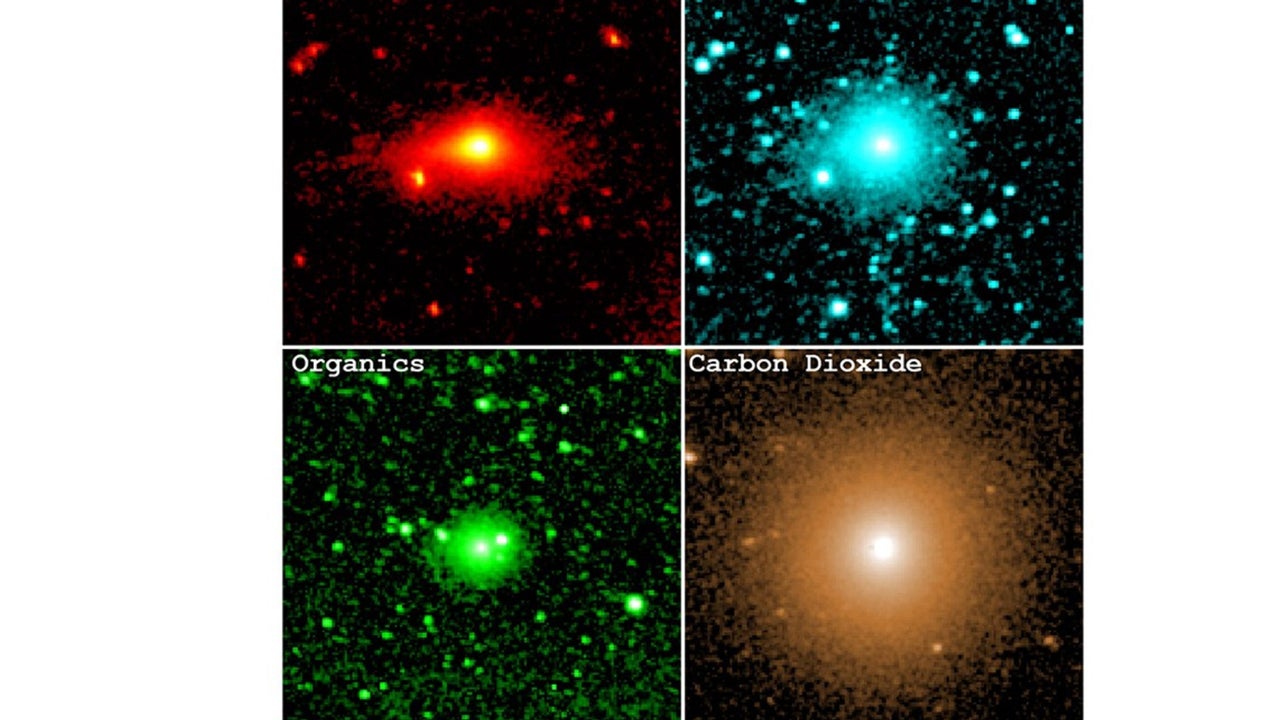
Now, for the first time, a NASA mission, the SPHEREx space telescope, has observed that 3I/ATLAS is expelling into space molecules that, on our planet, are closely linked to the chemistry of life. This observation opens a window to profound questions: are these ingredients common in other planetary systems? Could the “seed” of life travel from star to star?
The SPHEREx mission (acronym for Spectrophotometer for the History of the Universe, Reionization Epoch and Ice Explorer) was designed to study the composition of celestial objects through spectroscopy: break down the light they emit to identify different molecules. When SPHEREx targeted comet 3I/ATLAS, it detected an increase in brightness and, more importantly, signals consistent with the presence of simple organic molecules enriched in carbon.
When an interstellar comet like 3I/ATLAS passes near the Sun, the heat causes its ice to sublime (go directly from solid to gas), forming a bright coma and a long tail that can extend millions of kilometers. It is in that tail where SPHEREx sees the traces of organic molecules.
According to the NASA statement, the mission has been able “track the changing brightness of the comet as it approaches the Sun and examine the molecules released by its tail”. The presence of these compounds, some of which are precursors to more complex biological molecules, is notable because an interstellar comet was not expected to display such a rich chemical signature.
But what type of molecules were detected? The study, published in The Astrophysical Journal Letters, has not yet revealed a complete list of the molecules, but initial observations point to the presence of compounds with carbon and other elements essential to the chemistry of terrestrial life, such as hydrogen and oxygen. These molecules form the basis of more complex organic molecules such as amino acids (the “bricks” of proteins) or certain sugary precursors.
In our own solar system, comets like 67P/Churyumov–Gerasimenko (studied by the Rosetta mission) have already taught us that These ice balls may contain complex organic compounds. The surprising thing about 3I/ATLAS is that these signals come from an object that did not form in our cosmic neighborhood.
In astrobiology we often talk about “prebiotic chemicals”: molecules that are not life, but that, in the presence of the right conditions, can lead to it. The finding in 3I/ATLAS suggests that the basic ingredients for organic chemistry, and perhaps for life-precursor processes, could be common not only in our solar system, but also in other corners of the galaxy.
These types of observations with new telescopes bring us closer to answering questions that previously seemed impossible to address. One of them is yes The chemical processes that precede life are the same throughout the universe.