
3D printing has transformed the world of manufacturing, allowing Create complex objects directly from a digital design without intermediate tools. So much so that it has been taken to the International Space Station to produce tools or parts in case of failure.
However, for decades there has been a fundamental limitation: time. Although it is possible to obtain very complex geometries, most 3D printers take hours or even days to complete a single part depending on the size. This is because typical printing builds objects layer by layer, a process that inherently takes time.
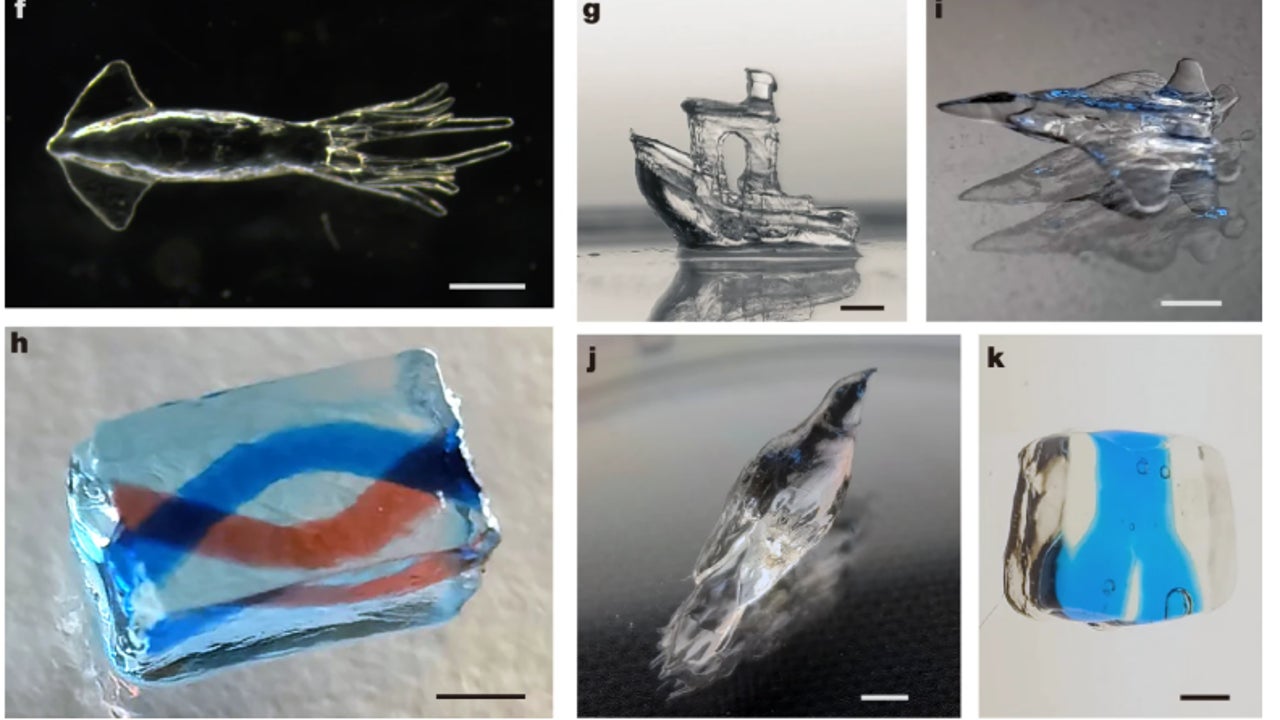
However, that obstacle could be about to be overcome. A team of scientists from Tsinghua University in China has developed a technology that allows printing complex three-dimensional structures on a millimeter scale in record time: just 0.6 seconds. For the first time, additive manufacturing of objects is not only fast compared to traditional methods, it approaches the speed of continuous industrial processes, and does so without sacrificing design resolution or complexity.
The key to this revolution is not in speeding up motors or improving extruders, as is the case with many conventional printers, but in advanced optical technology that uses high-dimensional holographic fields of light. The system, described by researchers as DISH (digital incoherent synthesis of holographic light fields), manipulates light patterns to almost instantly solidify multiple points of the three-dimensional object at the same time. Instead of “drawing” a part little by little, as a traditional printer does, the new method projects the entire complex structure simultaneously within a volume of photosensitive material.
While conventional technologies rely on the mechanical movement of heads or platforms to build each layer, this technique uses light patterns generated by algorithms capable of solidifying all geometry in a volume of material without the need for physical movement. That eliminates the bottleneck of mechanical travel, the most important frontier in terms of speed limit.
To this we must add that speed is accompanied by precision: the structures can have details of up to 12 micrometers. Those responsible for the advance, published in Nature and led by Wu Jiamin, point out that “we achieve mass production of complex and diverse 3D structures within low viscosity materials, demonstrating its potential for broad applications in various fields.”
The possibility of manufacturing parts ultra-fast could transform sectors such as micromanufacturing, advanced electronics, medicine (especially in the production of biological models or custom laboratory structures) and even the mass production of customized components.
Taken together, this advance raises an interesting question: are we at the beginning of a new era where 3D printing truly becomes a continuous manufacturing process, not just additive? If technologies like this are developed and adapted to larger scales, they could drastically reduce production times for industrial parts, which would have direct implications on the economy, product design, and customization of manufactured items. The only thing left to know is the price of this new technology.