
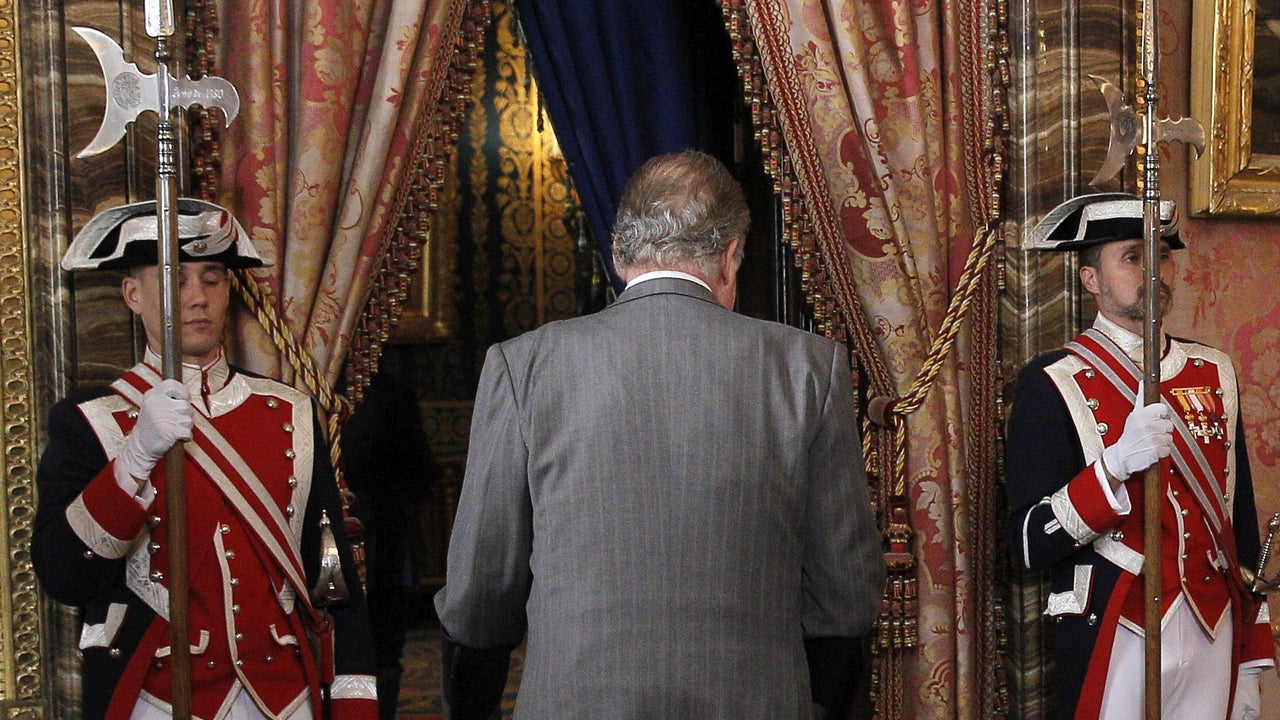
January 3, 1983. It was Monday. There were barely three days left until Juan Carlos I would star in the Military Easter, the most important military event of the entire year. However, the King was not in Madrid that day, nor was he finalizing preparations for his speech before the Government, the General Staff and the three Armies. It was, however, thousands of kilometers away, in the small Swiss town of Gstaad. He had gone skiing.
The trip could have gone unnoticed. It could be just one of the many he did, and the Spaniards had not yet gotten used to his frivolities. But the snow was hard that morning and a layer of ice betrayed him, he fell, and fractured his pelvis.
Due to the vagaries of his hobby, he suspended his participation in the Military Easter and returned to Spain on a stretcher. Many authorities stopped their work to pay attention to him and upon landing, Sabino Fernández Campo, his head of the King’s House at that time, told him: “Your Majesty, a king can only return like this from the Crusades.”
A few months before that scene, in October 1982, Felipe González had arrived at Moncloa after elections in which almost half of the Spaniards who went to the polls voted for him and in which he obtained the first absolute majority in democracy.
Although the PSOE had been in the Transition until that moment, where Juan Carlos I acted as the keystone, for the first time since the Republic there was a Government with socialists in it, and who knew if their anti-monarchist traditions could show up.
These two milestones caused someone in the Zarzuela Palace, very close to the King, but with the loyalty and influence to tell him things clearly, to begin to prepare a report admonishing Juan Carlos I to be careful with his private life. The report was finally titled “Short study on the present political situation and future forecasts in Spain.”
Dated April 27, 1983, and without signature, whoever preserves the original attributes it to Fernández Campo himself, although it could also have been written by Manuel Prado and Colón de Carvajal, a trusted man of the King.
It is known that the report was in His Majesty’s office, but it is not certain if the then head of state ever read it. If he did, it can be said that he did not take it into account too much, based on the scandals he was involved in later.
Consulted by LA RAZÓN, the report predicts that the Government will not object to the Monarch being able to enjoy a peaceful life, surrounded by socialites and with luxuries that are foreign to the rest of the citizens, allowing him everything without consequences. He asks her not to fall into the trap.
“The prophecy for Juan Carlos I was fulfilled, but Felipe VI acts as if he had read the report”
He predicts that the PSOE will be able to use it against him in the future and anticipates that Felipe González will show himself as someone with an authentic sense of State, in front of a frivolous King surrounded by wealth, which will irremediably distance him from the Spanish.
«That skiing accident caused the King to be out of action for several months and to take a back seat in political life during those days, with the socialists newly in power.
This anomalous situation is what caused the report, which was full of warnings, to be accelerated,” explains journalist Miguel Ángel Mellado, a deep connoisseur of the Royal House, deputy director for ten years of the newspaper “El Mundo” and former information director of “El Español.”
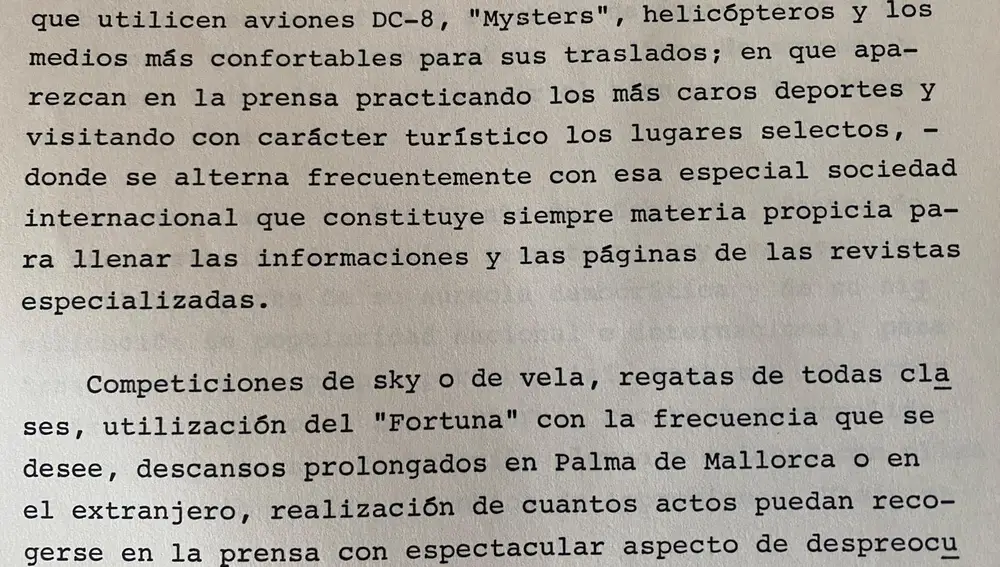
“Having now reviewed the 55 pages of the report, they sound like fulfilled prophecies of Cassandra, in which Juan Carlos I was warned about what he had to do to avoid ending up in disgrace, as in the end it happened,” says Mellado, in whose hands this premonitory study has been and which he preserves with annotations.
The document anticipates that the Government “will not object to the King and his family enjoying as many vacations as they wish”, using State means for their travel, “appearing in the press practicing the most expensive sports and visiting places where they frequently interact with that international society that is always suitable material for filling the information and pages of specialized magazines as a tourist.”
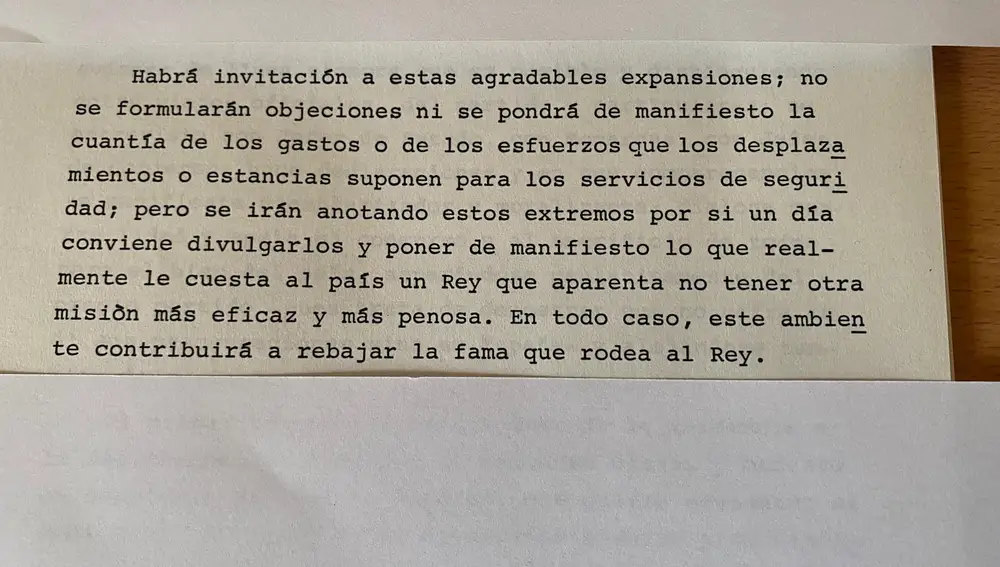
Everything mentioned there was fulfilled for years, practically point by point. But the report continued: “There will be an invitation to those pleasant expansions; No objections will be raised nor will the amount of expenses or efforts that the trips or stays entail for the security services be revealed; But these points will be noted in case one day it is appropriate to divulge them and reveal what a king who appears to have no other more effective and more painful mission really costs the country. In any case, this environment will contribute to gradually lowering the fame surrounding the King.
With the passage of time, those words sketched as a mere hypothesis now have a premonitory aura. They sound like a prophecy. The only thing that was not fulfilled is the role of the PSOE in all of this. But it was not necessary, the King did not need anyone’s help to make the crown fall.
The evidence that the words did not sink in was seen nine years later, in 1992. Felipe González had to replace his minister Francisco Fernández Ordóñez due to his illness and, when the press asked him if he had informed the Monarch of the changes in the Executive, as dictated by the Constitution, he responded: “The King is not there.”
Juan Carlos I was in Switzerland again, this time with his lover Marta Gayá, and it was the socialist president who was in charge of revealing his resignation to the Spanish people.
This was the first major earthquake in the King’s lifetime following the report’s warnings, but it was not the last. Not at all. The story is already well known to the Spanish, who year after year watched, perplexed, the life of a monarch surrounded by luxuries, lovers, cases of corruption, accounts in Switzerland, falls and accidents. So much so that one of those, the one from Botswana, ended up sentencing his crown.
“What the report prophesied was fulfilled,” Mellado remarks. “Although Felipe González did not contribute to it, the socialist Government laid the rug, without restrictions, for him to commit various outrages and it was Juan Carlos I himself who undermined his reputation and condemned himself to the greatest of disgraces,” he adds. He believes that the study is also premonitory regarding the idea of constitutionally displacing the Monarchy.
“González did not do it, but I think Pedro Sánchez has tried hard, since in 2019 he formed the coalition with Unidas Podemos and began to displace Felipe VI as much as he could,” he points out, pointing out as an example that he has fewer and fewer offices with him, sometimes even sending Félix Bolaños, and that he has displaced him in international events.
“If Felipe VI had approached the frivolity and immorality of his father, I believe that a regime change would have been considered a long time ago, especially with this Frankenstein majority, as Alfredo Pérez Rubalcaba baptized it,” the journalist believes.
«The stark difference between Juan Carlos I and Felipe VI is that the son, until now, has acted as if he had read the aforementioned report. In private, Don Juan Carlos criticized Felipe’s extreme care when acting and disdained certain gifts.
Now, who would have thought it, the one who is piling up the dead is Sánchez. Maybe because he doesn’t have anyone to write these reports for him,” he says.