
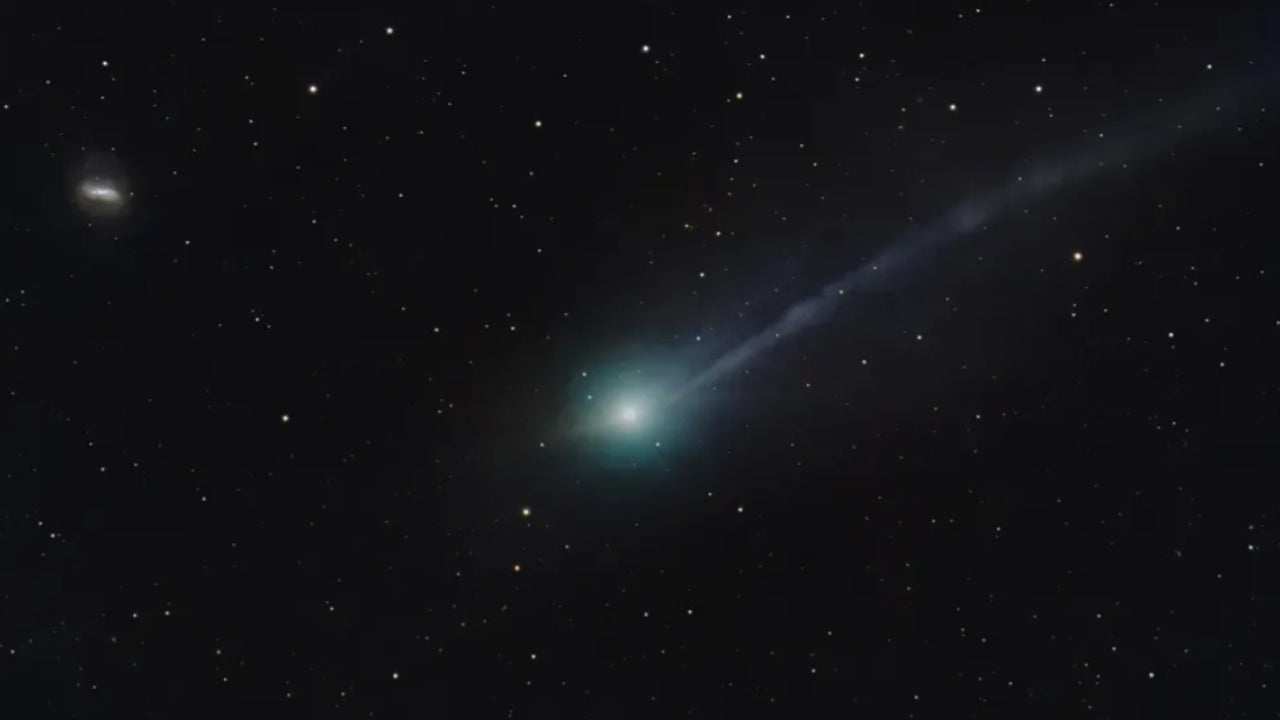
The interstellar comet 3I/ATLAS not only looks like comets in our solar system: lately it is showing a very complex tail morphology that is puzzling astronomers around the world. Four or five distinct tails have been detected in recent images, including well-defined jets, an antitail, and a highly collimated structure that appears to emerge directly from the core.
What does it mean to have multiple queues? Most comets have two main tails, a dust tail, made up of dust particles that are pushed by the pressure of sunlight, or an ionic tail, made of gases ionized by the solar wind that are blown away from the Sun.But with 3I/ATLAS we see something more complex. Observations made on November 8 by Michael Jaeger, Gerald Rhemann and Enrico Prosperi show a “spray” of jets and very narrow plumes, more than usual in comets, and also an antitail pointing in the direction of the Sun.
A special filter used by astronomers has revealed this structure: two very distinct tails, a highly collimated internal emission and an antitail aligned with the orbital plane. Why is it so rare or unusual? There are several reasons why this morphology draws powerful attention. That several jets come out from the core suggests that there are several “active points” releasing gas and dust, not just one. That may indicate a very irregular surface or multiple active regions.
The anticola, on the other hand, is a dust structure that, from our perspective, appears to point toward the Sun. It is not always real in the sense that the dust goes towards the Sun: sometimes it is an optical effectbut in the case of 3I/ATLAS some studies already propose that the reason is an anisotropy in sublimation (the ice sublimates unevenly in different parts of the comet).
Recent images show that the ion tail has lengthened and become more defined, suggesting that 3I/ATLAS is very “active” when receiving solar radiation. To this we must add that observations with the James Webb Space Telescope (JWST) have detected that the coma of 3I/ATLAS is especially rich in carbon dioxide (CO₂), more so than many “normal” comets. That composition can affect how tails form and how dust grains and gases are distributed.
What do these findings imply? The complexity of the tails could give clues to how 3I/ATLAS was formed in its system of origin. That it has a lot of CO₂, for example, could suggest that its formation occurred in cold regions of the protoplanetary disk of its parent star. At the same time, multiple tails indicate that it is losing mass in a more active and diversified waywhich can influence its trajectory (non-gravitational forces).
Finally, we must take into account its “exclusivity”. While some local comets also show jets and structures in their tail, The degree of complexity of 3I/ATLAS makes it a particularly valuable object to compare interstellar comet processes with those born in our local environment.
Without evidence to prove it, Avi Loeb, one of the most cited scientists regarding this comet, points out that part of these jets could appear similar to “propellants”: Not because I firmly believe it is a ship, but because the activity seems extremely vigorous and may require further explanations.
In short, The multiple tails of 3I/ATLAS are one of its most enigmatic and scientific aspects at this time. Not only do they offer us a spectacular image, but they are a window into its nature, composition and possible secrets about its interstellar origin.