
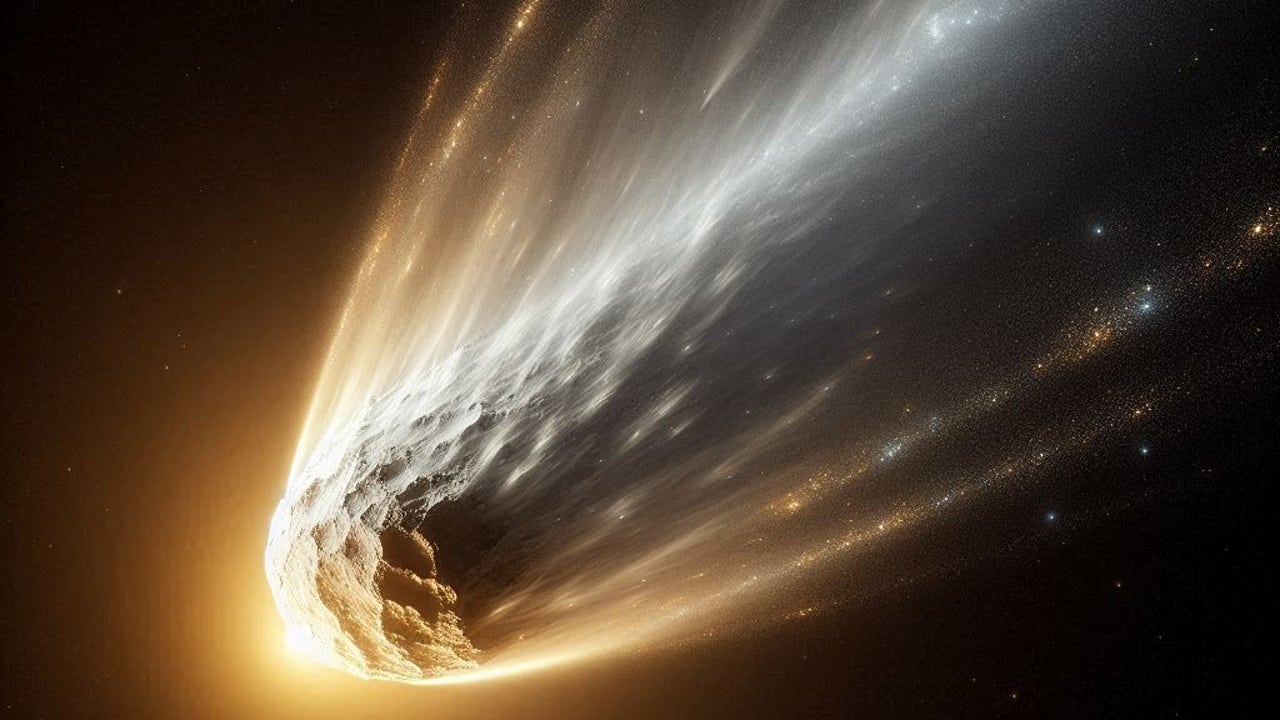
The most famous interstellar visitor, 3I/ATLAS, recently reached its perihelion (the closest point in its trajectory to the Sun) and, in doing so, began to show signs of non-gravitational acceleration, a strange behavior that is not explained solely by solar gravity.
Basically, as it approaches the Sun, the force of gravity of our star is greater and it is logical that it attracts it with “more force”…, but the acceleration that has been observed in 3I/ATLAS is not only due to this. So… why does this acceleration occur? According to a report of Davide Farnocchianavigation engineer at NASA’s Jet Propulsion Laboratory, 3I/ATLAS shows signs of “non-gravitational acceleration.”
Experts estimate that the object You could be losing mass (between a tenth and a sixth of your mass in a matter of weeks) by releasing a jet of particles and gas that acts as a propulsion engine. There is also a more speculative hypothesis: if it is not a conventional comet, it could be equipped with some internal device or mechanism (although this idea, mainly supported by Avi Loeb of Harvard, although published, is considered highly unlikely).
What does this finding mean? From a scientific point of view, This type of acceleration confirms that some interstellar objects do not behave like the asteroids or comets that we know in the solar system.which opens new questions about its origin and composition.
It also points out that 3I/ATLAS is richer in volatiles (gases and ice) than expected, which causes active reactions when approaching the Sun. And, finally, it also raises an invitation: if there are more objects of this type visiting our system, perhaps It may take us a while to detect them, but each one contains valuable clues about other star systems.
Astronomers have We plan to monitor 3I/ATLAS over the next few months, especially when it emerges from behind the Sun again.to look at the possibility of a “gas plume” of up to 5 billion tons or more that could accompany the mass loss.