
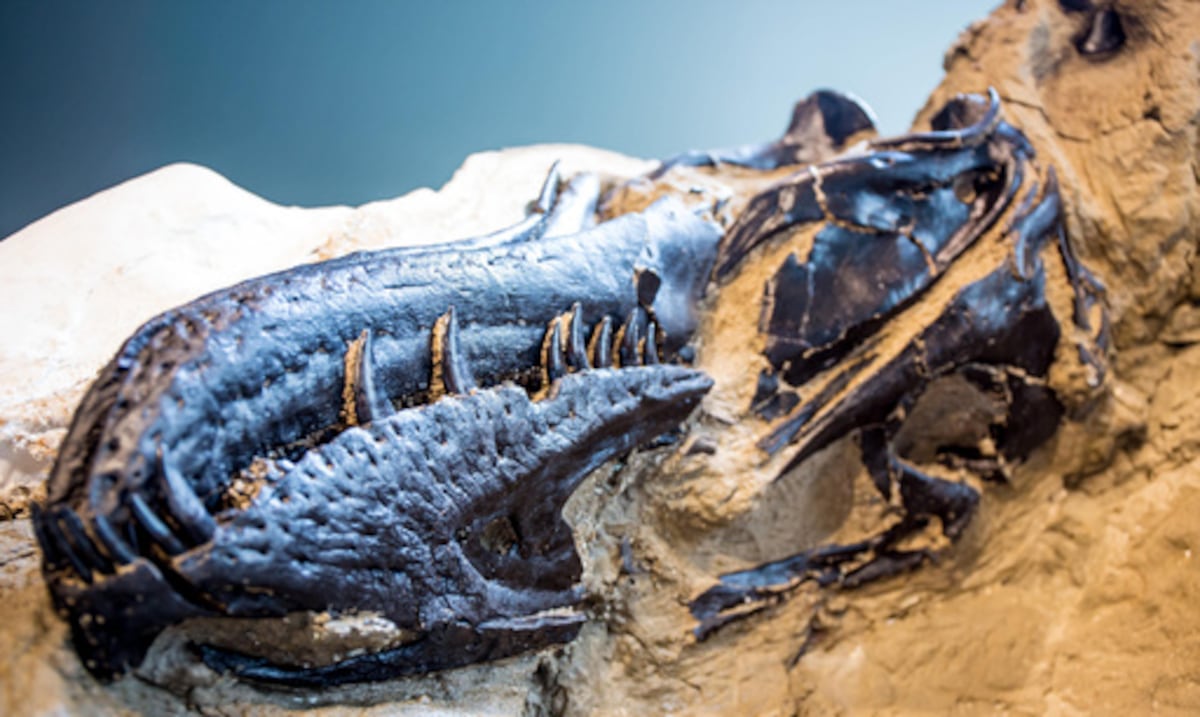
New York – Scientists have long been puzzled by the origins of a mysterious dinosaur excavated in the 1940s: Was it a young “T. rex” or another type of dinosaur?
At first, researchers only had one tyrannosaur skull, making it difficult to determine whether it belonged to a baby or an adult. Another skull and skeleton nicknamed Jane joined the debate, but did not resolve the controversy.
Now, an investigative team says there is new evidence that solves the case. The latest clue comes from a complete skeleton—first discovered in 2006 in Montana—which scientists say identifies the mysterious reptile as its own species and not a juvenile Tyrannosaurus rex.
The discovery “rewrites decades of research on Earth’s most famous predator,” said study co-author Lindsay Zanno of the North Carolina Museum of Natural Sciences and North Carolina State University.
Growth rings within bones found in Montana’s Hell Creek Formation told scientists that the new dinosaur was an adult about half the size of a full-fledged ‘T. rex.’ From growth comparisons with other reptiles such as crocodiles, they also discovered that the main differences between the creature’s skull and that of a ‘T. rex”—changes in bone structure, nerve patterns, and sinuses—were unlikely to form simply by going through puberty.
The signals pointed to a dinosaur that is a distant cousin of the “T. rex” known as “Nanotyrannus lancensis,” the researchers reported in a study published Thursday in the journal Nature.
There is now “more support and evidence than ever” that this relative of T. rex could exist, said Holly Woodward, a fossil bone expert at Oklahoma State University who was not involved in the new study. But she’s still not convinced that other mysterious skeletons like Jane are anything new.
Other independent scientists also said the debate is not over. The new skeleton is indeed an adult, but it could be a sister species to T. rex and not a distant relative, said vertebrate paleontologist Thomas Carr of Carthage College.
There are similarities between the shape of the “T. rex” skull and the mysterious specimens that prevent it from changing sides.
“I don’t think this study solves everything,” he said.
Resolving this case of mistaken identity is important to understanding how T. rex grew, said study co-author James Napoli of Stony Brook University. Another big question is whether “T. rex” was the top predator roaming around towards the end of the age of dinosaurs 67 million years ago, or whether a smaller, but still powerful, predator also roamed around.
The new skeleton is called “Dueling Dinosaurs” because it was found intertwined with the bones of a Triceratops, and is currently on display at the North Carolina Museum of Natural Sciences.