
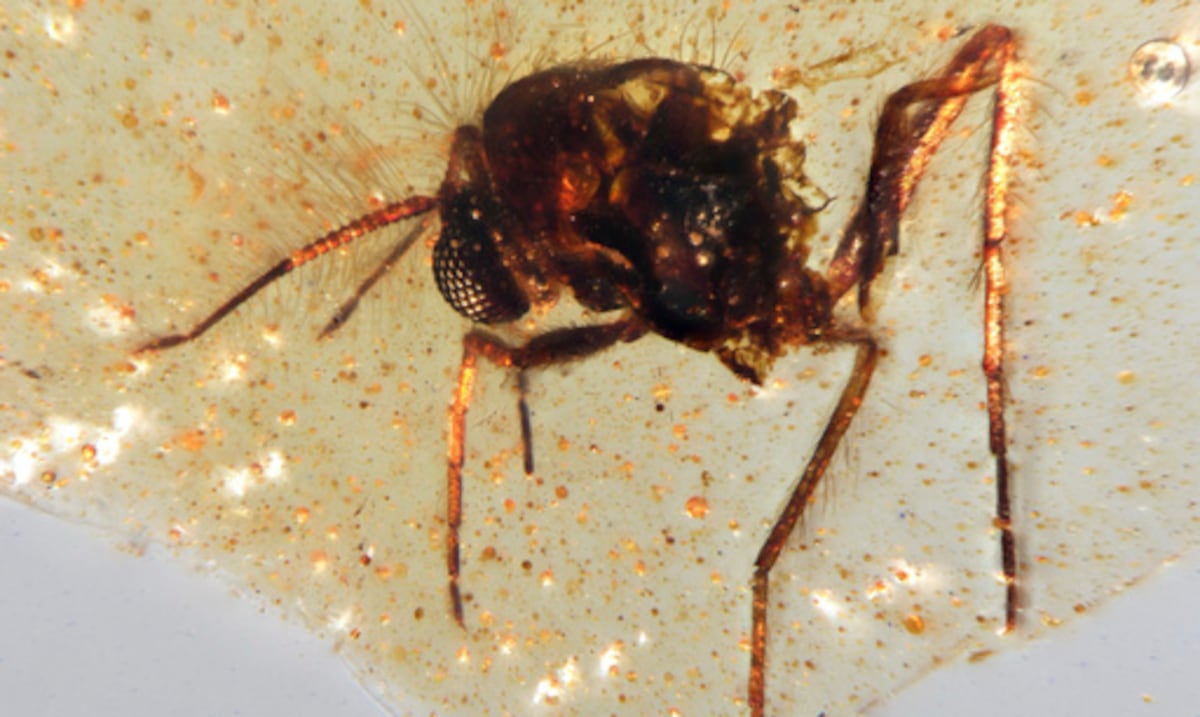
Scientists have discovered prehistoric insects preserved in amber for the first time in South Americawhich offers a new perspective of life on Earth at a time when plants with flowers were just beginning to diversify and spread throughout the world.
Many of the specimens found in a sandstone quarry in Ecuador date from 112 million years ago, said Fabiany Herrera, curator of fossil plants in the Field Museum in Chicago and co -author of the study published Thursday in the magazine Communications Earth and Environment.
Almost all known amber deposits of the last 130 million years have been in the northern hemisphere, and for a long time it has been “An enigma” That scientists have found few in the southern regions that once understood the supercontinent Gondwana, said David Grimaldi, entomologist of the American Museum of Natural History that did not participate in the discovery.
This marks the first time that researchers have identified beetles, flies, ants and old wasps in fossilized tree resin in South America, said Ricardo Pérez-de la Fuente, Paleoentomologist of the Natural History Museum of the University of Oxford, who also did not participate in the new study.
“Amber’s pieces are small windows to the past”Pérez-de la Fuente said, and added that the discovery will help researchers understand the evolutionary interactions between flower plants and insects that lived during the era of dinosaurs.
The researchers discovered hundreds of amber fragments, some with old insects, pollen and tree leaves, in a sandstone quarry in Ecuador that is on the edge of what is now the Amazon basin.
But the current tropical jungle is very different from that traveled by dinosaurs, Herrera said. According to an analysis of fossils in amber, the old tropical jungle contained species of ferns and conifers, including the unusual Monkey Puzzle tree, which no longer grows in the Amazon.“It was a different type of forest”said Herrera.
Ambar deposits were previously known by geologists and miners who worked in the Genoveva quarry. The study co -author, Carlos Jaramillo, of the Smithsonian Institute for Tropical Research, heard of them for the first time ago approximately a decade ago and set out to find the exact location, with the help of geology field notes.“I went there and realized that this place is amazing”Said Jaramillo. “There is so much amber in the mines”and it is more visible in the open quarry than it would be if it was hidden under dense layers of vegetation.
Researchers will continue to analyze Amber’s treasure to learn more about the biodiversity of the Cretaceous era, including insects that contributed to evolution when feeding on flowers. “Amber tends to preserve things that are tiny,” said Grimaldi.
“It is the time when the relationship between flowers with flowers and insects began”said Pérez-de la Fuente. “And that turned out to be one of the most successful associations of nature.”