
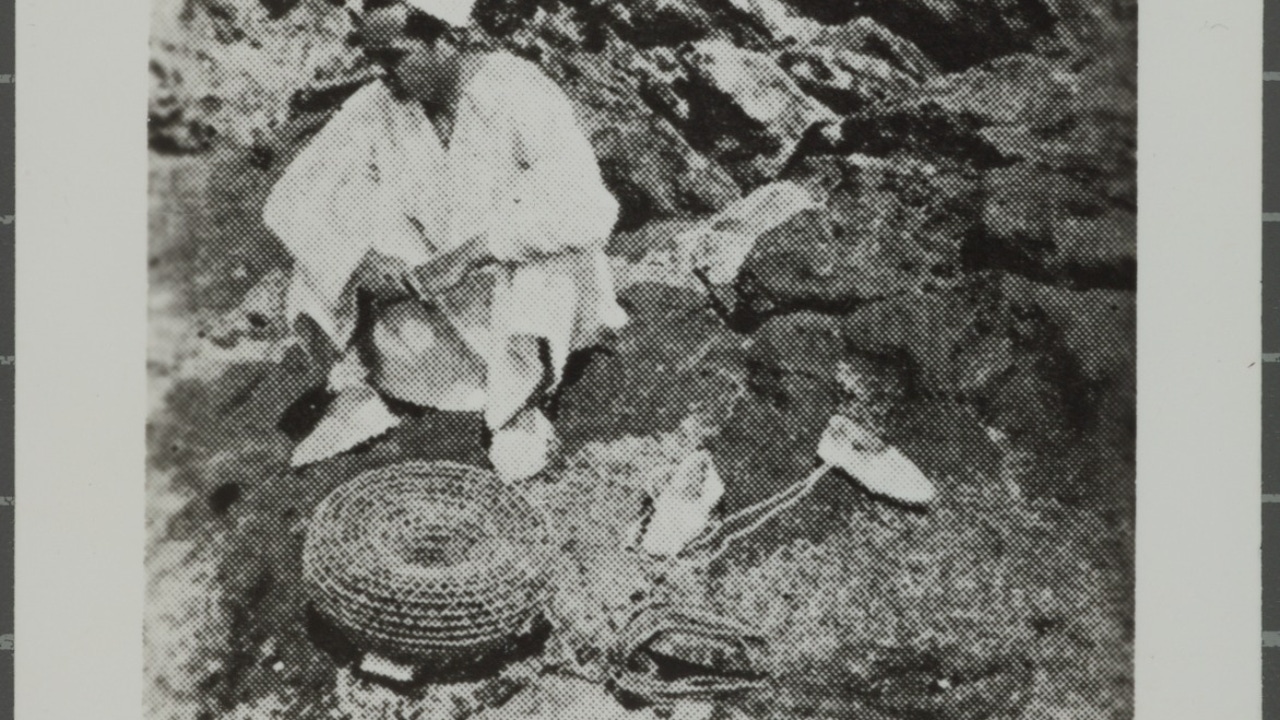
A few days ago, from these same pages, we echoed the digitalization of an important part of the Photographic Archive that is part of the documentary of art critic Rafael Santos Torroella and that today is owned by the City of Girona, after acquiring the collection of this student. While so far we have known that there were images of Santos Torroella’s meetings with Dalí, Miró or Tàpies, there is a copy that deserves to be rescued because it has behind itself an interesting story related to the adventures of a Granada poet by the city of the skyscraper, although the photograph was taken far from there, specifically in the town of Cadaqués. Let’s see what we are talking about.
The image stars Federico García Lorca who appears disguised as an Arab, a game that he practiced to delight his friends in the Student Residence, and with which he wanted to underline, being originally from Granada, which was identified with a lost culture, which fell with the victory of the Catholic Monarchs in the city of the Alhambra. This was stressed, for example, Ernesto Giménez Caballero during an interview for “The Literary Gazette” in 1928.
Who worried about capturing that moment was Anna Maria Dalí with her camera, specifically during the summer of 1927, the holidays that the poet spent in Cadaqués invited by Salvador Dalí.
Of all this, in addition to other snapshots captured before, in the Holy Week of 1925, we have a good testimony thanks to the work of Anna Maria, delivered to those moments not to be lost. However, he did not limit himself to festive photographs but won frames and a construction of the image of a very high quality. That Lorca liked that work after the camera gives good faith the fact that some was taken with him, today preserved in the archive of the Lorca Center of Granada, although not everything is. The set is part of an album that has not been lost fortunately and that has preserved the heiress of Anna Maria Dalí.
When two years later, in June 1929, Lorca took the ship that would take New York in the hope of getting off not a few internal and external ghosts, in his suitcase he carried with him some memories, including a handful of Anna Maria’s photographs. We know that because shortly after putting the feet in the city of skyscrapers, a magazine called “Alhambra” did not hesitate to inform about the Lorca stay there, translating some of its verses for the first time. The two pages were almost entirely illustrated with several of the images of Anna Maria Dalí.
Lorca appeared in “Alhambra” in August 1929, two months after a magazine had been born that was presented as “a new way between the lands of Cervantes and Whitman.” Under the direction of Ángel Flores, “Alhambra” had a brief life, counting on graphic design with Gabriel García Maroto, old acquaintance of Federico and editor of the Lorquiano «Book of poems». Precisely Maroto is probably who hid behind the pseudonym “Daniel Solana”, author of the article that presented Lorca to the American reader and included the English translations of “precious and air” and “romance of the black penalty.”
Let’s look at the photographs that Lorca delivered to Flores and Maroto. They are a total of five. One of them shows a serious Federico sitting next to a source in Lanjarón, probably during one of the rooms that his family performed in this population of the Alpujarras Granada. The rest are original from Anna Maria Dalí and her “rudimentary” kodak, as she herself defined.
The “Daniel Solana” article shows Lorca by making the dead, an image that served Salvador Dalí as a basis for one of his best known works of that period, “Sleep Invitation”, a fabric today unfortunately disappeared. Dalí arises precisely on this same page of “Alhambra” accompanying Lorca, both sitting on the beach of Es Llané, and communicating the thought through the poet’s bathrobe. That Lorca wanted Dalí to be in the magazine is a finding that he was still important in his life, although in those days they were distanced. The photo is said “writing a manifesto with Dalí.”
On the other page, where we have both poems, Lorca opted for two different photographs. In one of them he is accompanied by Anna Maria Dalí in fun attitude with two children, residents of the Dalí in Cadaqués. The second image is the one that occupies us and takes a certainly original photo: “On the coast of Africa.” Actually. It is the coast of Cadaqués.
The fact that the copy of the image is not good suggests that Santos Torroella made an extension from some copy of the “Alhambra” number.
It is striking, at least if you take into account the digitized and so far published on the website of the City of Girona, which no other photographs of Lorca appear that Santos Torroella kept. It cannot be forgotten that the critic and art historian had a direct contact with Anna Maria Dalí, especially while preparing for his editorial cobalt a first edition of the copious epistolary Lorquiano and that was announced in 1950.
An absence such as the image, the only one, by Santos Torroella with Federico García Lorca during the passage of the La Barraca University Theater in Salamanca, in 1933, is also striking. This is probably part of other deliveries of this digitalization.