
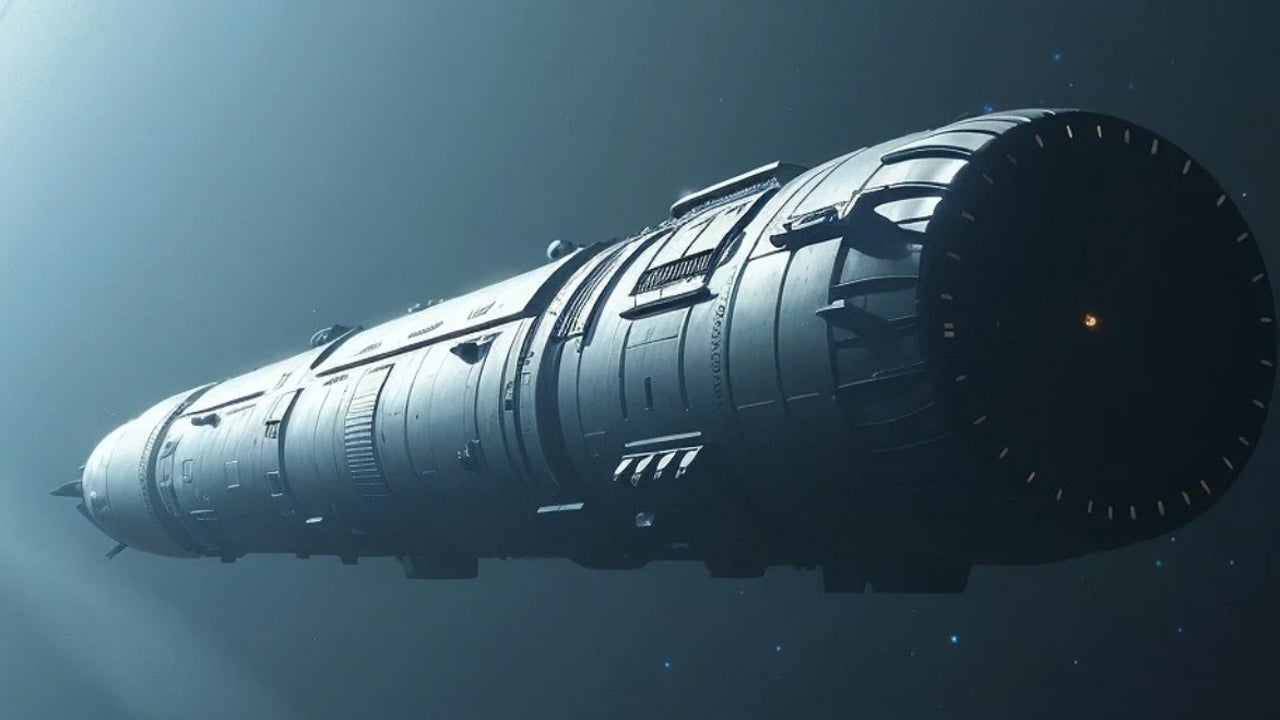
The Hyperion project is a study that seeks to explore the design of an interstellar manned spacecraft using current and future technologies. Started in 2011, the main objective of the project is to evaluate the viability of sending a multigenerational human crew to a nearby star system, such as Alfa Centauri. The committee, formed by NASA experts and different universities in the United States, has considered that Chrysalis is, to date, The most reliable project to take us to Alfa Centauri, our closest star neighbor.
Chrysalis who could transport up to 2400 people to Alfa Centauri, our closest star neighbor, and leave these travelers in a potentially habitable exoplanet next Centauri b. However, It is said that the trip only would last about 400 years due to the immense distance. Due to their incredible duration, many of the passengers would live all their lives aboard the spacecraft without ever knowing how life is on our planet.
“The Chrysalis generational spacecraft receives its name from the fascinating possibility of having A spacecraft capable of keeping its inhabitants safe and united, generation after generationuntil its arrival at the new solar system, ”said the proposal.
The ship, with cylindrical shape and multigenerational capacity, It would measure approximately 58 km and its constant rotation would create artificial gravity, which would allow the development of life inside. Before the trip, the first generations of passengers would live in an isolated environment in Antarctica for 70 to 80 years to prepare for life in the ship.
According to the proposal, the Chrysalis spacecraft It will be built at the Lagrange L1 point of the earth-lun system. This location is ideal, since it could allow the project to access the resources of the Moon and the Earth. Basically, a Lagrange point is a position in the space where an object, under the gravitational influence of two mass bodies (such as the moon and the earth), can maintain a relatively stable position.
“L1 is also ideal as launch point for a massive spacecraft of several kilometers long, To avoid the tensions caused by the differential gravitational effects on the structure when placing in orbit too close to the earth or the moon, ”says its authors.
Designed as a Russian doll, The gigantic spacecraft would be a complete ecosystem with different layers: warehouse, habitable modules, command section and gardens or orchards. In essence, it is an independent series of “worlds”, each with a specific purpose, each fed by nuclear fusion reactors.
In the inner nucleus, there are the ferry, ready to bring passengers to their final destination: next Centauri b. The next layer will focus on survival. Here, food production is a science, with controlled environments that could nurture everything from crops to cattle. Designers even included different ecosystems, such as tropical and boreal forests, for the possible preservation of biodiversity.
In addition, it would also house the heart of the community: parks, schools, hospitals and libraries. The outer layers house homes, industries and warehouses. With a trip that lasts several lives, population control is key. Births would be carefully planned to maintain a sustainable population of around 1500 people, thus ensuring the duration of resources throughout the trip.
To govern this complex society, Humans would collaborate with advanced artificial intelligence. This alliance would guarantee stability and transmit vital knowledge from generation to generation.