
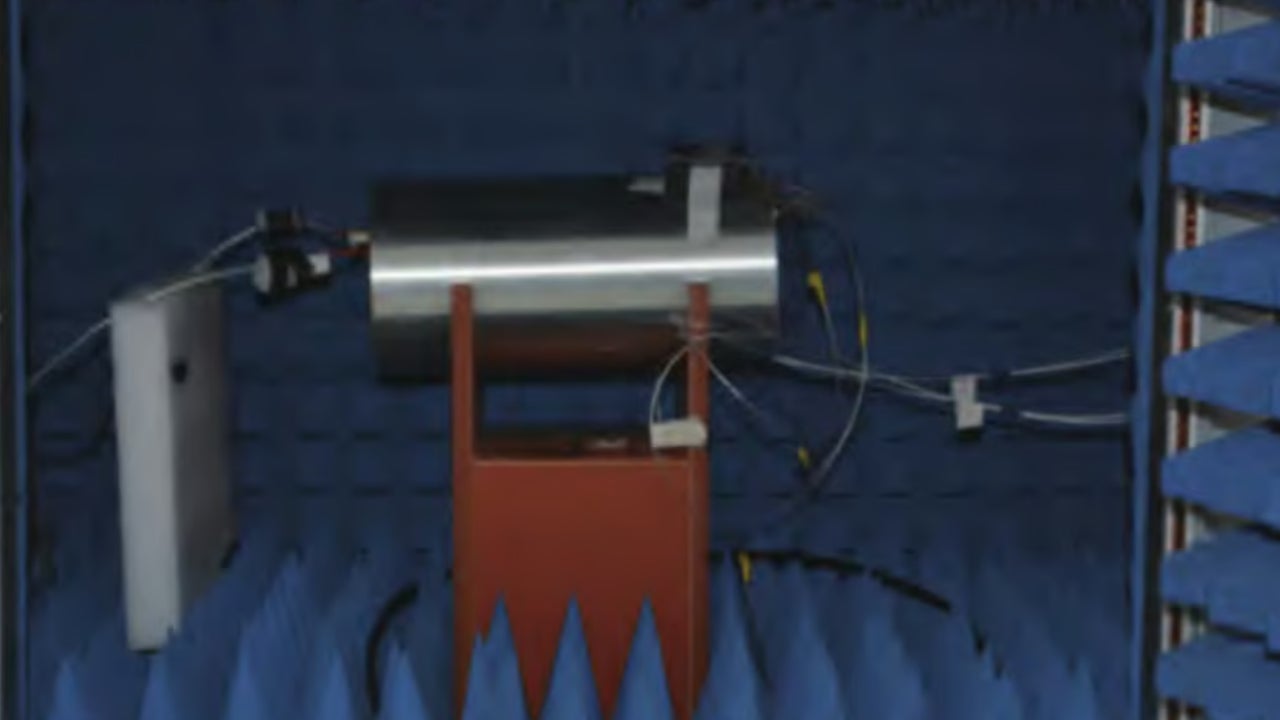
Until now, directed energy weapons that use neutron rays have remained in the science fiction field, not only because of the complexity of their name, but also because of the need for Large energy sources (as large accelerators capable of provoking the desired reaction) and its limited lethal reach. However, a team of Chinese scientists claims to have built precisely that: a portable neutron cannon.
According to a new study, published in High Power Laser and Partle Beams, the authors claim to have achieved controlled nuclear reactions between hydrogen and lithium on a compact device for the first time. Achievement constitutes a significant advance in neutrons generation technology, with implications for scientific, industrial and defense applications.
Unlike previous designs that required mass accelerators, this powerful, but portable particle cannon takes advantage of a new electromagnetic technique to launch hydrogen protons against lithium atom producing a nail size beam with 10 billion fast neutrons generated per second.
Neutrons are tiny particles inside atoms, without electric charge. Their neutrality allows them to go through materials as an “atomic flashlight”. Each neutron contains 3 million electron-power electron, similar to the particles emitted during the explosion of an atomic pump.
When concentrating on beams, they become a tool known as neutron source, capable of revealing atoms in viruses, finding cracks in air wings, eliminating deep tumors or detecting explosives in cargoes. Neutrons can also be used as a weapon, such as the “clean” neutron pump (for its precision) developed during the Cold War to kill people, but without affecting buildings.
While existing systems use accelerators in the size of a room, the engine of the new system is not greater than a fire extinguisher and feeds with only 10 watts of direct current. When lighting, a mechanical hammer hits a set of piezoelectric ceramics (a material that converts mechanical energy into electrical energy and vice versa), converting kinetic energy into pulses of one million volts of nanoseconds.
This electricity, similar to lightning, addresses a nuclear reactor of the size of a cup of tea, tearing the hydrogen gas it contains. In the reactor nucleus, it forms a rotating electromagnetic cage that Force overheated plasma to form a perfect sphere. Within the sphere, the protons extracted from hydrogen accelerate violently towards a cathode covered with lithium.
Thanks to a unique technique to control protons, known as polarized resonance, multiply the probability of a nuclear reaction by one million for that of traditional methods.
In these extreme conditions, Lithium and hydrogen fuse to form heavier elements, such as beryllium and boron, releasing a lot of energy in the form of fast neutrons.
These nuclear devices usually use deuterium, an isotope of hydrogen, as fuel. They are great and sophisticated, and They usually need a great energy source for food.
“The most notable characteristic of this reaction lies in the use of totally conventional materials, such as lithium and hydrogen -explains Yuan Jun, of the Institute for Modern Control Technology of Xian and study leader -. Hydrogen and lithium are the two most popular elements that drive the revolution of renewable energiesbut they are also good candidates for nuclear reactions. These elements are easy to obtain and have high effective reaction sections, with additional effects on multiplication of observed neutrons. ”
Jun’s team states that The device worked continuously for half an hour in the test.
“It represents an autonomous pulse generation system that is distinguished by four fundamental advantages: Elimination of high voltage external food sources, electronically controlled operational operation without work cycle limitationsconsiderable power amplification capabilities and a profitable design with structural simplicity and operational robustness, ”concludes the study.