
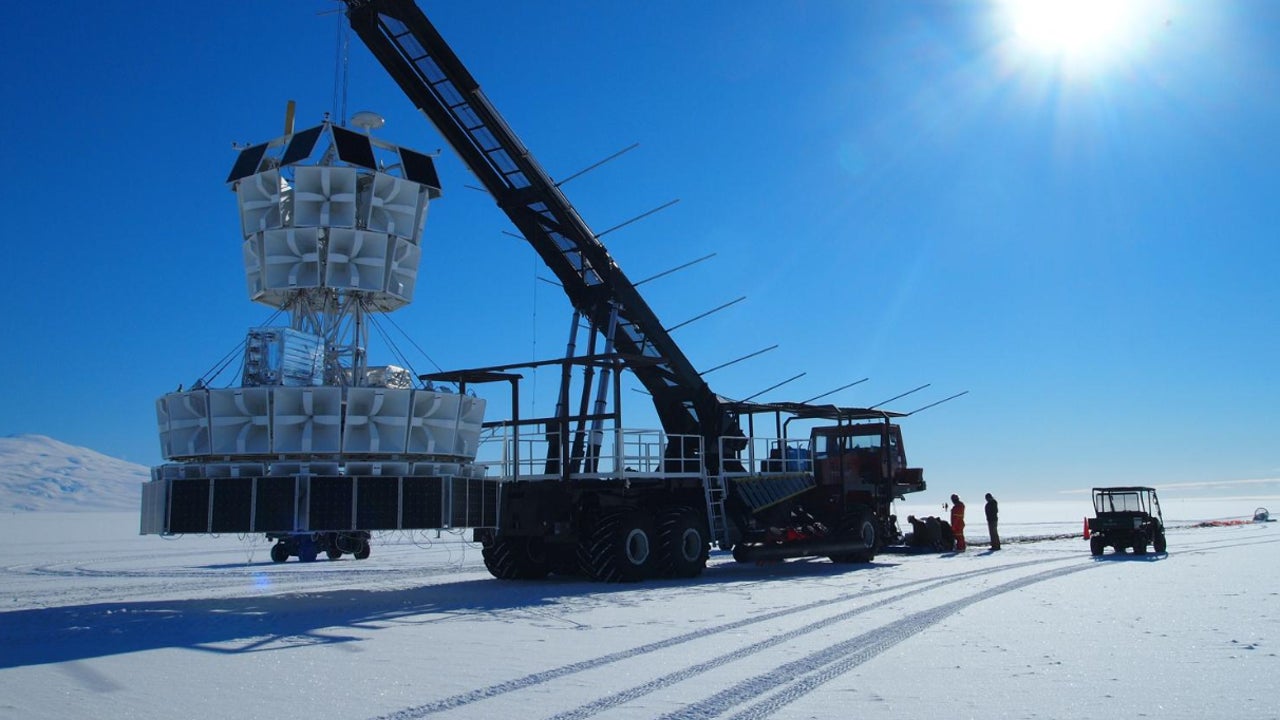
Among all the experiments that are currently being carried out in Antarctica, there is one that stands out. The Antarctic Antenna of Transitive Impulse (ANITA) has been running almost two decades and has been designed to study cosmic ultra energy (UHE) neutrinos. To do this, use a series of radio antennas suspended from a helium balloon that flies at a height of about 37 km high. But now it has detected something unexpected, something that, according to those responsible for the finding, challenges established physics.
The Anita experiment registered radio pulses that seem to rise through the Earth, something that should not be possible according to current models. The idea is that detectors capture signals from neutrinos, which are among the most elusive subatomic particles in the universe. But in this case, the signals did not behave as they should. Radio waves came from angles up to 30 degrees below the horizon.
These signals suggest that the particles traveled through thousands of kilometers of solid rock before emerging from ice. This is a scenario that existing particles theories cannot explain. What it raises The possibility of unknown particles or new forms of interaction between known particles.
Stephanie Wissel, physics at the State University of Pennsylvania who worked on Anita’s team, explains in A statement that this means that the particles would have had to cross the earth’s crust, The “problem” is that, by the time that signal emerged, it should have been absorbed. But the calculations do not fit.
Neutrinos are particles almost without mass or load that rarely interact with matter. They constantly move through space, earth and even the human body: “one billion neutrinos pass through the thumb at any time -says Wissel -, but detecting them is difficult precisely because they do not interact much. However, when they do, they can offer Crucial information about events such as supernovae or gamma rays bursts”
This is what makes Anita’s signal so confusing. If a neutrino caused it, the simple fact of detecting it would imply that he traveled through the earth without interacting until the end. However, the pronounced angle and the characteristics of the signal suggest otherwise. “We still don’t have a real explanation of these anomalies -adds Wissel -, but most likely not a neutrino. ”
To verify the findings, the team compared Anita’s data with information from two other important neutrin detectors: ICECUB in Antarctica and the Pierre Auger Observatory in Argentina. The results, Published in Physical Review LettersThey showed that None of the experiments recorded anything similar. This lack of support data, according to Wissel, discards the most probable known particles and reinforces the idea that something new could have to do with this detection.
To have a greater degree of security, the Wissel team also used simulations and models to remove background noise and known cosmic rays. The process left a single clear conclusion: the signals are still anomalous.
To get to the end of the road, the Wissel team are already building a more advanced version of the Anita experiment. The new detector, called Pueo, will offer greater sensitivity and a better opportunity to identify the cause of these unusual emissions. The idea is that you can detect more signs of this type and help scientists Understand if they are observing indications of new physics or simply unusual environmental effects.