
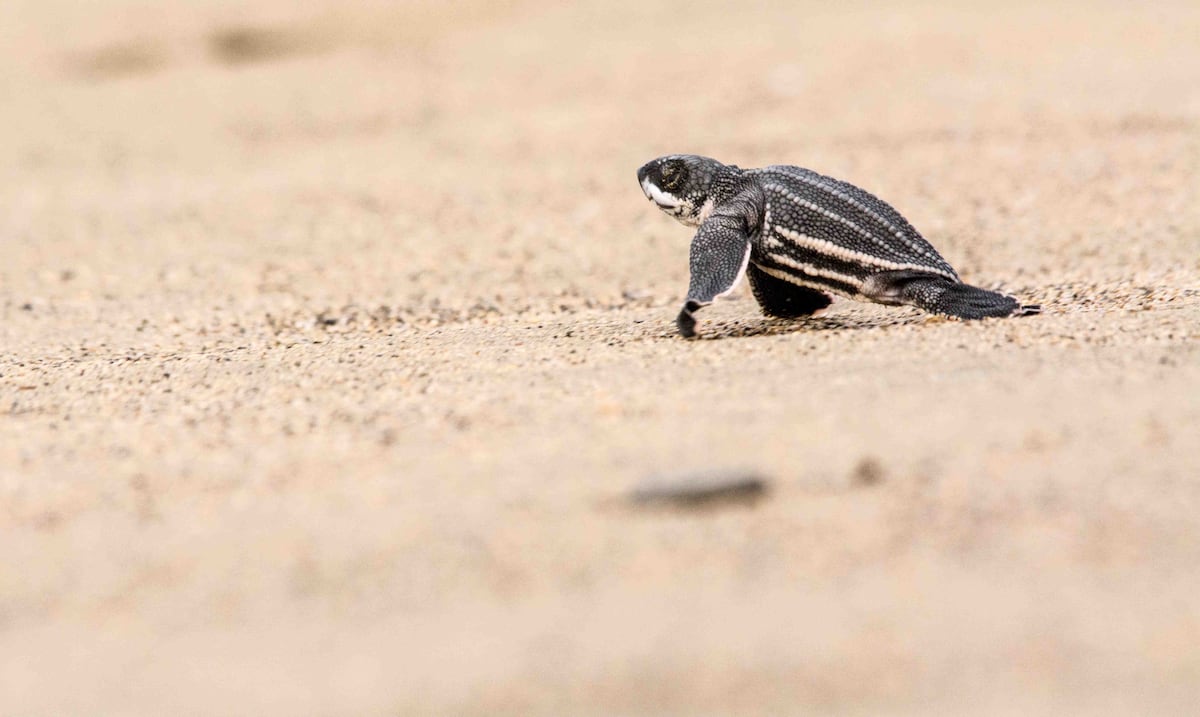
The week from June 8 to 16 is dedicated to sea turtles And, this Saturday, the organization Chelonia – in the conservation of these species – collaborated from Puerto Rico in a beaches cleaning global, coordinated by Oceanic Society and Be Turtle Week.
The event took place in the Playa Grande El Paraíso Natural Reservein Goldenand served to attract attention to the conservation of sea turtles and their habitat. The waters and coasts of Puerto Rico house five of the seven species of sea turtles in the world: TinglarCarey de Concha, Green Turtle (White Peje), Caguama and Golfina, these last two being the least common.
Jeriliz Ortiz Laboy and Julimar Nevárez Meléndezfrom Chelonia, were in charge of coordinating cleanliness, to which More than 80 community volunteers joined, together with 22 members of the organizationwhich is the longest on the island dedicated to the conservation of sea turtles, using scientific research, education and community participation to lead initiatives.
The group removed about 260 pounds of garbage.
“There were people of all ages participating”said Ortiz Laboy, in an interview with The new day. “For me, it is always very impressive to see the community meeting and see people who keep visiting us.”
The volunteers were divided into groups, based on the most likely spaces of containing marine turtles. For almost four hours, they collected plastic bottles and its tapas, trunks and even a cistern. The garbage was also divided into groups, depending on the type of materials, to later be sent to different municipalities for due processing. The vegetation found near the shore was relocated to an area with more flora covered.
Removing garbage is an essential action to ensure that female turtles have easy access to nesting spacesOrtiz Laboy highlighted. The process of spawning lasts about two hours, and begins with the arrival of the sea turtle to the shore. This is the most important step, and if there are obstacles – such as trunks – it is possible that the turtle cannot deposit its eggs because it is disoriented.
On the other hand, without garbage as an obstacle, the turtle will choose a site based on environmental elements, such as how thick the sand, humidity and temperature be coarse. Then, a nest will dug using its rear fins, between two to three feet deep, which will contain between 70 and 80 eggs. It will return to the sea, and the eggs will hatch after 45 to 70 days.
Having an ideal ecosystem is necessary to support the growth of fragile marine turtles, Ortiz Laboy said.
“We are also part of the ecosystem,” he emphasized. “It is necessary that, if we go to the beach, you have to take your garbage, but, in addition, if you see garbage that is not yours, pick it up”.
Using part of the garbage they collected during the event, the volunteers created a work of art dedicated to the Week of the Sea Turtles. Chelonia will continue to organize conservation and monitoring events of these populations. For more information, check your social networks in Facebook and Instagram.