
The telescopes on earth They have limitations to observe how the first stars affect the light emitted by the big Bangbut now a team of researchers has managed to have a clearer image of one of the less known times of the universe, the cosmic dawn.
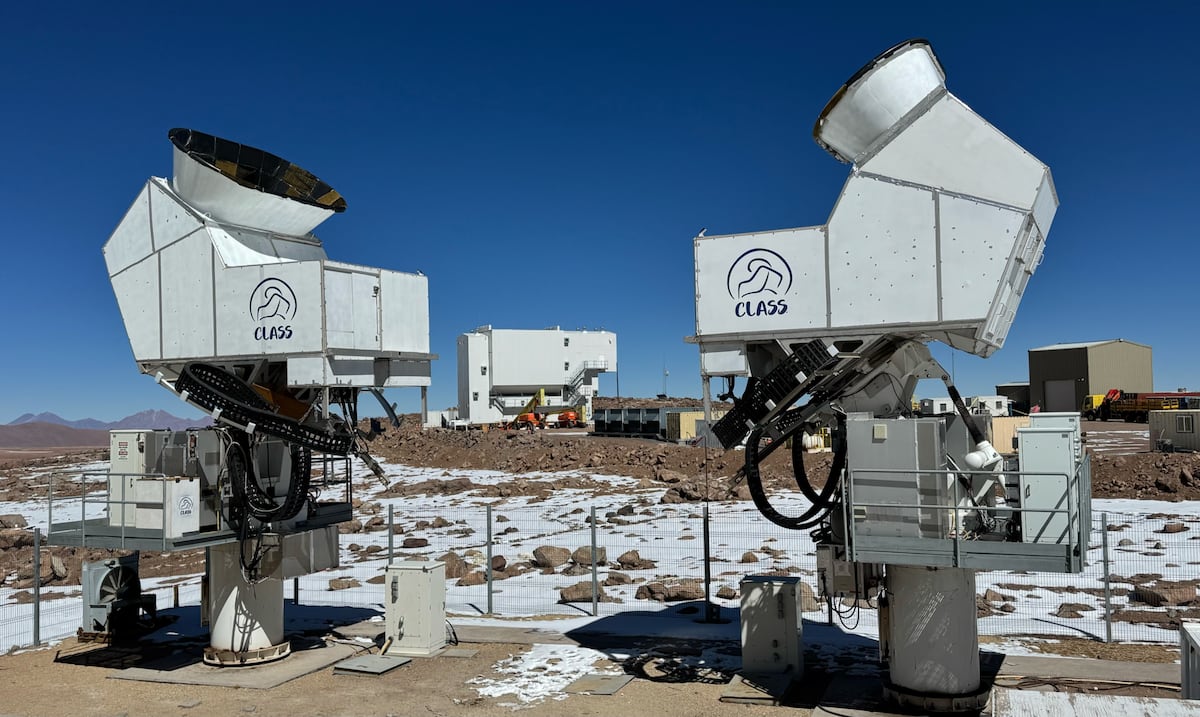
The study led by John Hopkins University (United States) and published by The Astrophisical Journal used small telescopes located in northern Chile to look back more than 13,000 million years.
To do this, the researchers managed to measure the polarized microwave light of cosmic dawn, something that “people thought it could not be done from land”, because these signs are “famously difficult to measure,” said Tobias Marriage of the John Hopkins and one of the signatories of the article.
“Terrestrial observations face additional challenges compared to spatials. Overcoming these obstacles makes this measurement a significant achievement,” he added.
Polarization occurs when light waves collide with something and then disperse, for example when they affect the hood of a car and see a glow.
Cosmic microwaves have a wavelength of just millimeters and are very weak. In addition, polarized microwave light is approximately one million times weaker.
On earth, radio waves, radars and satellites can drown their signal, while atmospheric, meteorological and temperature changes can distort it.
The class scientists (Cosmology Large Angular Scale Surveyor) of the National Foundation of the US Science Foundation used telescopes specially designed to detect the footprints left by the first stars in the light of the Big Bang.
When comparing the data with those of some space missions, the researchers identified interference and limited a common signal from polarized microwave light. Using that same signal, it can be determined how much what is observed is cosmic glow of light that bounces from the cosmic dawn.
After the Big Bang, the universe was a fog of electrons so dense that the light energy was unable to escape, but when the universe expands and cooled, the protons captured the electrons to form neutral hydrogen atoms and the microwave light was then free to travel through the intermediate space.
When the first stars formed during cosmic dawn, their intense energy started electrons from hydrogen atoms.
The team measured the probability that a photon of the Big Bang would meet one of the electrons released on its way through the ionized gas cloud and deviate from its course.
The findings will help to define better the signals from the residual glow of the Big Bang, or cosmic microwave background, and a clearer image of the primitive universe is formed.