
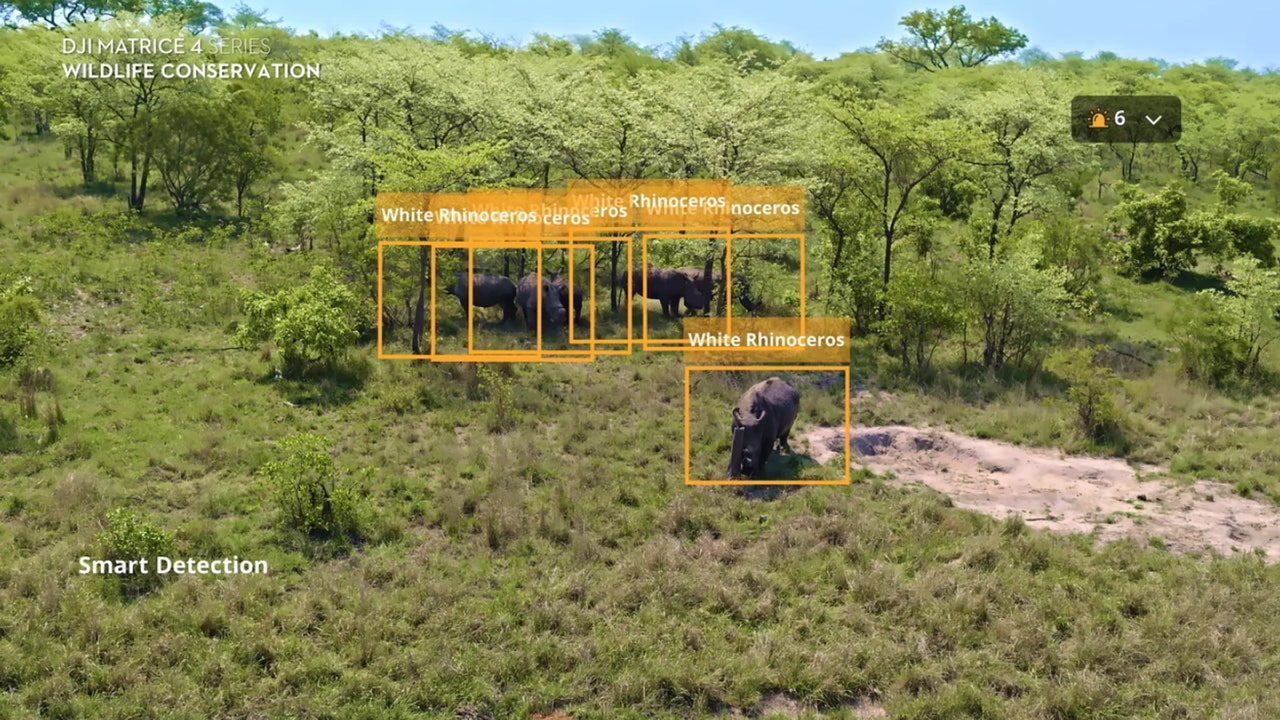
About ten years ago there were hardly six copies left, but conservation policies have been successful and partly is due to the use of new technologies. Among them the drones. The biggest problem of white rhino protection is poaching. In the Sabi Sand Natural Reserve of South Africa, have begun to use the DJI Matrice 4T drone to face this problem, among others.
Part of the Great Kruger National Park and with an extension of 65,000 hectares, the Sabi Sand Natural Reserve is a sanctuary for a diverse fauna, such as lions, leopards, elephants and the aforementioned white rhinos. It has open systems that connect it with all reserves in the area, which It allows animals to have broad freedom of movement … just like poaches.
This chases the rhinoos, mainly for their horns, which are then marketed in illegal markets. For 2015, poaching had reached critical levels, With more than 45 rhinoceros dead in a single year within the reserve.
To change this trend, the measure of flying over the reserve skies was taken using drones. This type of technology allows a better observation from the region to cover large areas much faster than land patrols.
https://www.youtube.com/watch?v=txggwhl5Sdu
To this we must add that Drones detect suspicious activity, such as vehicles or unauthorized people entering real -time reserves And, unlike helicopters, drones operate silently, minimizing the stress of wildlife.
Another advantage of using this technology is that, in this particular case, the 4T matrice has a night -scene mode, which provides a clear color visibility in the dark. The 4T matrice is also compatible with the High infrared resolution mode, which offers ultraralt precision by revealing subtle temperature details. The use of multiple sensors in a single drone platform (great angular camera, telecamara, infrared thermal chamber and laser telemeters) allows to combine several technologies to detect humans, animals and deduce characteristics that allow identifying some and others.
Finally, its ability to take off in just 10 seconds and keep in flight for almost an hourit makes it an essential tool in this type of task. So much so that the results, to date, are amazing: the reserve already has more than 600 days without poaching.