
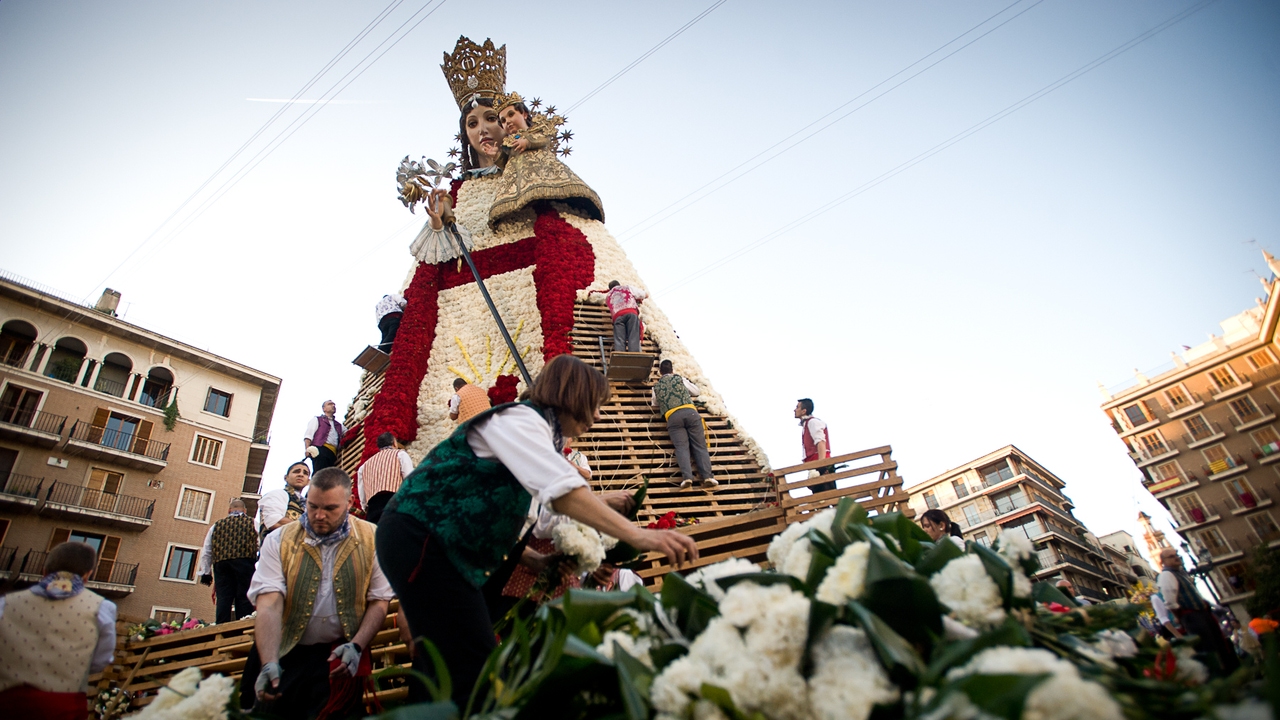
The recommendation of the València Foundation Climate I Energy in its “Guide to enjoy a sustainable party” is to use local and seasonal flowers. But, at least the first, it is difficult to get it at 100 percent. More having the figures that are handled at these parties with more than 100,000 falleras and faults, of all ages, participants only in Valencia in one of the most emotional acts of the party, the offering.
The carnations of the bouquets that with which the mantle of the Virgin is created, the closest will be from Andalusia and Murcia. Because, in Valencia, Province and Community, they barely produce carnations. Thus, more or less half, they will have arrived, above all, from Colombia.
A demanding crop
The surface dedicated to the cultivation of carnations in Spain decreases little by little, because, the characteristics of its crop make its continuity very difficult. José Luis García, representative of the Flor Sector cut in the ASOFLOR, (Andalusian Association of Viveristas and Floricultores), and owner himself of a nursery in Lebrija, Seville, explains what the cultivation of carnations is like: «They are planted in spring, gives the flower to October and the collection begins. But, it has the characteristic that it is not known how much production will be. Because, it gives many stems, of which the flowers come out, and once it is cut it will come out again with another flower, which can take days or weeks. So you have to give almost daily. Unlike other flowers, which have only one flowering ».
Reducing unknowns require some nurseries with very demanding technical requirements «with adequate facilities to control all the environmental factors that can be controlled, it is known when the flowering will be. But, in the case of the carnation, those facilities are very expensive ».
But, leaving them to the Albur of the evolution of time is risky. Clouds, little sun or low temperatures, influence that the production of flowers per plant is much slower and fall. That if there is no storm that destroys facilities and harvest.
In addition, «if the moment of much production coincides with a high consumption, well. But, if not, what do we do with flowers? They are not a product that can be stored indefinitely ».
With so many variables, scheduled plantations cannot be made by providing the dates greater demand, such as Holy Week, all saints, failures, etc. “All this is subtracting competitiveness from the local carnation,” concludes Garcia.
Faced with all this, the crop in Colombia has “a more uniform climate, without major differences between night and daytime temperatures, less labor costs and, perhaps, less rigorous environmental requirements. They are more economically competitive ».
In spite of the difficulties, wholesalers of flowers such as Victor Munera, Flores El Cala Manager, try to maintain commitments with their usual local suppliers “in our case, mostly come from Murcia.” They market around 250,000 carvings. And this year 80% is of national origin and 20% of Colombia ».
What is not foreseeable is that the flowers chosen to create the mantle of the Mare of Deu are others. Because, as Munera explains, “the carnation is a very compact flower and are the ones that best contribute to the mantle that thick appearance that is how much is finished.”