
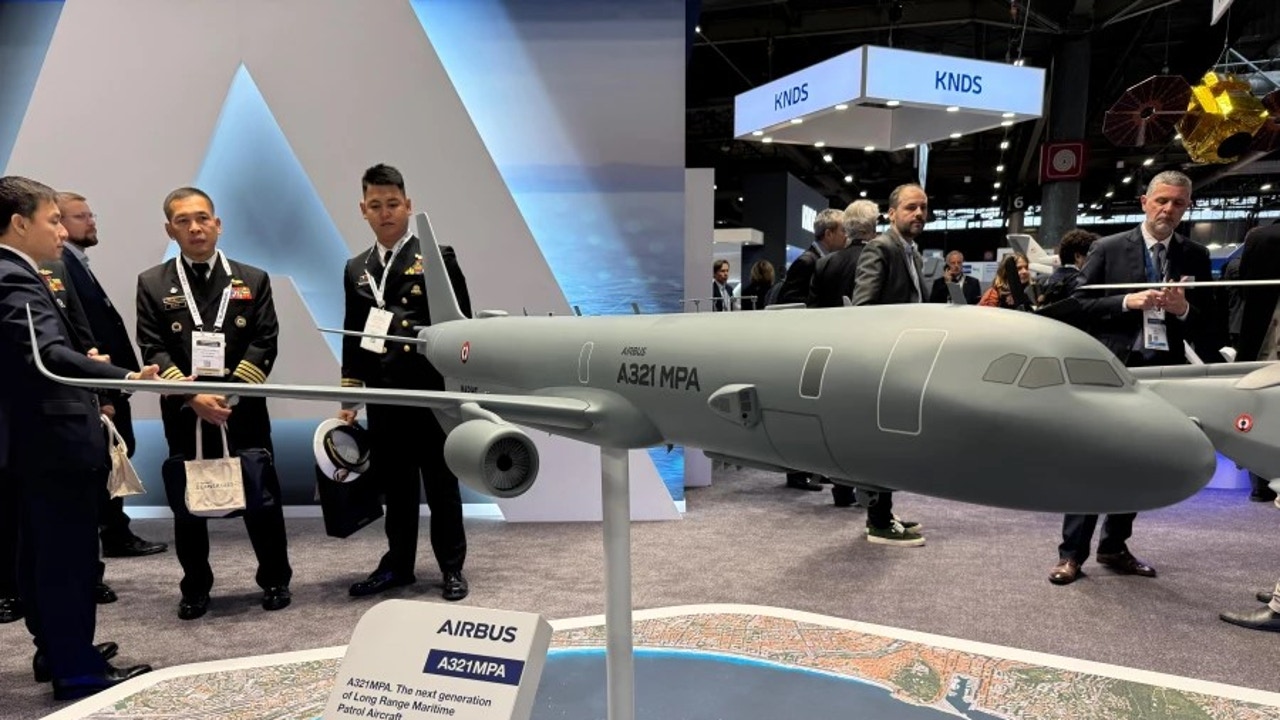
The aerospace group Airbus has taken advantage of the Euronaval sector fair, which takes place this week in Paris, to show for the first time its new concept of maritime patrol aircraft, the A321MPA, an aircraft designed to replace the veteran Atlantique 2 (now known as ATL2 ), developed in the 1960s, which still serves in the French Navy. The new development is based on the A321XLR commercial model, currently in service with the Spanish company Iberia. Its main competitor will be the P-8 Poseidon, from the American Boeing, the market leader since, in addition to the United States, it has also been acquired by Germany, Australia, Canada, South Korea, India, Norway, New Zealand and the United Kingdom. .
Its first objective will be, in any case, to replace the aforementioned ATL2 and, to do so, it will have in front of it the model based on the Falcon 10X from the French company Dassault Aviation.
The source points out that the Airbus option
The new A321XLR on which the A321MPA will be developed is a commercial aircraft with a maximum takeoff weight of 101 tons capable of covering distances of up to 8,700 kilometers. The Falcon 10X, for its part, has a maximum takeoff weight of just over 52 tons and can cover distances of 13,900 kilometers.
The future Airbus A321 MPA (Maritime Patrol Aircraft) marks a significant advance in the operational capacity of maritime patrol for the armed forces of various countries. Designed to replace the French ATL2, this aircraft incorporates technological and operational improvements that position it as a key tool in surveillance, rescue and maritime defense missions.
Main features of the Airbus A321 MPA
The Airbus A321 MPA is based on the Airbus A321neo platform, which provides it with notable advantages in terms of efficiency and advanced technology. Some of its notable features include:
- Scope and Autonomy: With a range of more than 8,000 km, the A321 MPA can perform long-duration missions without the need for refueling.
- Advanced Sensor Systems: Equipped with a synthetic aperture radar (SAR) and electronic intelligence systems (ELINT), it allows the detection and tracking of targets with great precision.
- Load Capacity: The A321 MPA can carry a variety of payloads, including torpedoes, anti-ship missiles and sonic buoys, making it extremely versatile in its missions.
- Fuel Efficiency: Thanks to new generation engines, the A321 MPA offers reduced fuel consumption, which translates into lower operating costs.
Comparison to Boeing’s P-8 Poseidon
The main competitor of the A321 MPA is the P-8 Poseidon from Boeing, widely used by the United States Navy and other armed forces around the world. Below, both models are compared in several key aspects:
Performance and range
- A321 MPA: It has a range of more than 8,000 km, allowing it to cover extensive maritime areas without resupply.
- P-8 Poseidon: Offers a range of approximately 7,500 km, slightly less than the A321 MPA, but still effective for long-range missions.
Sensor capabilities
- A321 MPA: Equipped with an advanced synthetic aperture radar, ELINT systems, and the ability to deploy sonic buoys, it provides complete coverage in surveillance and reconnaissance missions.
- P-8 Poseidon: Uses the AN/APY-10 radar, recognized for its capacity in maritime and land surveillance missions. It is also equipped with electronic warfare systems and advanced sonic buoys.
Loading and armament capacity
- A321 MPA: It will equip the new FMAN/FMAC anti-ship missile developed by France and the United Kingdom. This is a weapon developed by MBDA to replace the AM39 Exocet and Scalp EG missiles. It will also carry depth charges, mines and torpedoes for anti-submarine warfare, and will be able to launch A2SM 1000 guided bombs.
- P-8 Poseidon: Can carry torpedoes, Harpoon anti-ship missiles, and various payloads for specific missions.
Platform and Efficiency
- A321 MPA: Based on the modern A321neo platform, it offers improvements in fuel efficiency and reduced operating costs.
- P-8 Poseidon: Based on the Boeing 737 platform, it is also fuel efficient and has proven to be highly reliable in extended operations.
Falcon 10X: a potential competitor
In addition to the A321 MPA and the P-8 Poseidon, the Falcon 10X of Dassault Aviation emerges as a potential competitor, especially for the French National Navy. This long-range business jet, currently under development, could provide advanced maritime patrol capabilities with a different platform. The decision between the A321 MPA and the Falcon 10X centers on a comparison of different technical and commercial philosophies.
Implications for maritime defense
The introduction of the Airbus A321 MPA promises to significantly strengthen the maritime defense and surveillance capabilities of the armed forces that adopt it. This aircraft not only improves operational efficiency, but also offers greater flexibility and adaptability in critical missions. With the ability to conduct prolonged operations and cover vast maritime areas, the A321 MPA is positioned as an essential tool for maritime security in an increasingly complex global environment.
Future of the Airbus A321 MPA
The launch of the Airbus A321 MPA marks a new chapter in the history of maritime patrol. Its advanced design and capabilities make it suitable not only for military missions, but also for rescue operations and humanitarian missions. The versatility of the A321 MPA ensures that it can quickly adapt to the changing needs of the operational environment, providing armed forces with a robust and reliable tool.
Furthermore, the continuous evolution of maritime threats requires innovative and flexible solutions. The A321 MPA, with its advanced technology and cargo capacity, is well positioned to meet these challenges. Collaboration between Airbus and end users will be crucial to develop and adapt the aircraft to future needs, ensuring it remains a cutting-edge maritime patrol platform.