
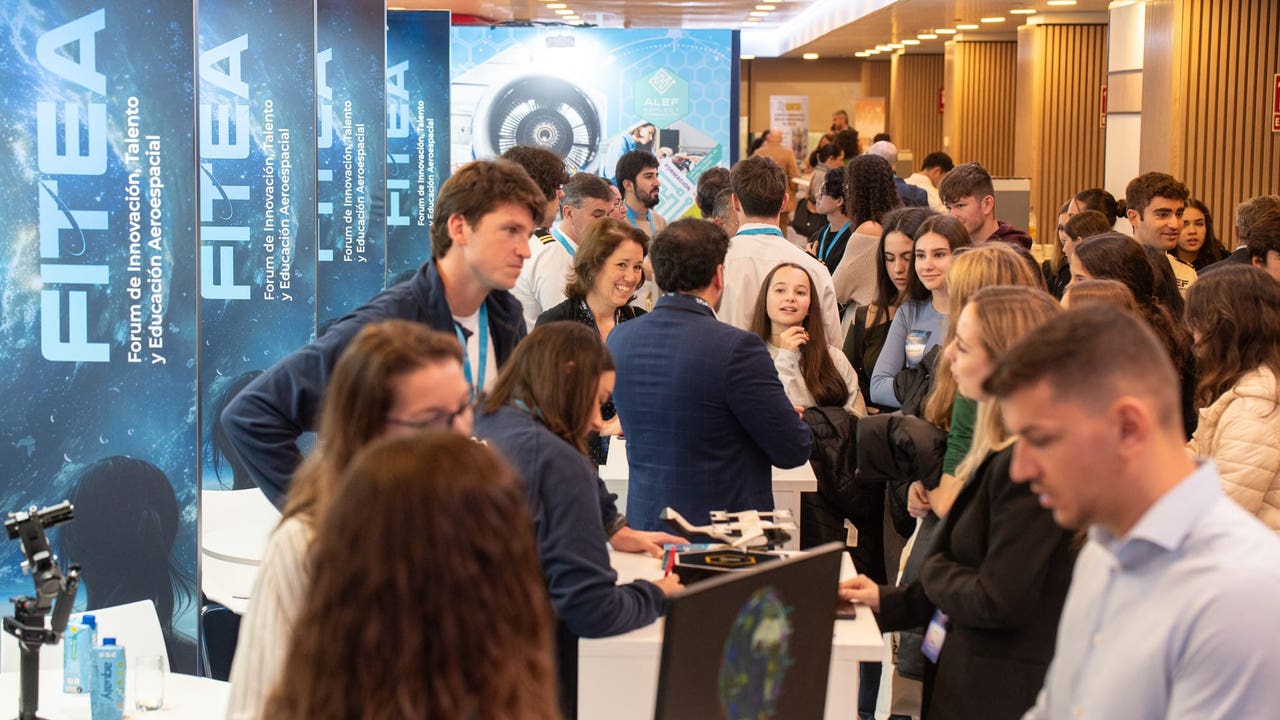
The aeronautical and aerospace sector in Spain is “on the boil”, or “in a totally expansive situation. Whether we are talking about aviation, industry, airline manufacturer, airports, air navigation, drones, etc. as if we were talking about the space world. The first thing is stated by Jorge Antón, president of Virtual Educa; the second, Isabel Maestre, vice president of Ellas Vuelan Alto. Both entities are the organizers of the Innovation, Talent and Aerospace Education Forum, Fitea, held in Madrid this week.
It is the first edition of this forum, which has two objectives: to bring together the top representatives of the aeronautical and aerospace sector in Spain to identify growth opportunities and the needs of new professionals; and that this meeting is a meeting point with students and teachers, so that they can learn about this sector and the professional possibilities it offers. And what a demand.
As an organization dedicated to “educational innovation, and the support of educational technologies in education and training, we have seen that the search for talent everywhere and, especially in the aerospace sector, is very great,” explains Jorge Antón, who adds: «the aerospace and aeronautics economy is in full evolution and needs all types of professionals. But, in general, there is a deficit of students who choose engineering. For this reason, we must begin to strengthen the base, which is the education of the young generations.
Young people in the spotlight
The event has covered such diverse approaches as to give the more than 400 secondary school students and engineering students an idea of the breadth of disciplines that can be involved in these sectors.
Thus, from “Exploring careers in the aerospace field”, to “I want to be a professional in aircraft maintenance, repair and overhaul”, including public service or sustainability in the sector, they have offered students an overview with which ” They can see this area as a possibility that is within their reach. “It’s not just about being an astronaut, but also business management, medicine or law are necessary professional profiles in aeronautics and space.”
For this reason, one of Antón’s aspirations is to “contribute to transforming the minds of our young people, so that they consider new professional challenges.”
Certainly, according to the data offered in Fitea, Spain will need 200,000 more engineers in the next 10 years. “The fourth industrial revolution is based on talent: only by incorporating new engineers, and especially female engineers, will we be able to continue climbing positions and standing out as a strategic sector for the Spanish economy,” says Jorge Antón. And another piece of information provided in the forum also stands out: The Spanish aerospace sector has earned a prominent position in the Top 5 in Europe by sales volume and number of people employed. Furthermore, with a growth of more than 24% in the last decade and a 10% investment in R&D&I, opportunities in the field of aeronautics, defense and space are multiplying.
Goal: diversity
In addition to promoting new scientific and technological vocations, Fitea also tried to contribute to this also happening among girls, who represent only 20% of engineering students and barely 10% of Vocational Training studies in technical branches. and technological.
Why this approach? Because “it has been proven that companies that have men and women more or less equally produce better, they produce more. It is profitable. And it’s not that they add up, it’s that they multiply equipment. In this sector we work permanently as a team. The design of an aircraft, its manufacturing and commissioning, operation and maintenance, everything is done as a team. It is essential that this team be nourished by that diversity,” emphasizes Isabel Maestre, who adds her experience as an aeronautical engineer, her knowledge of the sector, currently as deputy director of Prospective and Innovation of Services and Studies for aeronautical safety at SENASA.
Maestre highlights that in Fitea “they are talking about what the different jobs are like. So that young people see that studying is only 10% of working life. The rest of work. So, they are interested in knowing what the type of work is, what it does, what it is for. We wanted to make them aware of that with these workshops.
Added to this practical part is that among all the speakers of the activities there is “a variety of both senior talent and young professionals and, of course, men and women. “It is the way to transmit both the knowledge of veterans and the experience of women who can be references for students.” Together, Maestre believes, “we are managing to mobilize those vocations, those consciences and make them say ‘well, I hadn’t considered this sector, but I’m liking it’, or I had considered it but I didn’t know how to get there.'”