
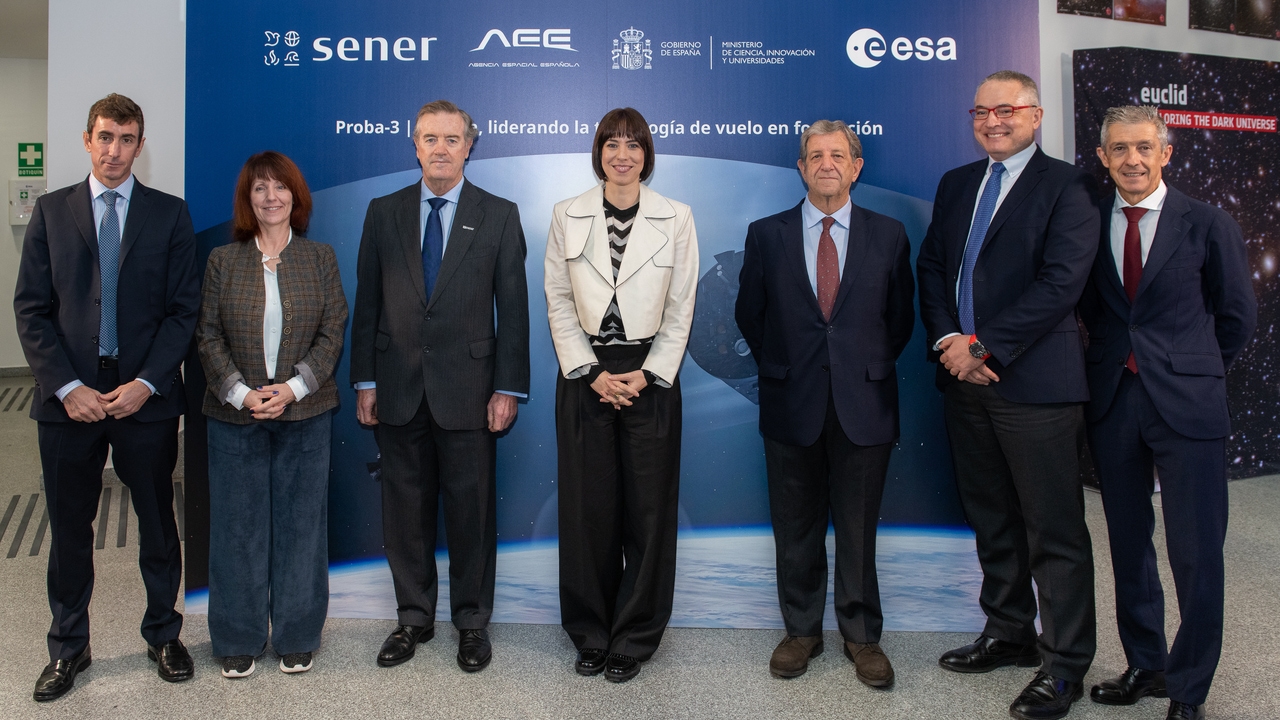
The Proba-3 mission of the European Space Agency (ESA) is ready for its next launch from India, as was announced today at an event at the facilities of the European Space Astronomy Center (ESAC), in Villanueva de la Cañada (Madrid). The event served as a presentation of the mission in Spain, a country led by Proba-3 through the engineering and technology industrial group Sener. in close collaboration with a consortium of 40 companies from 16 countries. The event was attended by Diana Morant, Minister of Science, Innovation and Universities; Juan Carlos Cortés, director of the PREPA; and Carole Mundell, ESA Science Director and ESAC Director; and Luis Manuel Partida, mayor of Villanueva de la Cañadaamong other authorities.
During his speech, Morant highlighted: “Proba-3 is a triple milestone. It is a technological advance, and also an advance for Sener and for our companies. But, furthermore, it is a milestone for our country. It is an achievement on the path towards a more prosperous country model and therefore more fair and egalitarian. Likewise, it is a demonstration of our country’s capacity to involve more generations in the challenge of achieving a better Spain. We have companies capable of involving our talent in this challenge, creating space and opportunities in new areas of action. The success of Proba-3 is the success of Spain.”
In the case of the ESA, Mundell stressed that “Spain is a key player in the aerospace industry and has made significant economic and political efforts to achieve this status. Today, Spain is highly competitive in the design, development and manufacturing of technology, with the consequent positive effect on employment, direct and indirect.” “The country and its industry are today indispensable agents in space exploration.”
For her part, Noelia Peinado, coordinator of the GSTP program at ESA TEC, said: “Proba-3 has great scientific value, which we will be able to access thanks to the development of a technology capable of guaranteeing thousandths of a degree of precision, autonomously and at a great distance from Earth”. Anik de Groof, Solar Orbiter Mission Manager at ESA, highlighted: “the solar corona is a region of great scientific value, an area that reaches millions of degrees Celsius and has effects that directly affect us, in areas such as communications. “Proba-3 will guarantee up to 1,000 hours of eclipses, which will allow us to study the interesting solar corona in unprecedented detail.”
Likewise, Pulido stressed “the satisfaction that this moment represents for all those involved in Proba-3, whose approval dates back to the ESA Ministerial Council of 2012. Today, Spain is capable of leading space missions of great technological and scientific value. It has been a path, of course, with challenges, but public support has been decisive in achieving it; support that will be reinforced in the Ministerial Council of 2025. Currently, Spain invests 300 million through the ESA.”
Diego Rodríguez, director of Space and Science at Sener, emphasized “the challenges that the mission must overcome. Two satellites, 150 meters away, will maintain millimeter precision at a speed of kilometers per second, and will be aligned autonomously. This milestone requires great effort in many areas, from mission analysis to guidance, navigation and control algorithms. Spain has played a fundamental role in the design, integration and testing of these systems. This mission has been led by Sener, but we could not have reached this point without the support of the participating industry and, most especially, the central team, made up of top-level Spanish companies.”
Finally, at the table dedicated to the industry, Diego Rodríguez, director of Space and Science at Sener, participated; Francisco Javier Benito, Proba-3 Project Manager at Airbus Defense and Space; Mariella Graziano, Director of Space Business Development at GMV; and Ignacio Tourné, director of business development at Deimos.
The success of the mission will require the perfect synchronization between two satellites, the Coronagraph and the Occulter, which will fly in an elliptical orbit, moving just over 60,000 km from the Earth (approximately 10 times the distance from the surface to the Earth’s core). Another technical challenge posed by the mission is the autonomy of the satellites: each one will act independently, calculating its position and trajectory with respect to its counterpart, without the support of a human operator; To do this, it will use advanced guidance, navigation and control (GNC) systems, a branch of engineering that deals with the design of systems to control the movement of vehicles, both manned and autonomous.
The Coronagraph will house the mission’s coronagraph, an instrument that will point directly at the Sun. The second satellite Occulter, will eclipse the Sun, placing itself between the star and the Coronagraph. To do this, it will use a disk of about 140 centimeters in diameter and various equipment (optical and laser) that will allow it to calculate the relative position and attitude between the two satellites and position both with extreme precision.
The perfect synchronization between both satellites will create an artificial eclipse in a way never before achieved: the coronagraph in space will be able to obtain images of the Sun that will not be affected by disturbances in the Earth’s atmosphere.while the Occulter satellite, hundreds of meters from the focal point of the optical instrument, will significantly reduce diffraction effects.
Formation flight allows satellites to act as a single optical instrument, composing a virtual structure in space with high reconfiguration capabilities. Proba-3 will demonstrate that future missions could be developed on a larger scale and at a lower cost using multiple small modules that behave in flight like a single large satellite.
Sener is the main contractor for the mission and responsible for both the flight and ground segments, and the participation of the Spanish industry is completed by Airbus Defense and Space.which has carried out the design and manufacturing of the two platforms; by GMV for the development of the formation flight subsystem, flight dynamics and the relative GPS function; and by Deimos, responsible for orbit analysis and development of the rendezvous experiment.
Proba-3 is part of ESA’s General Support Technology Programand Spain’s participation has been possible thanks to the support of the Center for Technological and Industrial Development, as well as close collaboration between companies at an international level.
This ESA space mission It aims to carry out a formation flight between two space platforms, demonstrating the feasibility of essential technologies for, for example, the development of large telescopes with separate components.
This innovative strategy will allow the relative position and distance between critical elements, such as lenses and detectors, to be maintained with accuracy and stability, which could change the way space observation instruments are built, promoting simpler and more economical structures.
This mission has the potential to revolutionize observation and data analysis techniques from space, opening new opportunities for scientific research.
Spain is the main contributor to this mission, contributing close to 40% of the budget. Specifically, Proba-3 represents an estimated financing of around 50 million euros for the Spanish industry. The total cost of the mission is 200 million euros.
The Ministry of Science, Innovation and Universities (MICIU), through the Center for Technological Development and Innovation (CDTI), enabled the financing of Spanish industrial participation in this project, through the General Support Technology Program (General Support Technology Programme, GSTP) of ESA. This allowed the company Sener to lead and develop a technological demonstration project in which other Spanish companies such as Airbus Defense and Space in Spain, GMV Space and Defense and Deimos also participated.
Spanish companies perform some of the most relevant functions of the mission and with greater technological interest, such as leading the global design, developing navigation algorithms, or designing a complete satellite.
Currently, the Spanish Space Agency (AEE) assumes all the powers of the CDTI in space and continues to support the Spanish industry for the development of this and other initiatives.
When is the mission going to launch?
The mission is scheduled to launch at the end of 2024.
Where will the launch take place?
Indian Space Research Organization’s Satish Dhawan Space Center in Sriharikota.