
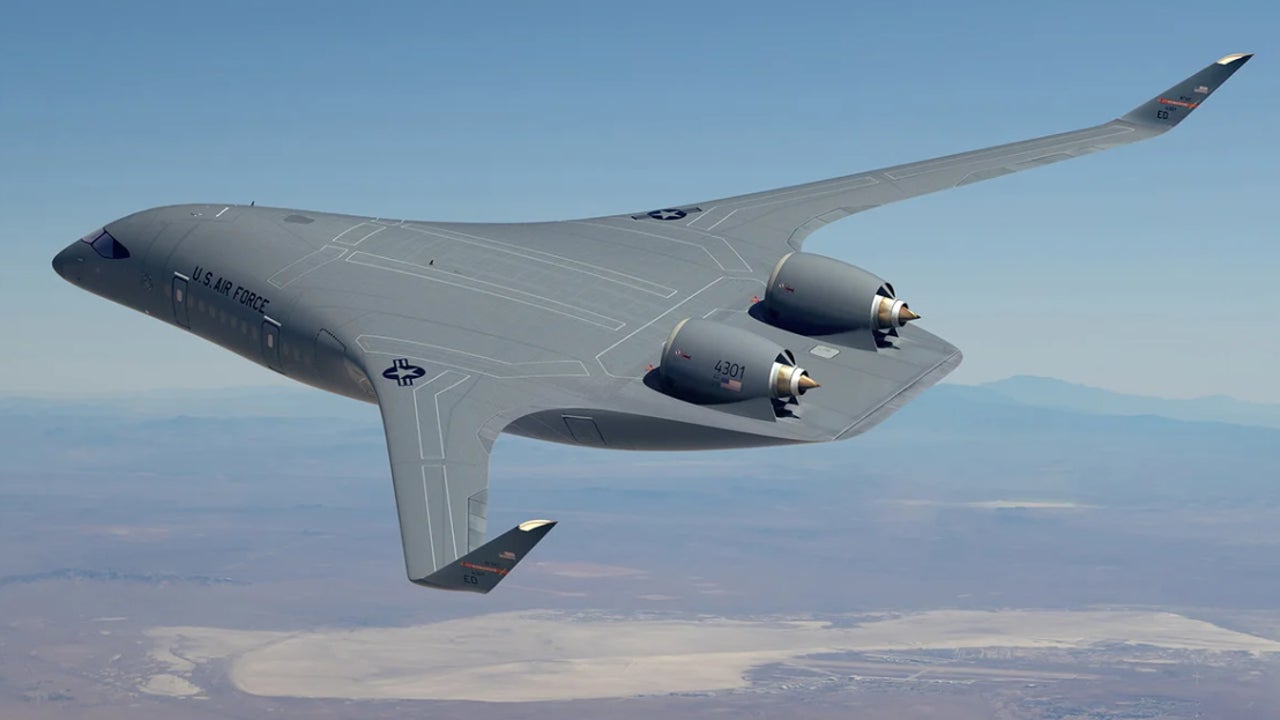
The future of commercial airplanes is conditioned by three variables: speed, emissions and their capacity to transport more or fewer passengers. If we add to that a differentiating design, we have a complete package with the JetZero, an aircraft that would make its first flights in 2027.
In the first instance, what is most striking about this, for now, prototype is its design, one that borrows from the “combined wings” appearance of stealth bombers and that has attracted the interest of airlines on both sides of the Atlantic: Alaska Airlines, for example, has invested in them and there is talk of EasyJet participation. And they are not the only ones.
The US Air Force awarded them a $235 million contract to design a prototype that could be used for configurations of cargo, air refueling or military transportmissions that comprise 60% of the Air Force’s total annual aircraft fuel consumption. Because? The key is that the fuel that this aircraft would use is hydrogen and its emissions would be zero, hence part of its name.
Taking into account the layout, passengers will be seated in a more spacious than usual arrangement, more like a theater, with 12 to 16 rows, which has the added benefit of faster disembarkation and turnaround times and individual overhead compartments.
Similarly, the absence of side panels on the fuselage makes it difficult to fit the familiar windows. With this in mind they have created an electronic display of external views from wingtip cameras and other perspectives. A complete digital scenography.
The two companies that produce most of the world’s commercial airplanes (Europe’s Airbus and Boeing in the U.S.) have experimented with blended wings. Airbus unveiled a prototype called Maveric four years ago. But JetZero believes it can advance faster than these two heavyweights of the industry.
JetZero’s design combines wings and fuselage in a manner similar to the US Air Force’s B-2 bomber. This design, according to the company, will allow its aircraft use 50% less fuel than a comparable conventional designbut with existing engine technology. It should also produce 50% fewer emissions.
Its ability to planned passengers (200 to 250 passengers) would address the size gap between single-aisle aircraft, such as Boeing’s 737 and Airbus A320 families, and the larger twin-aisle models from both manufacturers.
Considering that Airbus and Boeing are delivering new and more efficient aircraft slower than expectedJetZero’s schedule (a plane available before the end of the decade) is more than tempting for many airlines.
What is still unknown is how JetZero will be able to interact at conventional airports taking into account its size.