

The loggerhead turtle is common on the Spanish Mediterranean coasts. Neither sightings such as fishing, accidental or voluntary, are new. What is new is that reproductive females of this highly migratory species come out of the sea on a beach on the peninsula or the Balearic Islands, look for a suitable place, make a nest, lay their eggs and about 40 days later a bunch of them come out. of little turtles. Because they are philiopatric, that is, they go to the place where they are born to reproduce.
Until these last few years. Starting in 2001, some began to come sporadically to nest and since 2014 they have become more than frequent. So much so that in ten years 70 nesting attempts have been detected – last year there were 29 and this year 13 – plus those that have not been known, because turtles nest at night.
Everything indicates that it is the increase in sea temperature in the until now traditional places where the loggerhead turtle reproduced, Greece, Italy, Cyprus and Turkey, which leads them to explore new places. In addition to being highly migrant, it is now also a climate migrant.
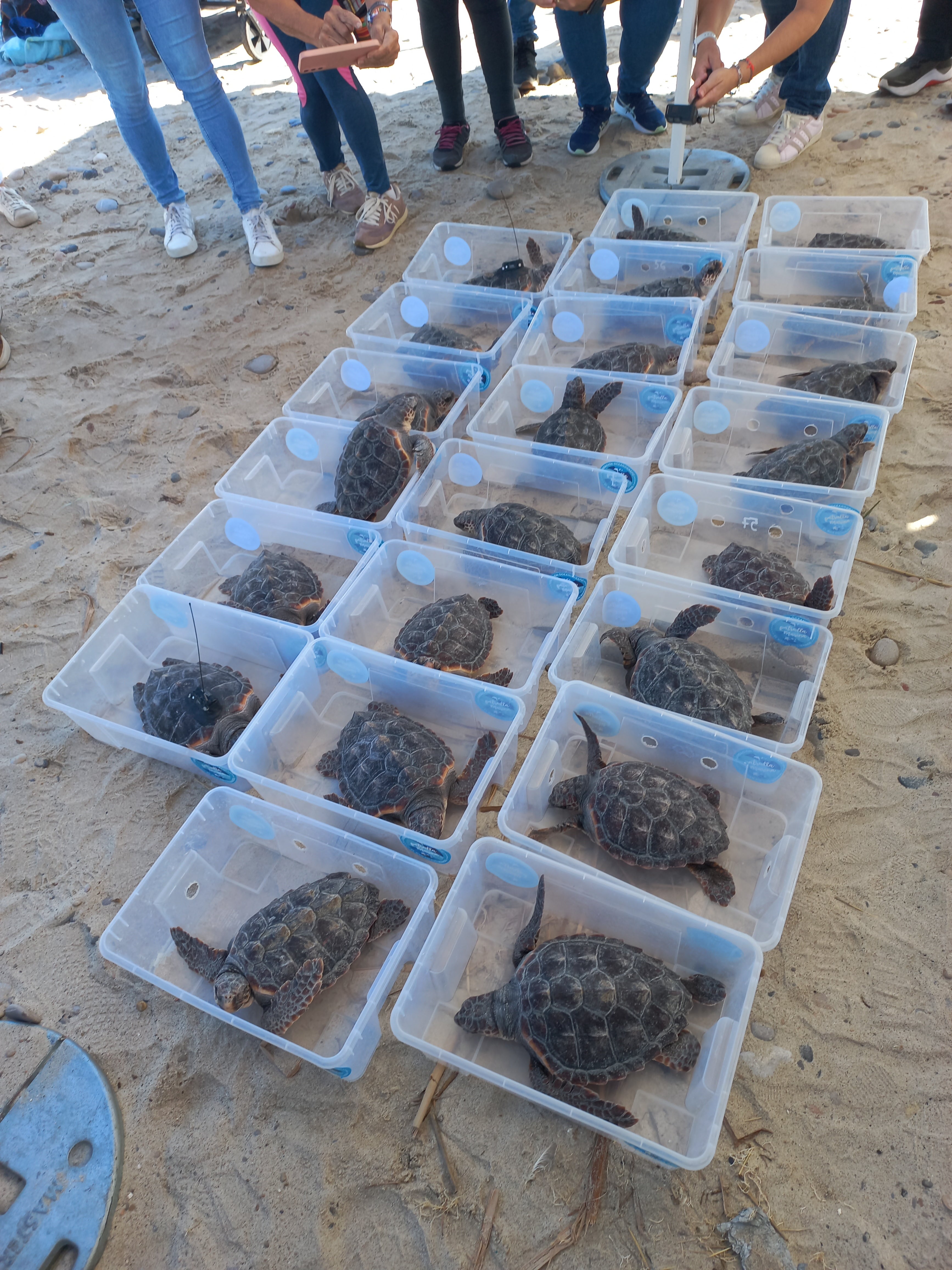
From one of last year’s nests came the 22 turtles that have returned to the Almassora beach, Castellón, where they were born, to go to the sea for the first time. Attracted by the lights of the promenade that gained the clarity of the sea, where they normally go, they had gone in the opposite direction and were rescued by experts and the neighbors themselves. Weighing no more than 20 grams and four centimeters of shell, they are very vulnerable and have a lot of predators: fish, crabs, seabirds, carnivores, etc.
His rescue was not accidental. On the contrary: it is one of the actions provided for in the Strategy for the conservation of the loggerhead sea turtle, Caretta caretta, and other species of sea turtles, and the Protocol for attention to nesting events. Both prepared within the Life Intemares project, coordinated by the Biodiversity Foundation.
The aim is to ensure the survival of the species, which is classified as vulnerable in the Spanish Catalog of Endangered Species and considered of community interest at the European level. Furthermore, sea turtles are indicators of the good environmental state of the marine environment. So, it is essential to do everything possible to keep them going.
Captive breeding and marking
This rescue was coordinated by Jesús Tomás, from the Department of Zoology of the University of Valencia. “There is a lot of natural mortality, the estimate is that one in every 500 survives.” Tomás also locates nests, evaluates their condition and participates in the decision about which ones will be left to continue their natural process and which ones will extract a quarter of the 100 eggs that, on average, these turtles usually lay. Those extracted are taken to the Oceanogràfic Foundation, and incubated there until the offspring are born. Tomás is seeing for himself how the loggerhead sea turtles have gone from “being here, feeding and not laying eggs, except in some particularly warm year. But now every year is especially warm. “What was an interannual variation in temperatures is the increasing trend.”
In the Sea Ark of the Oceanogràfic Foundation, the turtles “with adequate food, health, conditions and water temperatures, thrive. In the wild, they would take a long time to reach a size and weight to have fewer predators. They will reach maturity at 20 or 30 years old, and that will be when, perhaps, the females will return here,” explains José Luis Crespo, head of the Conservation area of the Oceanogràfic Foundation, where the captive breeding program for hatchlings is carried out. another of the project’s actions.
When they return to the natural environment, they all carry a chip, to recognize them if they are captured, and two of them – the only female and one of the males – have a satellite transmitter specifically developed at the Polytechnic University of Valencia, glued to their shell. Eduardo Belda, researcher at that
university, points out that “these animals have a very high mobility, which makes it very difficult to have information about where they feed, where they migrate, etc. With this equipment we will be able to know things that we did not know before, such as where there are more threats or greater fishing effort, when there may be problems, etc. All of this will serve, among other things, so that administrations can implement preventive measures for conservation based on the best knowledge.
Scientific knowledge, as seen, is essential to establish conservation and prevention measures. That is why some of the actions are directed at conservation and others at improving knowledge of the species. Collaboration and coordination between state, regional and local administrations, universities, foundations and all collaborating partners of the project is also crucial. It is the proper functioning of the mechanism formed by all these entities that is making it possible for the actions planned now, and those in the future, to be successful.
The evolution of a species before your eyes
The enthusiasm with which scientists committed to ensuring the conservation of the loggerhead sea turtle do their work, and tell it, includes the awareness that they are part of a chain of generation of scientific knowledge. José Luis Crespo is clear about it: «The turtles that we release now may return to nest here in 20 years. We may already be retired and we don’t see them. But everything we are doing will be picked up by others, it will serve them and they will continue it. Science is like that.”
In science, adds Jesús Tomás, you are always laying foundations, collecting data so that questions can be answered in the future. That’s why we have to do it as best as possible.” In return, Tomás highlights, “we are witnessing the process of adaptation of a species to climate change. It is evolution in action.
Civil society.
Civil society also has an important role in loggerhead turtle conservation. Fishing is one of the threats to sea turtles, for example accidentally caught in nets. Therefore, fishermen can be “essential collaborators to develop science and knowledge for the conservation of the species. They notify us when a specimen is caught in the nets, so we can take it to the Oceanogràfic and recover it so it can return to its natural environment. We also work a lot with them and they give us very relevant information for conservation,” says Crespo.
The Valencian Community is where the most nesting events are taking place. This past summer alone there have been eight. The rescue of the turtles released in Almassora was possible because previously, when they were born, someone realized what was happening, gave it the importance it had and acted correctly: they notified 112 and thus the operation was launched. It is possible that the experts came and, helped by the neighbors themselves, recovered many of those absent-minded turtles.
Therefore, citizen awareness is also essential. And among the project’s actions, training and awareness activities are carried out for different groups: fishermen, schoolchildren, local police and other security forces, lifeguards and other professionals who work on the beaches, etc. The fact is that everyone internalizes what to do when faced with a large and strange footprint, like a truck wheel, perpendicular to the water line, because it could very well be the footsteps of a turtle that has come out of the sea to lay its eggs and there. Nearby there may be a nest that can be destroyed simply by sticking an umbrella into the beach. In general, if you locate a nest, a trail or a sea turtle, you should call 112.
The lives of loggerhead turtles
They are migrant species, they move from one side of the Mediterranean to the other with enormous speed, but when they are small they migrate passively. That is, they go where the ocean currents take them and eat everything that floats, even plastics. Adults dive deeper, up to and
From the moment they reach maturity, at 20 or 30 years old, reproductive females lay eggs every two or three years. It is a philopatric species: it returns to the beach where it was born to reproduce, at the beginning of summer. They orient themselves by magnetic fields to go to the area, and they locate specific beaches by the olfactory and visual imprints they receive when leaving the nest.
Each turtle lays an average of 100/150 eggs, similar in size to a ping pong ball, and they remain in the nest alone during incubation, which lasts about 80 days.
The sex of turtles is determined by the temperature of the nest during incubation. This occurs in the second third of this period. If the temperature is lower, it lengthens and male turtles will emerge; If it is warmer, it will be shorter and females will emerge.
Mostly males are being born on Spanish beaches, while many more females are being produced on those of Cyprus.
satellite marking
A female and one of the males released on Almassora beach have satellite tracking devices attached to their respective shells. These teams, developed by the Polytechnic University of Valencia, adapt to the new satellite constellations. They have built-in solar panels, a battery and a battery that allows up to 4,000 recharges, which means a duration of 10 years. During all this time they may be emitting signals that will provide information about the animal’s movements.