
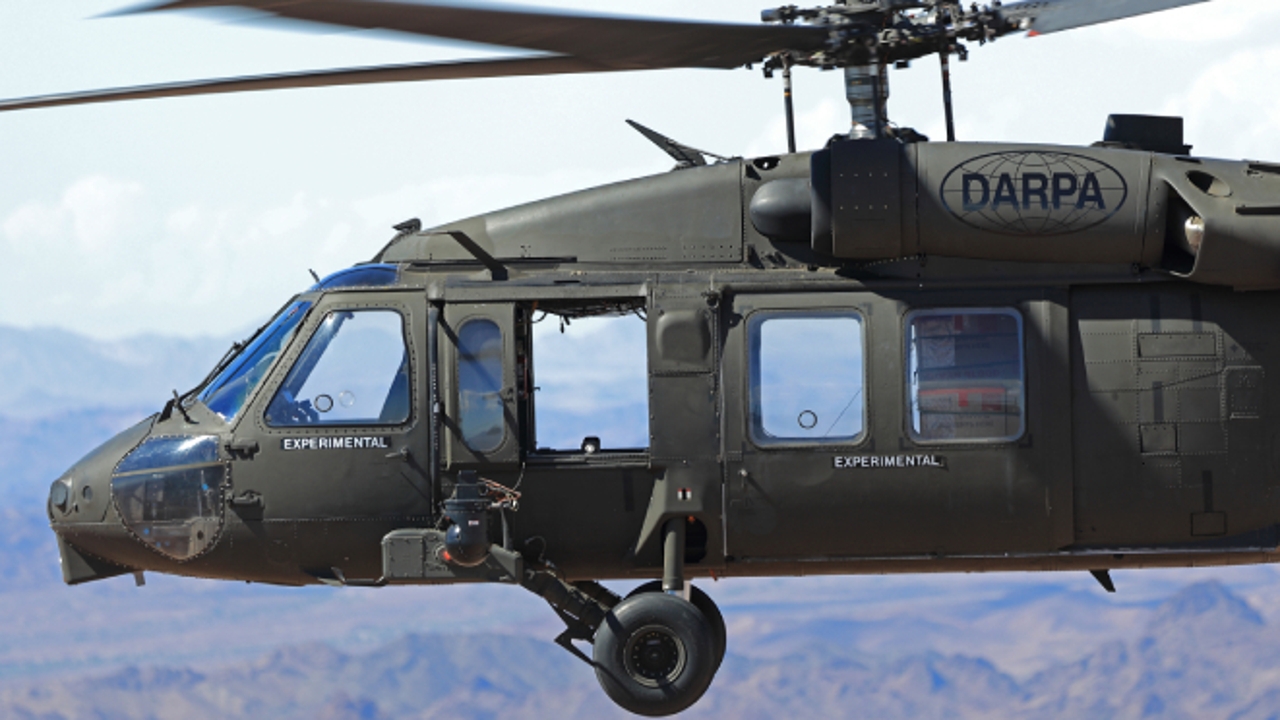
He Sikorsky UH-60 Black Hawk It is a medium-load, twin-engine, four-blade rotor military multipurpose helicopter, manufactured by the American company Sikorsky Aircraftsubsidiary of Lockheed Martinand medium size. It was introduced in 1978 and more than 5,000 units since then, which are used by the United States Army and from countries like Mexico, Türkiye either Brazilamong others. In its nearly half a century in service, it has had numerous variants that have improved it, but none has represented as radical a change as the one the manufacturer is now developing. A ‘robotic brain’, which will allow the helicopter to operate autonomously and without pilotsis being incorporated into an experimental helicopter UH-60M of the US Army
Sikorsky Aircraft has obtained a contract from the Defense Advanced Research Projects Agency (DARPA) of 6 million dollars to install the flight autonomy system ALIAS/MATRIX on the US Army’s experimental Black Hawk helicopter designated MXthe upgraded aircraft will allow the US Army Combat Capabilities Development Command (DEVCOM) test and evaluate a wide range of autonomous capabilities, from single-pilot operation to fully unmanned flights.
‘Autonomy-enabled aircraft will reduce pilot workload, dramatically improve flight safety, and give battle commanders the flexibility to conduct complex missions in contested and congested battle spaces, day or night, in any weather conditions‘, he explained Rich Bentonvice president and general manager of Sikorsky. ‘Soldiers will depend on Black Hawk helicopters until the 2070sand modernizing the aircraft today will pay off for decades for current and future Army aviation.’
The MATRIX autonomy system forms the core of DARPA’s ALIAS (Crew Cockpit Automation System) program. In 2020, as part of ALIAS, Sikorsky provided the hardware and engineering support to add electric flight controls to the MX aircraft. When combined with the MATRIX autonomy system, the MX aircraft will be an almost exact copy of the helicopter UH-60A Optionally Manned Black Hawk from Sikorsky, the company’s flight laboratory that has tested MATRIX autonomy during hundreds of hours of flight.
Sikorsky will integrate the MATRIX system into the MX helicopter in 2025. The aircraft will allow DEVCOM explore and develop practical applications of a scalable autonomy system and its possible operational concepts. The evaluation will include assessment of different sensor suites to detect and avoid threats, obstacles and terrain, and the development of system standards and specifications that will be integrated with the MATRIX system and the flight control system with electrical controls.
In July 2024, Sikorsky and DARPA demonstrated to US military personnel and senior Department of Defense officials how the Optionally Manned Black Hawk helicopter can Fly and be easily controlled by an operator in the cockpit or on the ground by entering high-level mission objectives via a tablet.
These recent demonstrations were based on the autonomous flights of the Convergence 2022 Projectwhen Sikorsky and DARPA successfully tested how the Optionally Manned Black Hawk helicopter, operating without humans on board, can safely and reliably perform internal and external cargo resupply missions.
Autonomous capabilities like MATRIX technology are a key part of Lockheed Martin’s 21st Century Security vision, which includes modernizing the Black Hawk helicopter to stay ahead of new threats. In addition to autonomy, the US Army’s Black Hawk helicopters could be equipped with next-generation engines from 2025.