
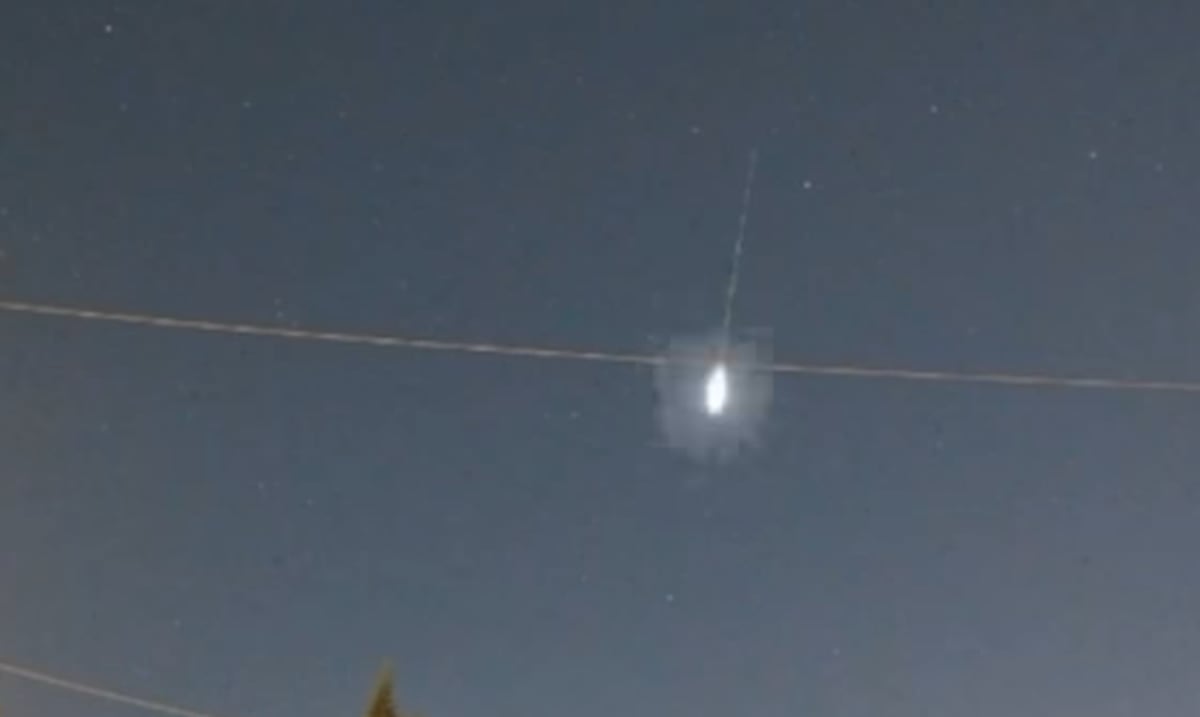
At the end of September and mid-October, some Puerto Ricans sighted the passage of the comet identified as C/2023 A3 (Tsuchinshan-ATLAS). Multiple images flooded social networks in the wake of the celestial visitor who adorned the sky for several days. On this occasion, another opportunity is presented for space fans, since, during the night of this Sunday, a light meteor shower will be visible in Puerto Rico.
The Caribbean Astronomy Society (SAC) explained that these are particles released by Halley’s Comet, whose last sighting was recorded in 1986. According to the entity, the spectacle will be visible due to the passage of the Earth along the path previously taken by the famous comet.
“On that path, the comet released numerous particles not far from the area where we see the stars known to many as ‘the three wise men.’ Late these nights our planet is pointing or looking towards the part of the sky where the constellation of Orion is located, and that is when, upon intercepting them, we see these fragments entering our atmosphere at high speed, in what we call the Orionid meteor shower.” explained the SAC in a publication on its social networks.
Although the Moon will be illuminating the sky and will cause some difficulty in seeing the celestial spectacle, the organization assured that Some meteors will be visible starting at 11:00 pm, when the constellation Orion is visible in the east.
“You do not have to look towards a specific area of the sky to see them, since the Moon will be present, we recommend avoiding looking at it or even looking up or other areas of the sky distant from where we see the Moon. This will increase the possibility that we will be able to see some”said the SAC.
The educational entity explained that, because Halley’s Comet orbits in the opposite direction to that of the Earth in its journey around the Sun, the debris released by the comet also moves in the opposite direction to that of our planet. This causes the meteors to be extremely fast, reaching speeds of up to 148,000 miles per hour.
The enormous speed also causes some of these meteors to leave brief green trails of ionized gas, or even a persistent line of smoke, as occurred with one captured by the SAC in the early hours of this Sunday, which left a remaining line of smoke that remained visible for about three minutes.
(You may be interested in: A cave in southern Puerto Rico collects a celestial story about the passage of Halley’s Comet in 1910)
The SAC always recommends observing comfortably from a reclining chair or even from the ground because the meteors could move through different parts of the sky.
Why is she called Halley and when will she be visible again?
According to the National Aeronautics and Space Administration (NASA, for its acronym in English), until the time of the English astronomer Edmond Halley (1656-1742), it was thought that these celestial bodies only passed through our solar system once.
However, in 1705, the astronomer found similarities in the orbits of three comets that were visible in the years 1531, 1607, and 1682. At that time, Halley suggested that the trio was actually a single comet that made periodic journeys and predicted , correctly, that he would return in 1758.
According to NASA, The first “periodic” comet in history was named in its honor and, since that time, the celestial body has been linked to ancient observations dating back more than 2,000 years.
“In each orbit around the Sun, a comet the size of Halley loses between three to 10 feet of material from the surface of its nucleus. Thus, as the comet ages, its appearance darkens and it may lose all the ice in its nucleus. The tails disappear at that stage, and it eventually becomes a dark mass of rocky material or perhaps dissipates into dust,” the federal entity reports.
Its next visit near Earth will be in the summer of 2061.