
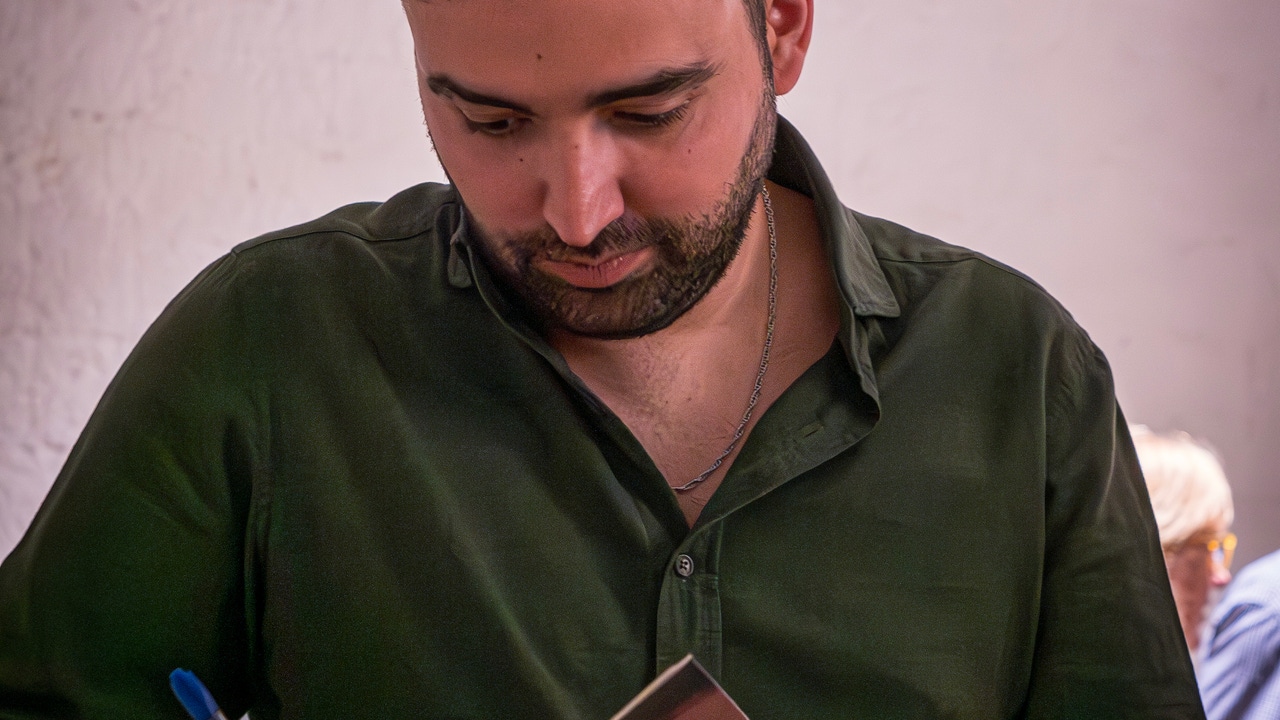
I called him by mistake a week before. I ask him about a laboratory issue. Logically he doesn’t know anything. It’s Pol Turró. He has just published “Escape from the Darkness” (Editorial Alt Autores). A book that reads itself. Agile, fast, raw, sincere. Hook up. In it Pol opens up and explains without frills what it is like to be bipolar. But, What does a person with this disorder feel?
“Depends, at what time?”ask. That’s the key. This chronic disorder is manifested by alternating moments of depressive and manic episodes. It’s like having euphoria and energy on one side and sadness and inhibition on the other. Furthermore, the seesaw is not in the middle for long, in balance.
In Pol’s case, the manic episodes weigh more. It’s agile, fast. Everything is going well, too well, until things go haywire. «The manic phase before it gets out of hand is like cocaine in a vein without having to take it and for free. “I have fucked like no one else and I have also taken great risks,” recalls the author.
And in the case of psychotic episodes “is fucking crazy.Living for months doubting everything, whether your mother is your mother, If planet Earth is your planet…”
«Your mind – Pol continues – constantly deceives you. You can discover a friend deceiving you, but it is very difficult to discern that your mind is deceiving you. On some occasions I have been able to realize, once or twice, out of ten years of illness. When you are psychotic it is very difficult to achieve it, everything you see is real, in my case I have, above all, auditory hallucinations. “I have been able to have 12-15 psychotic episodes” and “15 admissions”esteem.
But let’s go back further, to when he was diagnosed. «It was in 2014. A year after opening at just 20 years old, with my partner, Telemaki»one of the first Japanese food delivery companies in the country, which had five restaurants and a staff of 80 people.
And it was “at the height of my life and in a way and manner that I do not remember kindly. A doctor in his 50s, polite but cold, who told me “you are bipolar” and shut up. Then he told me he will be able to do so and he won’t be able to do so, so, so. All he had to do was tell her that sex was in moderation, as Pol says in the book.
«I was amazed by how they told me and because I didn’t know what it was. Now it is talked about more, but ten years ago it was taboo. “I didn’t know what it was like to be bipolar, and on top of that they told me not in a bad way but in a cold way without taking into account that it is a chronic illness that marks your life.”
That is why for Pol “I would have to say first a psychologist, not a psychiatrist. These professionals are undervaluedin front of psychiatrists. And psychologists have saved my life. To speak, to communicate what I had inside that I didn’t count…».
Previously, he lived his days to the fullest. “I didn’t sleep even four hours.” His parents, concerned, took him to visit a psychiatrist, who, without him knowing it, recommended his admission. It was March 2014. «My parents took me to the psychiatric hospital the first time without telling me (they told him they were taking him to another consultation for a second opinion). Then I was the one who asked to enter“, remember.
«You enter deceived, confused and there is nothing to do. They don’t offer you anything. In private psychiatric hospitals there are groups, workshops. In public, no. And in my case what I did was flirt,” he recalls. And apparently he’s not bad at it.
“In private psychiatric hospitals there are groups, workshops. In public ones, no. And what I did was flirt”
That’s when he received the diagnosis. But it’s one thing for them to tell you and another assume it. “It took me years. First because the answer they offer you is only medication. In a public hospital there are usually no psychologists. They give you a mood stabilizer, an antipsychotic…, but what about everything else? You take pills and you see that the results are not what you expected because you are young, perhaps you continue using drugs and going out to party and that kills you.
His addiction was cannabis. “Most people tend to think that bipolar disorder is latent and in my case it was uncovered by cannabis and not sleeping,” he says.
His introduction to drugs was relatively late: at 17 years old. «Drugs are death for people with mental illnesses. “It enhances them,” he says, yet he is in favor of the legalization of cannabis.
What is clear to him is that anti-drug campaigns do not work: “They should be more emotional or very spectacular. But these half-measures like ‘say no to drugs’ don’t work.”
“We must reformulate current anti-drug campaigns. Half measures are not enough”
In his case, Pol stopped “using cannabis after my first suicide attempt, but I have had some relapses that are part of the process, three or four, two or three years ago.”
It was July 21, 2017, a few days left until Pol would be discharged from the Psychiatric Hospital in Sant Boi. But as he acknowledges in the book, “I was as bad or even worse than when I entered,” and even so that day he was on leave. «I had met a friend and without telling him I went to the beach and started swimming, four hours, seven hours…». He got scared and didn’t accomplish his goal, that’s when he decided he was going to commit suicide. I would jump off a bridge. He thought about it and did it.
Result: they had to induce a coma. He had a double head injury.. “If he is very serious, at least he is alive,” says his mother in a chapter of the book after receiving the call from the Mossos. A very hard testimony of that day that Pol admits he has not yet been able to read.
He remembers, yes, all the previous moments. «I was living a movie, I didn’t feel shit. I swam at dawn, I ran half marathons, I smoked more joints than ever, I talked to myself, I debated with a Buddha graffiti that is in my house…
And despite how traumatic it was, he was not the only one. «I have had three suicide attempts. In my case I make the decision very suddenly, three or six hours before, “If I wouldn’t be dead.”
Eliminate taboos and stigmas
He is critical – or realistic – with how suicide prevention and, in general, mental health are addressed in Spain, on the eve of World Mental Health Day, which is celebrated this Thursday.
«We are at the antipodes of what should be. You have to look at Nordic countries, what they do is a very different intervention. You have to medicate less and listen to the patient more. If there is mental illness, it is obvious that there must be psychiatrists, but not only them. The mind also involves emotions and the person responsible for emotions is the psychologist. We have to promote the figure of the psychologist,” he emphasizes, and this despite the fact that “it was precisely a psychologist who told his parents that it was better not to tell anyone that he was bipolar. That’s horrible because it isolates you, you can’t talk to anyone. Luckily things are starting to change,” he acknowledges.
“The figure of the psychologist should be promoted in these centers. They have saved my life”
And as he rightly maintains: “I am not responsible for my bipolarity, nor for my 1.85 height.” «People fear, we don’t like and even hate the unknown. And since this is not talked about because it is taboo, it is stigmatized and judged. Nobody is going to tell you that it is your fault, but they make you feel it out of ignorance. We must eliminate the taboo and the stigma” and that is precisely what Pol aims to do with his book “Escape from the Darkness.”
- “Escape from the darkness” (Editorial Alt Autores)
The author discloses his personal story and his experience in the field of mental health, with the aim of helping people who find themselves in a similar situation and their loved ones to address this problem. A unique and sincere testimony with which Pol aims to eliminate taboos.