

On May 19, 1910, one of the phenomena occurred astronomical most significant of the 20th century: the majestic appearance of a comet that illuminated the sky and fueled scientific fascination. However, its wake, in addition to causing astonishment, also spread fear around the world due to its proximity to the Land. It was about the return of Halley’s Comet.
At that time, the French astronomer Camille Flammarion He proposed that Halley’s tail contained deadly cyanide gases. These claims gave rise to widespread concern, even though the astronomical community maintained that the comet did not pose a threat to life on Earth.
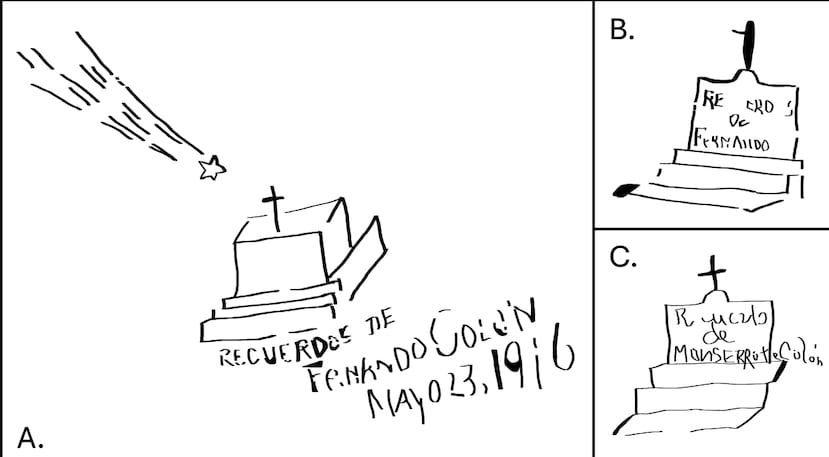
In Puerto Rico, this celestial visitor aroused interest, but its brightness also spread panic. This was captured in a fascinating work that researchers from the Arecibo Campus of the University of Puerto Rico (UPR), they maintain, was created in 1910, inside a cave in the south of the island that they explored in 2018. Scientists think that the drawing, presumably, shows the comet on what appears to be a tomb. Beneath the simple drawing, someone wrote “Memories of Fernando Colón, May 23, 1910”.
The investigation, which began in October 2023, discovered that the rock art was created, probably with charcoal, by a 15-year-old boy named Fernando Colón Vázquez, who, like many at that time, “He was fascinated and perhaps a little terrified by the passage of the comet,” highlighted professors Ángel Acosta Colón and Abel Méndez in the study.
Faced with the astronomical event, the teenager would have sought refuge in this cave where, according to scientists, he captured the sea of emotions that Puerto Ricans felt at that time, drawing inspiration from contemporary illustrations to represent a comet.
However, it would not have been an easy task, since, according to the researchers, reaching that area of the cave, which lacks natural lighting, requires a person to crawl.
“Consequently, the artist would have had to resort to artificial light sources, such as flashlights or an improvised bonfire, to execute his work (…) which highlights the artist’s commitment to commemorating the celestial event despite the physical limitations of the cave.”, read the scientific study.
“He portrayed a structure more like a chapel with stairs or, more likely, a tomb, pantheon or mausoleum, rather than a conventional church. This suggests an artistic interpretation (…) The iconography of a comet, represented as a star with a tail, is deeply rooted in artistic representations.which suggests a connection with traditional visual language,” they state in their analysis.
The research, which is part of the efforts of the Planetary Habitability Laboratory (PHL) and the Research and Education Group in Karsos and Caves (KCREG), was structured in five steps: decipher the rock art, identify the comet depicted, determine the artist and discover the motivation behind the work.
Through interdisciplinary research methods, as well as analysis of historical records, newspapers and censuses, experts from the Arecibo Campus put together the historical and social context in which Colón Vázquez lived.
In fact, a second visit to the cave, in November 2023, revealed similar artwork with the names of Fernando and Monserrate Colón (one of his brothers)confirming the connection between Fernando de la Cueva and the 1910 census that the experts analyzed.

Although the researchers did not reveal the location or name of the cave to preserve its condition, they indicated that it is part of the extensive limestone systems of Puerto Rico.
The analysis also led them to determine that the journey, from the young man’s house to the cave, represented an extensive walk, requiring approximately two hours on foot.
“This distance reflects not only the physical separation between their residential area and the cave, but also underlines the effort and determination it took to reach the cave. The decision to undertake such a trip, with a difficult karst topography and a semi-arid climate where modern means of transportation are insufficient, underlines the importance of the destination or the motivation for the visit.”the researchers discussed in the study.
“Widespread panic about the comet, fueled by sensational media reports predicting catastrophic outcomes, likely motivated Colón Vázquez, his family, and possibly others to take refuge in the cave. The case of Fernando Colón’s rock art illustrates the intersection between astronomical phenomena, social fear and individual expression. “This incident sheds light on the broader impact of celestial phenomena on human societies, especially in isolated communities with little scientific knowledge.”they concluded.
According to the team’s research, Colón Vázquez died in 1950, at the age of 54. He had several children, of which two may be alive at an age close to 80 years old.
For experts, this cave, beyond being part of the island’s topography, represents a window to the past.
In turn, they hope that Puerto Ricans will remember the artistic legacy of young Fernando the next time they raise their gaze to the sky to admire a comet and that reality may not be so far away, since it is expected that the comet C/2023 A3 (Tsuchinshan–ATLAS) reappear over the western horizon and at a safe distance from Earth between October 12 and 14.
Why is she called Halley and when will she be visible again?
According to the National Aeronautics and Space Administration (NASA, for its acronym in English), until the time of the English astronomer Edmond Halley (1656-1742), it was thought that these celestial bodies only passed through our solar system once.
However, in 1705, the astronomer found similarities in the orbits of three comets that were visible in the years 1531, 1607, and 1682. At that time, Halley suggested that the trio was actually a single comet that made periodic journeys and predicted , correctly, that he would return in 1758.
According to NASA, The first “periodic” comet in history was named in its honor and, since that time, the celestial body has been linked to ancient observations dating back more than 2,000 years.
“In each orbit around the Sun, a comet the size of Halley loses between three to 10 feet of material from the surface of its nucleus. Thus, as the comet ages, its appearance darkens and it may lose all the ice in its nucleus. The tails disappear at that stage, and it eventually becomes a dark mass of rocky material or perhaps dissipates into dust,” the federal entity reports.
After the 1910 event, Halley was received with more enthusiasm around the world when he was sighted again in 1986. His next visit near Earth will be in the summer of 2061.