
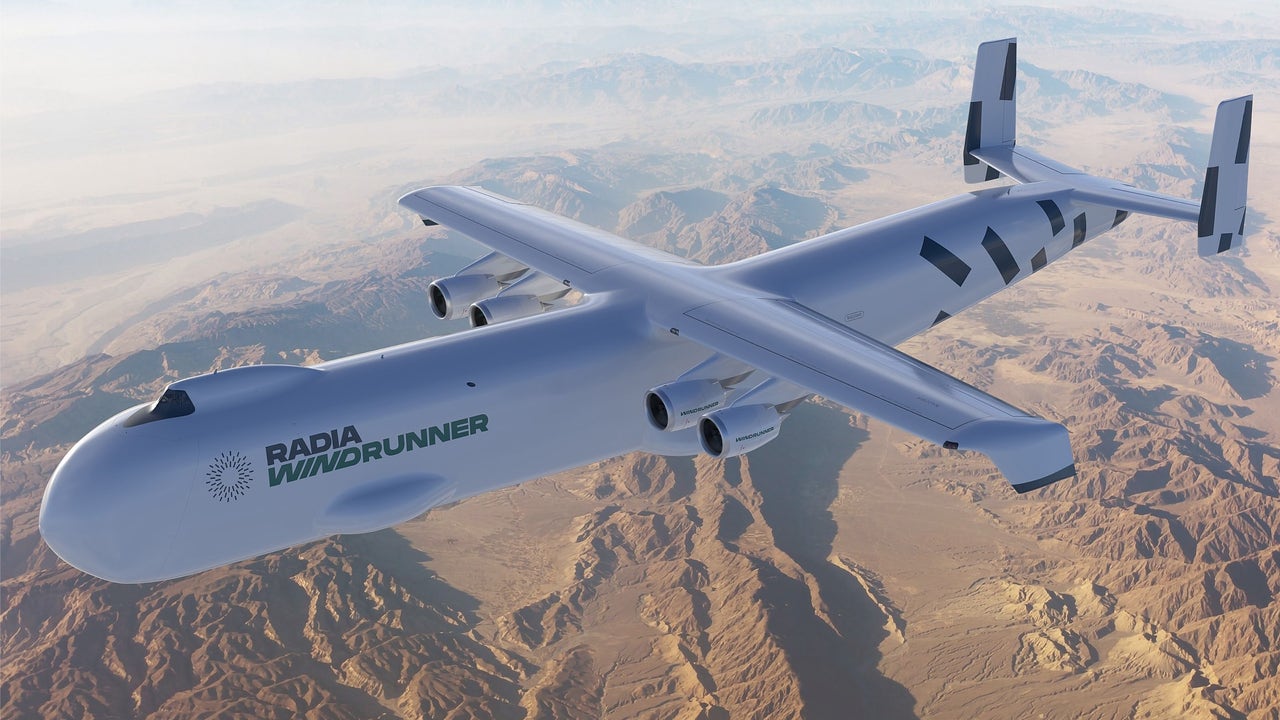
He Windrunnerdeveloped by the American company Radia, is a revolutionary transport aircraft that is projected to be the largest in the world, both for its cargo capacity and its innovative design. Initially designed for the transport of wind turbine blades Large in size, the aircraft has evolved to have additional military and commercial applications, company sources have revealed.
Radia Aerospace, a US-based company, is leading this ambitious project, which is supported by the US Department of Defense and key international allies. The company has been known for its innovation in advanced aeronautics, and the Windrunner is its flagship project, destined to revolutionize global military transportation.
Technical characteristics of the Windrunner
Its dimensions are:
- Length: 108 meters
- Height; 24 meters
- Wingspan: 80 meters
- Maximum payload length: 105 meters
- Maximum payload height: 7.3 meters
- Maximum payload width: 7.3 meters
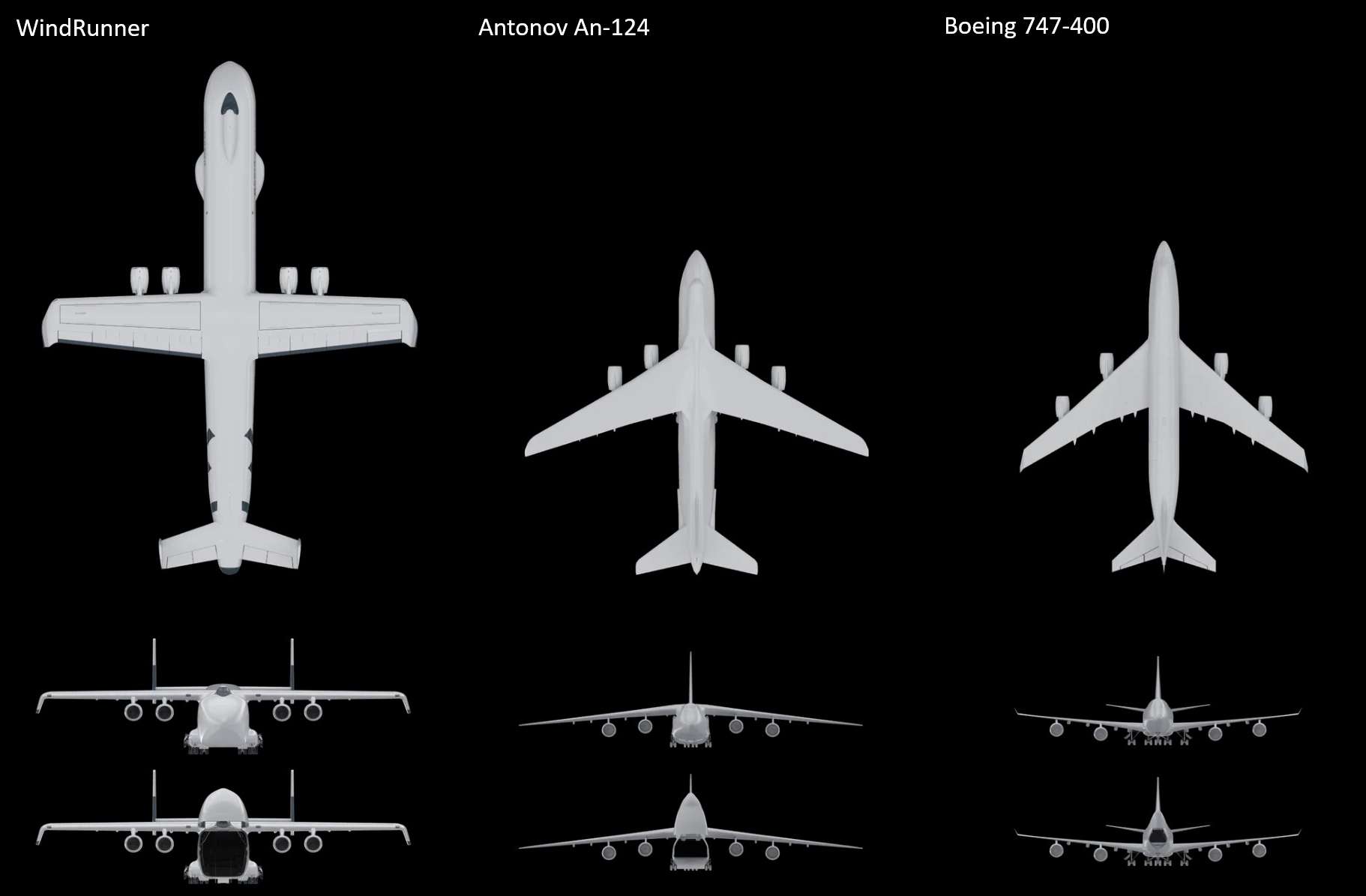
He Windrunner measure 108 meters long and is designed to carry loads of up to 72 tons (72,575 kg), with a focus on optimizing volume rather than weight, that is, it is an aircraft that breaks with the traditional military conception in which more thought is given to moving volume than mass. In this case it is the other way around and, obviously, there are other airplanes with greater loading capacity in terms of weight, but in this case the design is optimized for large volumes. Its carrying capacity in terms of volume is approximately 12 times larger than that of a Boeing 747, making it the perfect aircraft for transporting components such as wind turbine blades more than 100 meters in length, which are key for onshore and offshore wind energy projects.
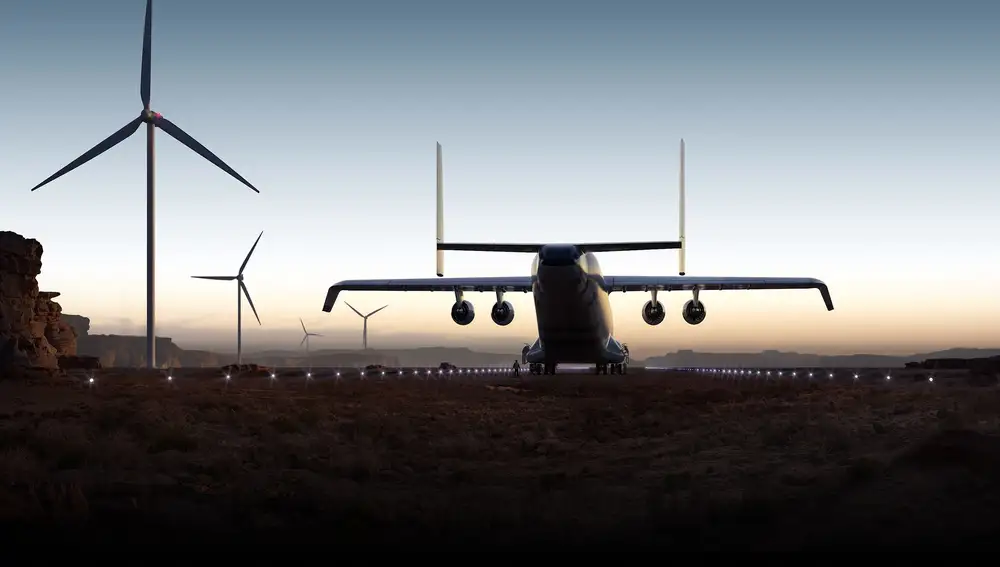
The plane uses four highly efficient motorsallowing it to reach cruising speeds of up to Mach 0.6 (approximately 740 km/h). Despite its large size, one of the most notable features of the Windrunner is its ability to landing on short, unpaved runwayswhich is essential to operate in remote areas where wind farms are usually built.
Context and purpose of development
The main objective of this aircraft, since its conception, has been to facilitate the transportation of large wind components to locations where the installation of larger turbines is necessary to meet global green energy goals. According to statements by the CEO of Radia, Mark Lundstromthe Windrunner will allow you to transport offshore-sized wind turbines to onshore locations. This could transform the energy sector, reducing the costs of onshore wind energy and significantly increasing the areas where this energy source is economically viable.
In addition to its use in the wind industry, the Windrunner has been adapted for military purposes. Its ability to transport up to six Chinook helicopters with propellers intact either six F-16 fighters makes it a strategic tool for military logistics, providing armed forces with the ability to move large equipment quickly.
Current status of the project
He Windrunner It is still in the development phase, with plans to begin test flights in the coming years. Radia projects that the first operational fleet will be ready before 2029. In addition to its commercial and military applications, the aircraft could have a significant impact on the reduction of CO2 emissionshelping to combat climate change by supporting renewable energy infrastructure.
Currently, three leaders in the aerospace sector – the Spanish Aernnova, Leonardo and AFuzion – have partnered with Radia to develop WindRunner. Aernnova will collaborate with Radia in the development of the wing pylons and the aircraft’s engine. Leonardo will develop the fuselage. AFuzion will provide advice on security and certification.
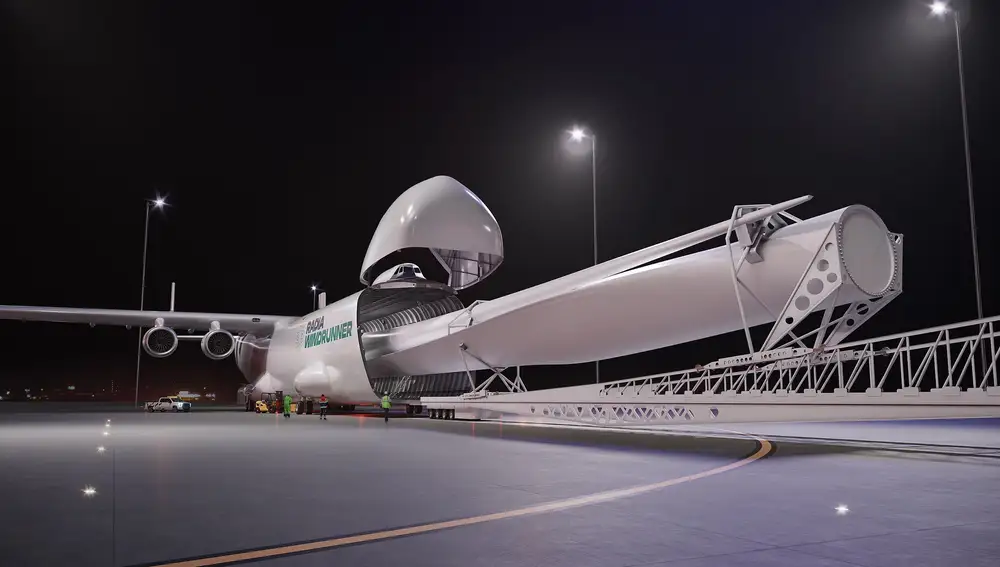
The partnership agreements are the latest step forward for WindRunner, an aircraft designed for its primary mission: transporting large turbine blades, up to 105 m in length, longer than a football field, directly to locations. building the wind farms, landing on semi-prepared dirt runways of only 1,800 meters. It will overcome the logistical barriers that currently prevent the expansion of onshore wind energy. Wind turbines become more effective and efficient the larger they are. But long turbine blades are extremely difficult and expensive to move by ground transportation because literal obstacles—bridges, tunnels, and curves in the road—get in the way.
“WindRunner is an opportunity for the aerospace industry to make a decisive impact on climate change, diversify into the energy industry and take advantage of a huge market opportunity,” said Mark Lundstrom, CEO of Radia. “We are very pleased and excited that Aernnova, Leonardo and AFuzion, three companies at the forefront of aerospace design, development and engineering, have chosen to partner with us on this critically important project.”
“We are excited and proud to participate in the largest aircraft in the world, especially taking into account its mission,” said Ricardo Chocarro, CEO of Aernnova. “Based on my previous experience in this sector of the wind turbine industry, I can affirm the importance of the solution that WindRunner provides. The agreement with Radia for the development of the WindRunner project positions us to support the design and manufacturing of wing pylons and engines, recognizing our experience in the design and development of this ambitious project.”
In summary, the Windrunner Not only is it shaping up to be the world’s largest transport aircraft, but it could also play a key role in the global energy transformation, facilitating the implementation of wind energy in new areas and reducing current logistical barriers.
Largest cargo planes in the world
These are some of the largest and capable of transporting greater loads:
- Airbus 400M: With a maximum payload of up to 37 tons and a volume of 340 m3, it can transport numerous large pieces of cargo, including vehicles and helicopters that are too large or too heavy for previous tactical transport aircraft, e.g. an NH90 or CH-47 Chinook helicopter or a heavy infantry fighting vehicle for military purposes. It is capable of landing and taking off from any unprepared short, soft and rugged CBR 6 (pavement rating) runway below 750 m, while delivering up to 25 tonnes of payload and with enough fuel on board for a 930 km round trip. Thanks to its state-of-the-art technologies, including its four exclusive EuroProp International (EPI) TP 400 turboprop engines, the A400M has the capacity to fly distances of up to 8,900 km, at a cruising speed altitude of up to 11,300 m, and at a speed of up to Mach 0.72, very similar to that of a turbofan transport aircraft. It can even fly up to 12,200 m for special operations.
- Airbus, A300-600ST Beluga: There are airplanes with more capacity and that can carry heavier loads, but none can carry loads as large and voluminous as the Beluga: its compartment measures 7.4 m in diameter and 37.7 m long. In total, it carries up to 47 tons of cargo.
- Antonov An-22 Antei (the largest propeller plane in the world);
- Antonov An-225 Mriya, the heaviest aircraft in the world, with a maximum takeoff weight of 640,000 kg. It is the largest civil cargo aircraft in the world. Its cargo compartment is 43.32 m long, 6.4 m wide and 4.4 m high.
- Boeing 747-400 Dreamlifter / LCF, It is a heavily modified version of the Boeing 747-400. The 747 Dreamlifter is the longest cargo plane in the world
- Boeing 747-400ERFcan carry a maximum payload of 113 tons.
- Boeing 747-400F, can carry a maximum payload of 113 tons.
- Boeing 747-8 Freighter, with a maximum payload of 140 tons.
- Boeing C-17 Globemaster III, Originally designed to serve the needs of the United States Air Force, it is capable of carrying a maximum payload of 76,657 kg, has a maximum range of 10,390 km and can land on short runways.
- Lockheed Martin C-130 Hercules or its upgrade, the C-130J Super Herculeswith a maximum payload of 21,470 kg and a range of 4,074 kilometers.
- C-5M Super Galaxy– Improved variant of the C-5 Galaxy, can carry a maximum payload of 129 tons.