
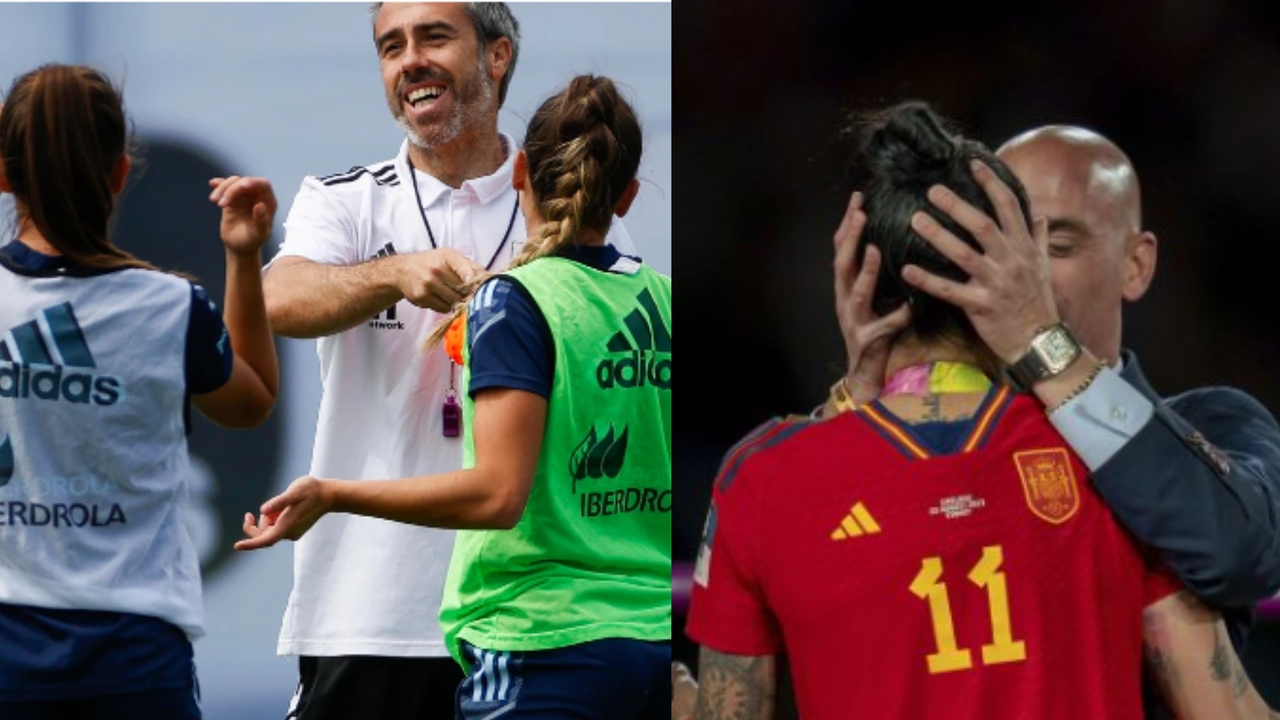
On August 20, 2023, Spain became world champions. The dream came true after defeating none other than England in the final. However, beyond a historic achievement, what dominated all the comments on radio, websites and social networks was the attitude of the president of the Federation, Luis Rubiales. The kiss on the mouth that the then president of the Royal Spanish Football Federation (RFEF), Luis Rubiales, gave to the player Jenni Hermoso at the medal ceremony went around the world and caused an authentic tsunami that dynamited the RFEF and caused an unprecedented purge with the departure of the president and coach Jorge Vilda at the helm.
He incident turned Jenni Hermoso into a symbol beyond the grass. Considered a champion of feminism She was chosen as one of the 25 most influential women in the world, according to the Financial Times and the footballer of the year for The Guardian.. A media push that Netflix has not hesitated to take advantage of. Netflix Spain has presented its next feature-length documentary, “#SeAcabó: Diario de las championas”, which will premiere on the platform worldwide on November 1.
A film that narrates the path from the 15 o’clock card to the World Cup, told first-hand by some of the champions. The fact that the film starts with the famous plant has already been the subject of criticism since the main protagonists of the documentary Jenni Hermoso, Alexia Putellas or Aitana Bonmatí either did not sign it or backed down. “They talk about the 15 but neither Jenni nor Putellas were part of it. Honor Mapi León, Patricia Guijarro and Claudia Pina” or “Coincidentally, the three main protagonists of the documentary did not sign the “15” manifesto. Always with the “15” and their values and principles. They are references and are the true champions”, son some of the messages that can be read on networks.
AND is that the mutineers were almost as protagonists as those that reign today in women’s world football.
Who were the “15” and what happened in the selection?
One year before placing his star on his chest – in September 2022 – Fifteen players from the Spanish women’s soccer team resigned from playing with the national team “as long as the situation that had arisen in the last concentration with coach Jorge Vilda is not reversed.” An order to which RFEF reacted forcefully and was inflexible in its stance of not “admit any type of pressure from any player when adopting sporting measures.”
“The RFEF communicates that, throughout today, it has received 15 emails from 15 players of the senior women’s soccer team, coincidentally all with the same wording, in which they state that the current situation generated affects them ‘definitely. ‘significantly’ in their ’emotional state’ and in their ‘health’ and that, ‘as long as it is not reversed,’ they resign from the Spanish national team,” the organization said in a statement.
Previously, there had already been a request from a sector of the internationals for the resignation of Jorge Vilda, something that was denied by captains Irene Paredes, Jennifer Hermoso and Patricia Guijarro, although they did recognize that there was “certain internal aspects” that had to be “changed.”
Vilda “the controller”
But the war had only just begun. If a month before the emails, the Barça captains, Patri Guijarro, Irene Paredes and Alexia Putellas, had already asked the president of the Royal Spanish Football Federation (RFEF), Luis Rubiales, for his head and met with Vilda pBefore asking him face to face to resign from his position, after the Federation’s statement the tension increased. “We blame him for our ovaries” some of the wardrobe heavyweights even stated, according to Cadena Cope.
The players hinted that they did not trust him, that he would not be up to the task, that the atmosphere in the locker room was very tense and that a change was necessary before the 2023 World Cup in Australia.
but later It would be shown that the differences with the coach went beyond the game. Sources close to several of these players told Mundo Deportivo that the main reasons are related to excessive control on the part of the coach, which is sometimes unhealthy and which they even classify as “dictatorial.” As confirmed by Jenni Hermoso in the program “Planeta Calleja”, Vilda forced the players to keep the doors of their rooms open until twelve at night to check for himself that they were there before going to sleep, a decision that they considered threatened their privacy and their rest.
Likewise, they denounced that the coach He controlled them when they went shopping, to the point of checking their bags and their contents, and they even had to say who they were going to have coffee with.. Every movement was always subject to strict surveillance that hIt seemed that the players felt disturbed and self-conscious on many occasions, they say.
However, the Federation did not give in, it kept Vilda and from that same day none of them were summoned. The 15 players in question were: Ainhoa Vicena has site, Patri Guijarro, Sandra Paños, Amaiur Sarriegi, Leila Ouahabi, Lucía García, Mapi León, Ona Batlle, Laia Aleixandri, Claudia Pina, Aitana Bonmatí, Mariona Caldentey, Lola Gallardo, Nerea Eizagirre and Andrea Pereira.
The controversy goes backwards
Months later, and seeing the proximity of the World Cup, part of the mutineers began to retreat. In a surprising change of script, in June 2023, the vast majority of the “rebels” who sent an email to the Royal Spanish Football Federation (RFEF) asking not to be called until things changed They sent a new email to the RFEF saying that they were available again and that they could be called up if the coach Jorge Vilda wanted it. Some emails in which, according to internal sources, no type of apology was included. A retreat that was harshly criticized on social networks and to which the Federation only gave in minimally.
There were eight who backed down and announced their availability to compete in the World Cup, but Vilda only recovered three of the 15: Ona Batlle, Mariona Caldentey and Aitana Bonmatí. The rest followed the World Cup from Spain. Seven of them, Mapi León, Patri Guijarro, Claudia Pina, Lola Gallardo, Ainhoa Moraza, Nerea Eizagirre and Amaiur Sarriegi were kept out by their own decision and the other five – Lucía García, Laia Aleixandri, Leila Ouahabi, Sandra Paños and Andrea Pereira – after being ruled out by the coach for technical reasons.
The silence of “12”
The absolute silence of the “12” who were left out was thunderous throughout the World Cup and the absence of any message after the historic passage to the final generated a bitter debate on social networks.
If the then president of the Federation, Luis Rubiales, remembered them with a harsh message: “What we have endured has been a lot. Let Jorge Vilda, who is a hard-working man, a world-class technician, be questioned, who have renounced other teams that offered them more money and stayed in Spain. We have stayed with those who have always wanted to be, but also with those who have valued the great work that has been done to grow, and we have forgotten the people with resentment who do not add up. “He has continued working with his people and has not listened to those who wanted to destroy.”
A lot has rained since then. The kiss marked a before and after in Spanish football but there are still many wounds to heal and Those who started the revolution that everyone applauds seem to have been forgotten.