
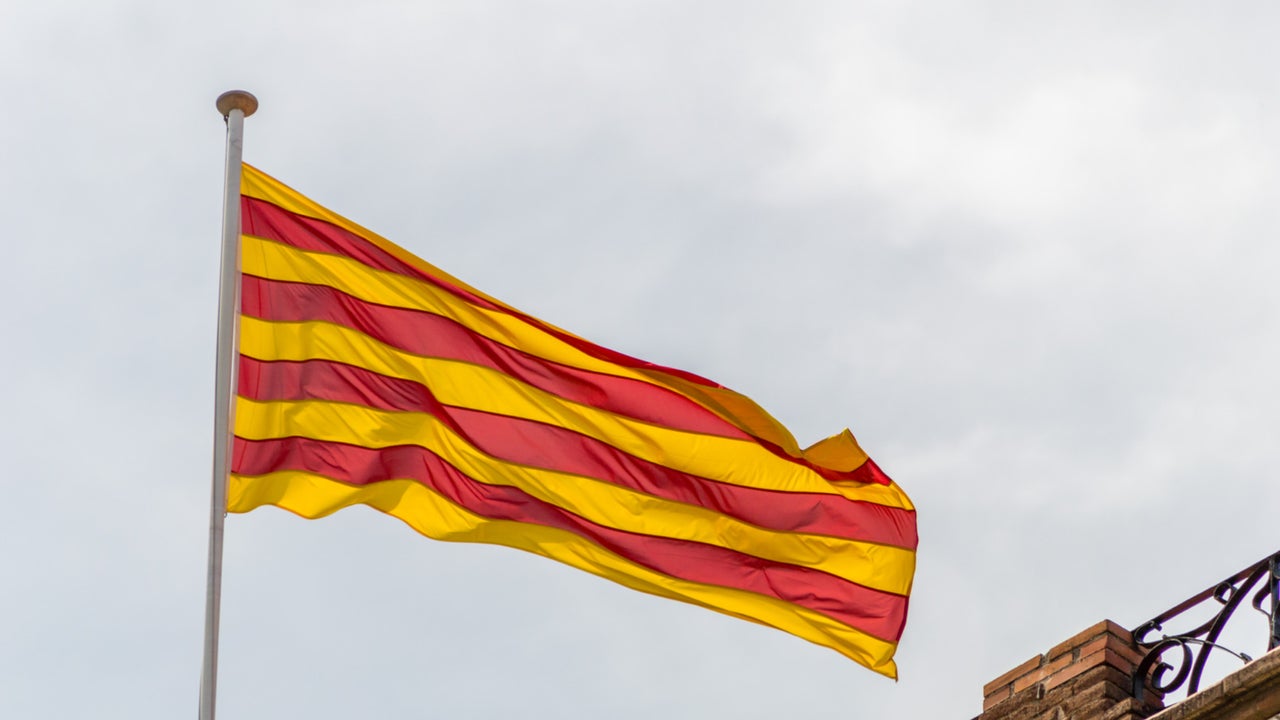
The Catalan flag, to which also It is known as ‘senyera’has a very easy way to describe. It is about the representation of a community based on A yellow background with four horizontal red stripes. At first glance, all this seems very simple, but historical reality and evolution have caused him to possess Heraldry signs, political reinterpretations and stories They still continue part of Catalonia.
As for the first solid trail that documents why this design, You have to go back to the High Middle Ages. Almost all historians coincide in that theory that the emblem of these four bars appeared in The seals linked to Count Ramón Berenguer IV. At this time, which would be around the 1150wax impressions were made in documents where a shield appeared with the red bars on gold field.
The representation of the kingdoms and the counties
In this sense, prior to the fact of having been a popular flag and recognized by the whole society, It was a differential sign that was related to a specific dynasty, that of the Barcelona counts at that time. As the years passed, it evolved until it was transformed In the real signal of the Crown of Aragonsomething that represented kingdoms and counties.
More research on Vexilology shows that the stripes, also called as the sticks, an emblem of the real authorities and corresponding to the nobility worked. All this began as a sign of identity and belonging, and then be transferred to the shields, banners and, of course, to the flags that They were part of the various territories of the crown.
The importance of the Renaissance in the ‘senyera’
Apart, during the centuries of the Renaissance, a mythical version based on a legend was ran by which the Franco King wet his fingers in The blood of an injured count and traced on a golden shield the four golden stripes. This is the story that appeared For the first time in the second part of the General Chronicle of Spain of Valencian Pere Antoni Beuter (1551). Since then, it has been very repeated and dramatized by artists.
THE ‘SENYERA’ It ceased to be a unitary dynastic seal and changed its way of acting, especially during the 19th century. In this sense, it went from being more unitary to being more collectic. During the Catalan rebirth, The four red bars recovered strength as a national emblem. Now, the flag began to represent the language, culture and politics.
Current recognition and legal character
Currently,THE ‘SENYERA’It also has a legal recognition. The flag of Catalonia was regulated after the recovery of self -government in democracy and appears in the norms that define the symbols of the Generalitat. In addition, its forms and use are collected in the statutory text that set the way in which it should be shown as an institutional emblem.