
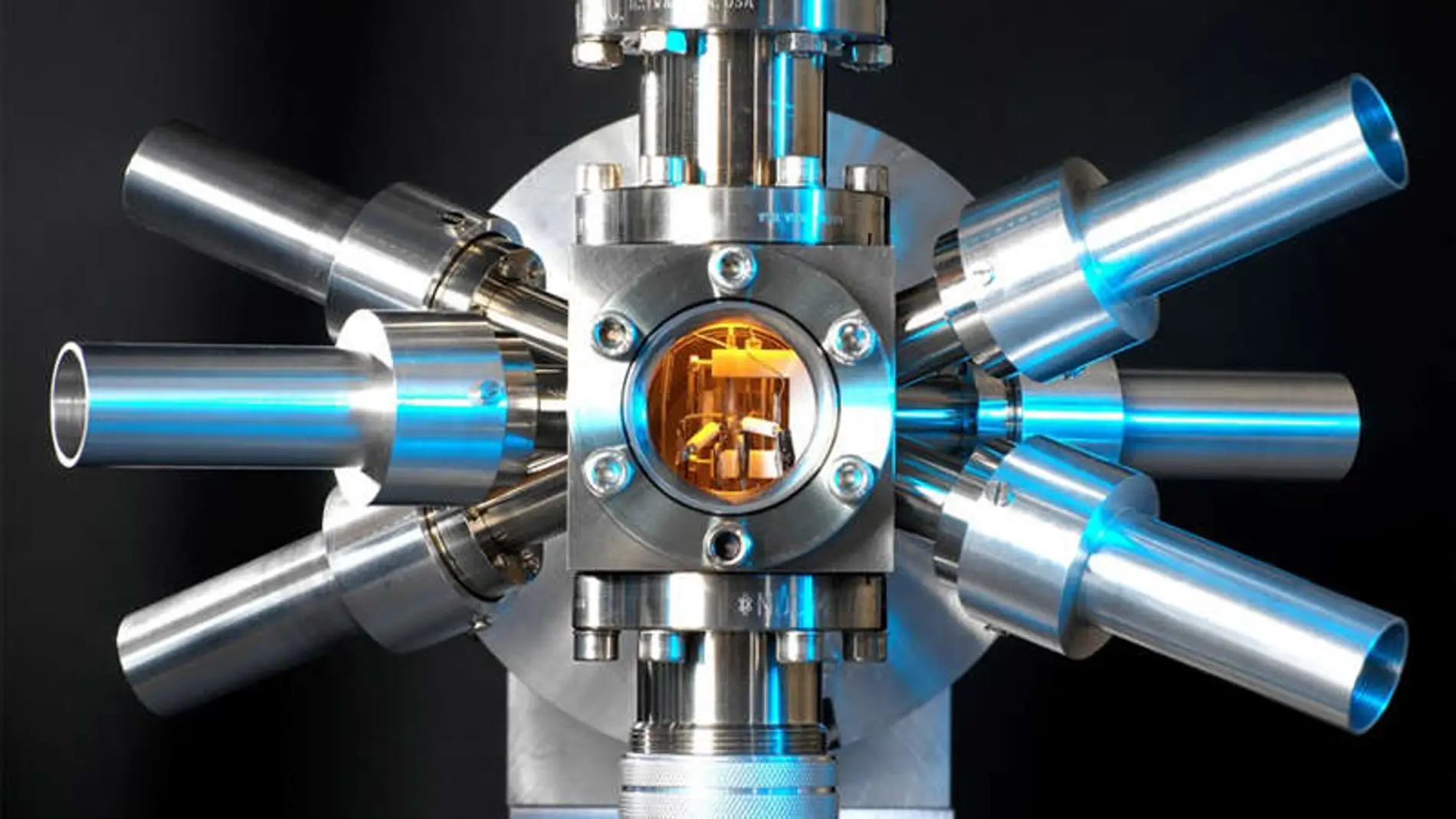
an atomic clock It is the most precise instrument that exists to measure time in the world. This is because instead of using a pendulum, a spring or a quartz crystal, takes advantage of the extremely stable frequency with which atoms absorb or emit energy when changing state.
Inside the clock atoms are excited (usually cissus, rubidium or strontium) with microwaves or lasers. When the frequency of that radiation coincides exactly with an energy transition of the atom, it reacts in a predictable way. The device counts these oscillations as if they were the ticks of the metronome of a conventional clock.
The atomic clocks that keep the official world time there are approximately 500 Most of them distributed in metrology laboratories around the world. This figure varies constantly because some are continually retired, replaced or incorporated.
He International Atomic Time (TAI)based on UTC or international civil time It is calculated by combining data from more than these 500 atomic clocks. Spain, for its part, has the Royal Navy Observatory (ROA) in San Fernando that provides seven weather patterns, in addition to another one monitored remotely at the Spanish Metrology Center, in Tres Cantos (Madrid).
Why are atomic clocks separated from the earth?
Now, it is intended that these atomic clocks are separated from the rhythm of the earth’s rotationto avoid adjustments that complicate the operation of computer and telecommunications systems.
A user of platform ‘X’ explains this situation perfectly, explaining that: ” The first measurements of time were made by periods, mainly the periods of the stars in the sky.. How long it took for the sun to rise again, how long it took for the moon to have the same shape, how long it took for a constellation to be in the same area of the sky…
“And this was done because it is useful for humanss. “Predicting how long it takes for the sun to rise again helps us plan a hunt, knowing how long it takes for the moon to return helps us know when a pregnancy is possible, and looking at the stars helps us plan a harvest.”
“From there came the days, the months, the years…and at the beginning what really mattered was the position of the stars. The days began to be divided into hours, but for centuries the hours lasted differently in each place or time of the year, and it was not the same time in 2 places.”
“Noon was the time when the sun was highest, and you divided the morning into six parts and the afternoon into six others. “Hours could be longer in summer and shorter in winter.”
“The entire system collapsed with the industrial revolution and the railroad.. The hours began to always last the same, since otherwise productivity and salaries could not be well controlled. And with the arrival of the train, the fact that noon was at a different time in each city also began to fail, because we have a vehicle with very strict schedules, which continually changes cities at high speed. “We had to standardize.”
“What was the solution? Well, establish a single place to mark the time: An astronomical observatory: Greenwich. Since then they measure where the Sun is, and when the Sun is in the correct position with respect to Greenwich, then it is “o’clock” everywhere.”
“The clocks were imprecise, they went back, aheadthere was no way to be totally sure how much time had passed, but nothing happened. You looked at the sun and the sun told you when it was noon to set the clock.
“But then they came atomic clocks. Atomic clocks count the number of times a cesium-133 atom vibrates, but it is not important to understand this. “It’s just that they are something tremendously precise.”
“AND We trust them so much that now we know that the days do not always last the same. “The sun does not always take exactly 24 hours to be at exactly the same point in the sky, because the earth does not rotate at a constant speed.”
Two types of time
Sometimes the earth’s axis moves a little (happens with large earthquakes) and we know that the earth rotates more and more slowly. But the relevant thing is that now we have two times:
– Coordinated Universal Time: which we obtain by looking at the stars and the sun.
– and atomic time: which we obtain by counting movements of cesium atoms.
They are almost the same, but they separate little by little. Because they do not measure the same, they are not worth the same. atomic time It measures how many seconds have passed since we built the first atomic clock. universal time coordinated when exactly it is noon. But until now we corrected atomic time with UTC.
When UTC was too far from atomic time we added a leap second: We delayed it by a second, because until now the important thing was to maintain exactly when it is noon. When the continuous time of our clocks reads 11:59:59 at the moment when the observatories say that the sun is at its highest, well We take a second to correct it and make it strike 12.
It’s the same thing we do with leap years. Now they have removed the leap second because that happens every 2-4 years and involves different software fixes, costs, etc. And instead of doing it every second, they will now wait for the time to go back an hour and adjust an entire hour. If the leap seconds are every 2 years or so. We are talking about that if we wait an hour we will not have to update for thousands of years.
How does separating atomic clocks affect us?
Well then The sun will never again be at its highest at noon. Not even in Greenwich. We will hardly notice it during our lives.. But it will go further, in 100 years it could be a minute.
In Spain we have experience with that. When the difference between atomic and solar time reaches 1 hour, it will be as if winter time were summer time, and summer time… super summer time. The sun would set at 11 pm.
And since people will continue to live by solar hour, everyone will have dinner an hour later. And that is the question, so that the technology works with fewer problems, and has less costs, We are changing the last connection that the time on our clocks had with the natural time of our ancestors.