
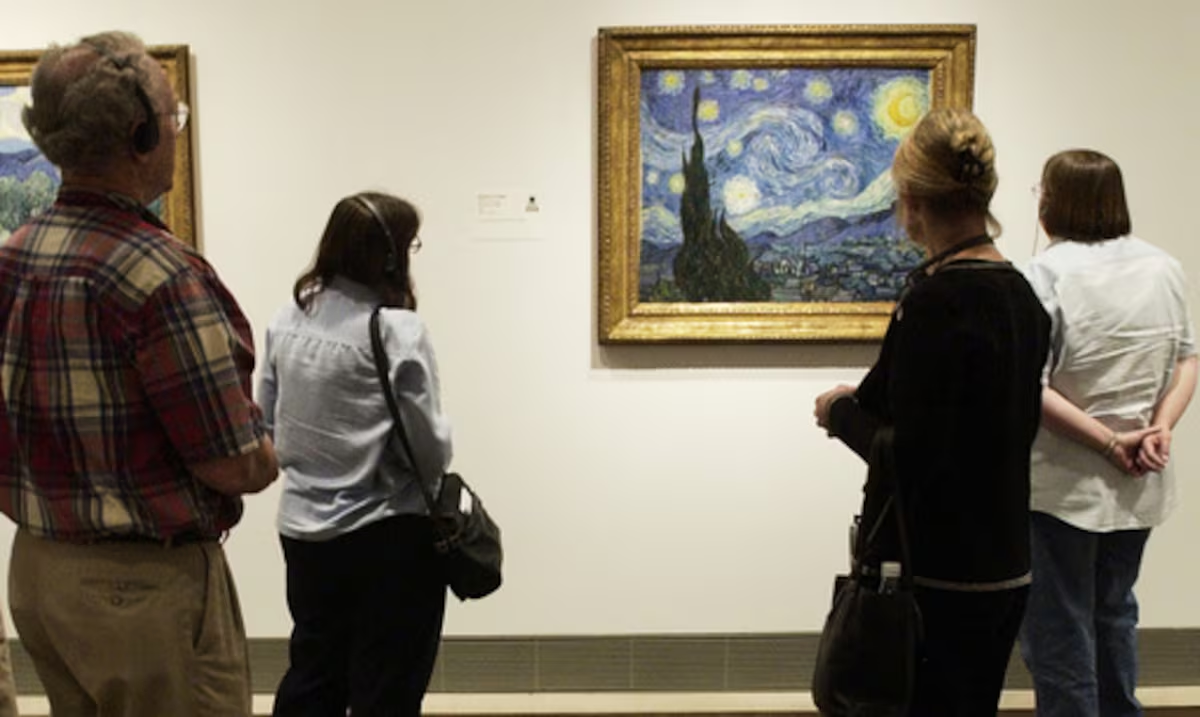
Some scientists who also act as art detectives have related “The Starry Night”of Vincent Van Goghwith a celestial scene that suggests a new date for one of the most famous paintings in the world.
Their findings indicate that, rather than being the fruit of Van Gogh’s imagination, “The Starry Night” could have been inspired by what he saw when looking at the sky from the French asylum where he was 137 years ago.
A South Korean team reported Thursday that after years of forensic astronomy and research on the Dutch artist, they have identified his masterpiece with the pre-dawn sky over Saint-Rémy-de-Provence, France, around July 22, 1889.
This is a month later than what has long been considered the time frame for this Post-Impressionist painting, which depicts a crescent moon and Venus surrounded by a sky of swirling stars, with a town nestled at their feet and cypress trees towering to one side.
Art historians have long dated this painting to June 1889, shortly after Van Gogh was admitted to the asylum. He had cut off his left ear several months earlier, during an argument with the painter Paul Gauguin.
A team led by Elijah Jeong-hyun Kim, CEO of a telescope manufacturing company in Seoul, now casts doubt on that date in a study published in the journal Scientific Reports.
The sky closest to the one in the painting was observed around July 22, 1889, according to Kim, who is also a doctoral student at Kyung Hee University. He noted that the few days before and after could also have served as inspiration for Van Gogh.
“No two skies are the same. Something always changes. I think Vincent noticed those changes and captured them in the painting,” Kim said in an email.
He added: “I am convinced that July 22 is the best date. I am betting on this date.”
The latest study addresses “a real enigma”: that, in mid-June 1889, the moon was not the thin crescent painted by Van Gogh, according to José Luis Aragón, from the National Autonomous University of Mexico. He has studied “Starry Night” from a physics point of view, but was not involved in the new research.
“Still, I would consider the July date more of an interesting hypothesis than a definitive answer,” Aragón said in an email.
Long fascinated by Van Gogh’s art, Kim traveled to France in 2019, the first time in mid-June and the second around July 22. He watched the bright stars emerging in the July sky before dawn, unlike what he had seen in June.
Kim and his team discovered, after further investigation of the sky, that around July 22, 1889, the shape of the Moon before dawn resembled that of the painting, with the Hyades star cluster, in the constellation of Taurus, rising in the east next to Venus. According to his meteorological analyses, the sky should have been clear enough for Van Gogh to see all of this.
It is believed that Van Gogh suffered an epileptic seizure around that time, in July. However, Kim and his team maintain that the attack occurred later in July, based on their analysis of letters exchanged between the painter and one of his brothers. Some of those letters reference cicadas, another clue pointing toward a warmer July, according to Kim.
The researchers tested and verified their methods on the night skies of other paintings, which Aragón said constitutes “a thorough and truly interdisciplinary study.”
Given that Van Gogh painted in a workshop at the asylum from sketches and from memory, “it is likely that the sky is a combination of many nights, as the authors themselves recognize,” Aragón stated.
“What seems most convincing to me is the general message: the painting is not pure fantasy. Van Gogh observed the real sky very carefully,” said Aragón.
Despite all her research, Kim has never seen “Starry Night” at the Museum of Modern Art in New York.
“Now that the article is published, I have to go see ‘Starry Night’ in person, right?” he said.
This story was translated from English to Spanish with an artificial intelligence tool and was reviewed by an editor before publication.