
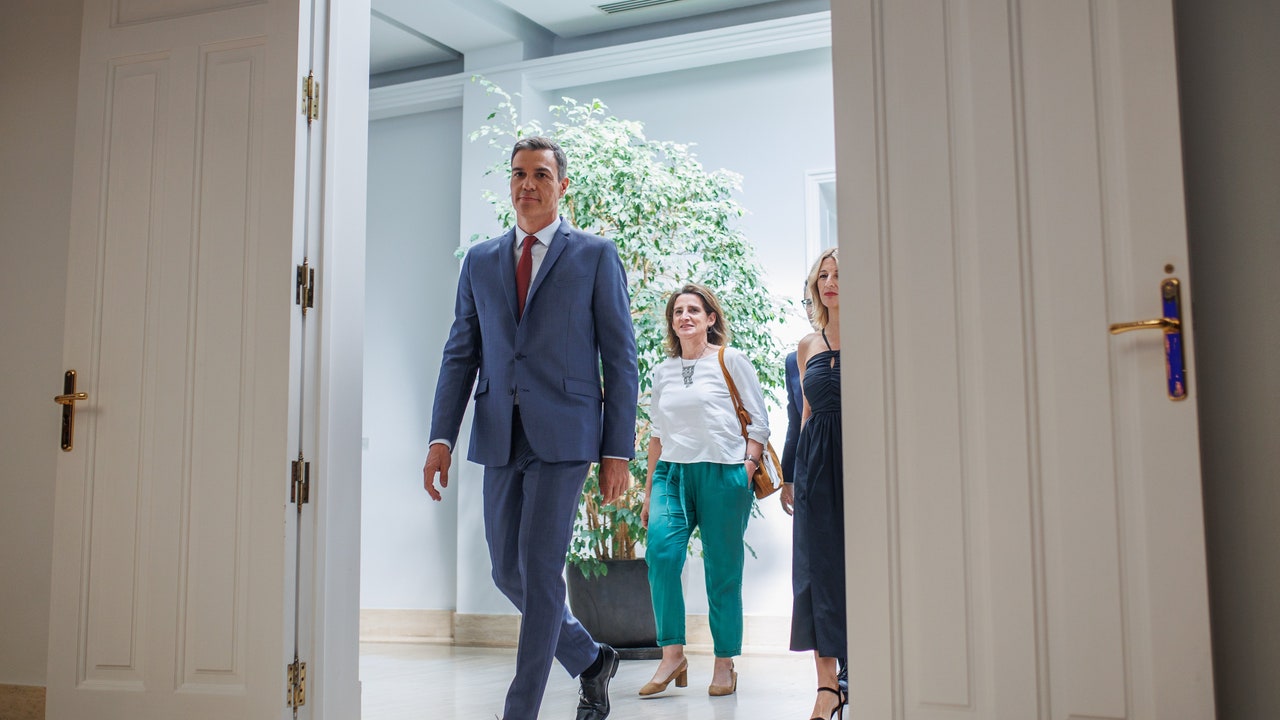
For those who work day by day in the “Seed Building” of Moncloa, baptized thus by storing select seeds from the Ministry of Agriculture, it is almost impossible to avoid the comparison with those who preceded them.
The men and women who act hand in hand with the president of the Government inside and outside their cabinet live day by day with the pressure of the exhausting public service 24/7. Perhaps that burden is the only thing that remains and that unites, as an invisible thread, to the generations that have worked in the halls of power.
But Spanish society is not the same as the late 70s and early 80s. It is not its political elite. The country has given an unprecedented leap in the last 50 years, especially at the educational level of citizens. The striking thing is that in recent weeks a False curriculum hunting initiated by the Minister of Transportation, Óscar Puente —Cleenciada in Law—by pointing to the already former deputy of the PP Noelia Núñez, who admitted not having any title despite having sustained otherwise.
Titulitis jelly through Moncloa has already charged three resignationsone of them that of the government commissioner himself for the Dana, as well as several “rectifications” in the biographies of much of the country’s political class.
If at the beginning of 1980, the proportion of adults with higher studies did not exceed 7%, According to a study signed by economists Ángel de la Fuente and Rafael Doménech for the BBVA, today, according to the OECD, 44% of those who are between 24 and 65 years of age have at least one university degree. Something similar happens with those who have a doctorate. The annual number of thesis defended in the 80s was much lower than the current one: hundreds instead of the thousands that are read today.
In the same way, that some degree would have been sealed at a foreign university was something exotic in that decade. It can be said that this was one of the great traumas of the Spaniards of the past, also that of those who landed in the Poncloa Palace by the first governments of Adolfo Suárez and Felipe González, although those cabinets, in truth, were not at all a reflection of the society of his time.
Both former presidents share a law degree. Suarez from the University of Salamanca and González for that of Seville. The Abulense even a doctorate at the Complutense of Madrid.
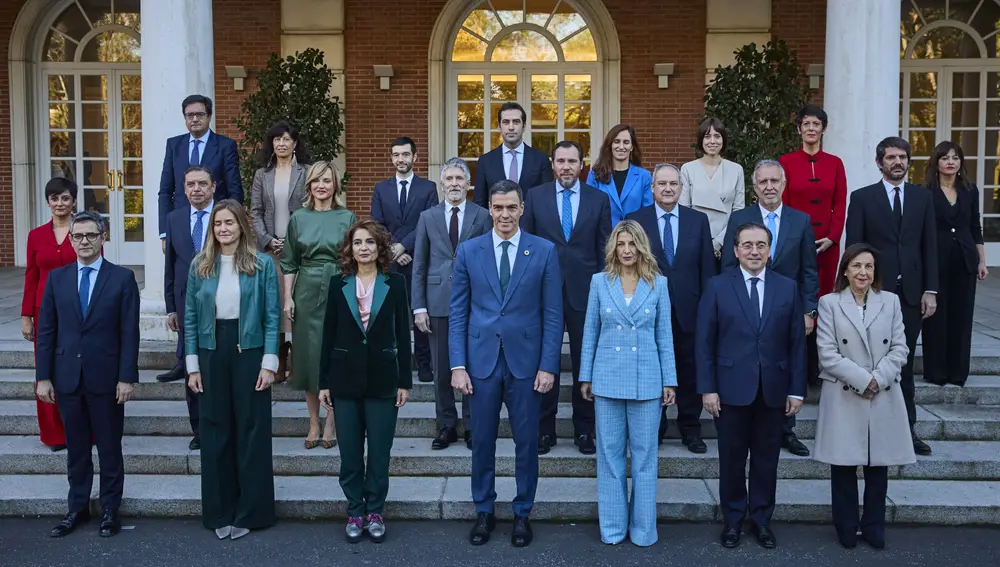
Its first executive, that of the Constituent Legislature, composed of 19 ministers, It was a graduate cabinet. His vice president and defense minister, Lieutenant General Manuel Gutiérrez Mellado, made military career. And the first of González, formed by 16 ministers, also made full of degrees. The 22 portfolios of the current Sánchez government – tuned in economic and with a controversial thesis for their level – are also subject to 22 graduates.
But what the sources consulted in the Executive highlight is the formation of the presidency cabinet. Those who work there are machaconally repeat that they are academy people.
“Almost everyone has doctorates for the best universities in the world,” explains a person close to Sánchez. Oxford, Harvard, Georgetown or Bologna are some of the elite centers in which experts who advise the president, including their chief of cabinet, Diego Rubio, a graduate in History, with a master’s degree in Lyon and doctorate in Oxford. Like him, most of his team are specialized in political science, sociology and economy without more ancestry within the PSOE than a certain ideological affinity.
Although there are those who ask what so many elite experts are of if the management is poor. “If the excess of bureaucracy in the administration is accompanied by inflation of political positions, the deprofessionalization is served: budgets that are not executed, trains that do not enter through the tunnels, poorly managed mortal danas, bridges that fall, mass blackouts …”, laments the sociologist Narciso Michavila – critical with the appointment of the chief of the chief of the chief of the chief of the chief of the chief of the chief of the chief Presidency.
The head of GAD3 asks: “If so good they are, why we are not capable.” The first head of Cabinet of Democracy was Carmen Díez de Rivera – the only woman who has been – who worked for Suárez and studied political sciences in the Complutense. «My mother wanted us to study. This was important because at that time women only met the three Germans (children, kitchen, church), ”he explained in an interview.
But it is that level of curriculum elite that, highlights the sources consulted in Moncloa, who did not have those who built the first governments of democracy. While it is true that they do not say it with the intention of belittling the work of those who preceded them, they are intended to relativize the criticisms of the “elders” to the political decisions that are made from “seeds.”
There are those who remember the Pullas de González. Or Alfonso Guerra. In a way, the generational warfare is intuited; The classic conflict that arises from misunderstanding between people who grew up in very different political worlds. «The presidency cabinet has to do with what the president seeks, it is a reflection of society. And now she is more needy of specialists. Nor do I believe that the formation is decisive. In that building the spirit of service to Spain must prevail, ”says political consultant Luis Arroyo, linked for decades to the PSOE.
Inevitably, the question that arises is: Is it necessary to have a title to serve the country? «It may not come badly, but it is not essential. It is enough to have a global, general and efficient vision of politics. It is not essential to be a doctor of political science to be minister. Society is now full of titulitis to show that having one is to sell better, ”says the former socialist deputy Manuel de la Rocha, father of one of the experts, of the same name, who advise Sanchez today – the director of the Office of Economic Affairs.
Both embody that generational tension: the father, a law graduate, and the son, in business with a master’s degree in economic policy from the University of Columbia. If the spirit of the previous generations had to be conducted, it is enough to replicate what Rodolfo Martín Villa, former minister of Suárez, answered when he was asked if he was helped by his engineering studies in the positions he occupied: “Politics and, in many cases, the profession, they do not constitute a science, so they are not exact. Engineering has helped me not to confuse forecasts with desires, to be necessary in the values and Be flexible in everything else. He continues to excite me that a son of a mason arrives at the road engineer. ”