
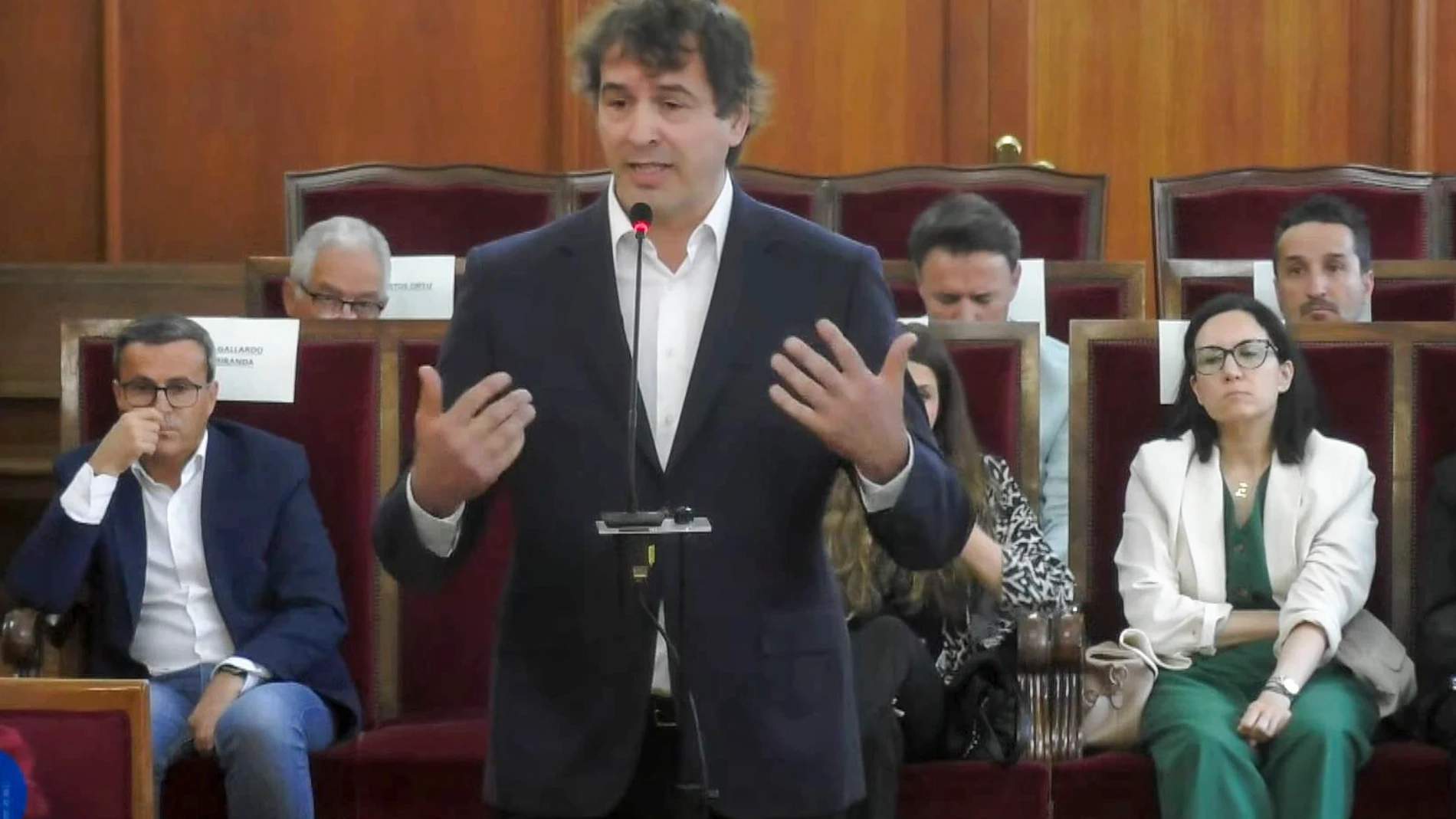
The lawyer for the former directors of the Culture area of the Badajoz Provincial Council Manuel Candalija and Emilia Parejo and the former deputy Francisco Martos considers that the sentence in the “David Sánchez case” is “inconsistent and hasty.” In his appeal against the sentence of all of them to nine years of disqualification for prevarication, as necessary cooperators, the lawyer Rafael Arenas maintains that the ruling of the Badajoz Court “is unsustainable and deserves to be removed as soon as possible from the legal panorama.”
As he highlights, his clients have been mere stone guests, “invisible”, in this procedure. “Because this is the “David Sánchez” case, it is the “Hermanísimo” case,” he highlights in his appeal before the Superior Court of Justice of Extremadura. “And all the rest of us, my clients, are conquered land, rather razed, insignificant collateral damage.”
The lawyer points out that the popular accusations – the Prosecutor’s Office did not accuse the musician and requested his acquittal as they saw no evidence of a crime – “aspired to the big game, which they have finally obtained, that is, to the conviction of the brother of the current president of the Government.” But that condemnation was not possible, he argues, “if the insidious theory of spreading an alleged institutional rot to the entire Badajoz Provincial Council did not take hold at the same time.” And his clients, he laments, “had the bad luck of coinciding in time and space with the target subject.”
The defense revolts against what it understands as a “coffee for all”, the sentences of nine years of disqualification from holding public office. And he regrets that the “general cause” that he attributes to the popular accusations has found “protection” in Judge Beatriz Biedma first, instructor of the case, and in the court later.
Barrage on accusations about the “sewers”
The appeal questions the decision of the Chamber to not take into account the testimonies of the Provincial Council officials who defended, in their appearances as witnesses, the hiring of David Sánchez. “The witnesses, all the witnesses, are disqualified either because they are not impartial officials, but rather servile ones, whose words and testimonies do not deserve to be or even taken into account, if not being socialists, it does not matter whether they are or not,” he states.
The lawyer draws attention to “the well-coordinated position” of the popular accusations, “that expedition coming from Madrid, that constant noise at the doors of the same judicial body”, and reproaches them for “miserably” trying to include the lawyers of the accused “among the beneficiaries of I don’t know what sewers led by a certain Sáenz de Tejada, clad in a judge’s toga, a grotesque absolutely unrelated to this defense and who, if it has had any effect, has been to deeply harm us.”
In his presentation, he criticizes “the mantra that inspires the entire sentence”, the “gratuitous assertion” that the Culture Area of the Badajoz Provincial Council “was always at the service of Mr. David Sánchez’s personal tastes from the end of 2016 until he resigned from his position.” Something that, he complains, forces him to also defend Candalija, Parejo and Martos of acts “for which they are neither accused nor convicted.” In any case, he makes it clear that “the objective of the creation of the position was not for David Sánchez to occupy it.”
The lawyer believes that the Badajoz Court has violated the rules and procedural guarantees and has violated the right to an impartial judge by rejecting the challenge against the three members of the court, who, according to him, had “a prior opinion” on the case (having resolved appeals against decisions of the investigator) “which, in addition, was prone to conviction.”
Pedro Sánchez “was nobody”
Likewise, he argues that the resolution of the Badajoz Court that rejected the causes of annulment presented by the defenses anticipates the guilt of his clients. And he reproaches the magistrates for going back to October 2016 (when the process of creating the senior management position that was awarded to David Sánchez began) to “embedding” the supposed “capacity for influence” of Pedro Sánchez”, “whom we believe has not even been called to the case as a defendant for such a crime.” It was about, he complains, “introducing the President of the Government directly as an influence peddler, perhaps with the intention that the accusations They would call, at least as a witness, to the case.” But at that time, he emphasizes, “Pedro Sánchez was not only nobody, but he was defenestrated in the party and even confronted, among others, with the Extremaduran Executive.”
The lawyer defends that Martos’s only intervention in modifying the name of the musician’s job (who in 2022 went from conservatory coordinator to head of the Performing Arts Office, according to the ruling to adapt it to his personal preferences) was to “sign under the initials vºbº the proposal issued by the Area Directorate.” His “only sin,” he says, “would have been to sign a simple approval of the proposal issued by the director of the area,” Emilia Parejo, for the “modification of the position.”
And as for Parejo, he states that “he limited himself to signing the reasoned proposal after being warned by higher authorities that it was, in effect, a modification and in no case the creation of any new position.” Finally, Candalija says that “there is not the slightest evidence of any crime.”
The lawyer for Candalija, Martos and Parejo also charges against the seizure of the emails of the Badajoz Provincial Council ordered by Judge Biedma in November 2024 (and subsequently ratified by the Badajoz Court). For the lawyer “a complaint “also based on press clippings” (that of Manos Liminas, which gave rise to the “David Sánchez case”), “cannot be enough” to decree “the exorbitant interference of a police body in the communications of people who, furthermore, do not even appear on the list of those accused or accused, nor did they have the status of being investigated.” The measure, he denounces, “seriously violated his rights” and violated his right to defense, which in his opinion should have led to the nullity of the procedure.
Criticism of Biedma
He also questions Biedma’s instruction, which for him “has not been impartial”, because he provided “obvious favorable treatment” to the popular accusation, and “has never given the most basic opportunity to the principle of presumption of innocence.”
As highlighted, the instructor incurred a “clear legal fraud” by constructing “her own account of accusations where, at her will, some have been left and the person marginalized” (in reference to the then regional deputy Antonio Garrote), “that is, the person whose status would motivate his necessary abandonment of the instruction.” “Would it have been imaginable that Mr. Garrote would not have been on the list of defendants if he had not had the status of a certified person?” he asks before emphasizing that “there is not the slightest justification in the entire case” for his exclusion from the list of those investigated.
Finally, he reproaches the court for allowing the popular accusations to modify a “substantial alteration of the facts and the legal classification” at the end of the trial, endorsing what he describes as an “attack by land, sea and air” endorsed “at the expense of the accused’s right to defense.” “The Chamber not only did not correct, but rather laxly admitted, the substantial alteration of the accusation and, therefore, of the terms of the procedural debate and thus of the trial itself.”
The appeal notes an error in the court’s appreciation of the evidence because “it has not been proven that the creation of the position was made at the request” of David Sánchez nor that it was “at the request of a person or persons close to Mr. Sánchez.” Nor, he adds, was it done “at the request of people related to Mr. Sánchez who were aware of his need for stable work.”