
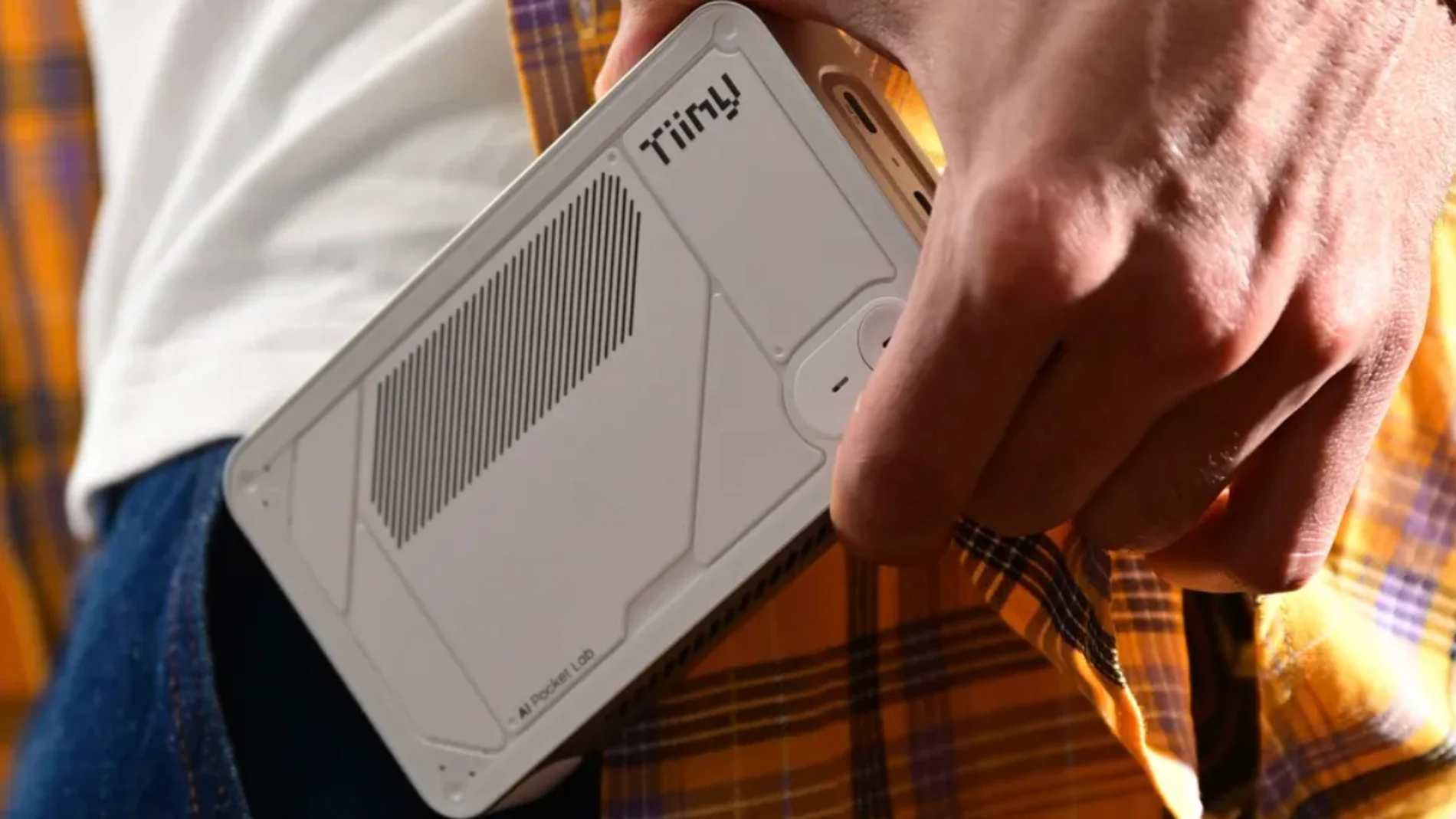
For decades, supercomputers have been gigantic machines. Rows of refrigerated servers, entire rooms full of cables and processors, and electricity consumption capable of powering a small neighborhood. Therefore, when a device appears that promises to concentrate some of that power in a device the size of a portable batterythe question arises almost automatically: to what extent can artificial intelligence be miniaturized?
That is precisely what Tiiny AI Pocket Lab proposes, a device presented by the startup Tiiny AI that is announced as the smallest artificial intelligence supercomputer in the world. With barely 14 centimeters long, 8 centimeters wide and just over two centimeters thick (approximately the size of a power bank) weighs about 300 grams, but promises to run artificial intelligence models that until recently could only work in data centers. Such is its size, that it has been recognized by Guinness as the smallest in the world.
The idea behind this device is simple but ambitious: transfer artificial intelligence from the cloud to your pocket. Inside the AI Pocket Lab is a 12-core ARM processor accompanied by a dedicated neural processing unit (NPU). Together they reach approximately 190 TOPS (trillion operations per second), a common measure for calculating AI processing capacity.
In practical terms, that figure puts it in a surprising league for a portable device. Many mainstream AI-accelerated laptops hover between 30 and 50 TOPS, while some chips designed specifically for AI in PCs slightly exceed 100 TOPS. This little device, on the other hand, surpasses those figures and comes closer to the performance of specialized hardware.
But what really stands out is the memory: 80 GB of LPDDR5X RAM, an amount that many professional laptops don’t even reach. That huge reserve of memory is what allows something unusual: running giant language models directly on the device, without an internet connection. The AI Pocket Lab can run artificial intelligence models with up to 120 billion parametersa scale that until recently was reserved for server infrastructures or professional GPUs costing thousands of euros.
In other words, tasks such as complex text analysis, code generation, or multi-stage reasoning could be performed directly on the device. According to its developers, this capacity reaches what described as “doctoral-level intelligence”, that is, models capable of addressing complex problems with multiple steps of reasoning. And all this without depending on external servers.
This approach has two important advantages. The first is Privacy: data never leaves the device. The second is cloud independence, which means that artificial intelligence could be used even in places without an internet connection.
The key to squeezing so much capacity into such a small device is efficiency. The system uses optimization techniques such as TurboSparse, which activates only the necessary parts of the neural network during the calculation, and PowerInfer, an engine that distributes work between CPUs and specialized processors.
Instead of trying to reproduce the enormous raw power of data centers, the device reduces the problem: it calculates only what is essential. This allows the entire system to operate with relatively low consumption for its power, with about 30 watts of thermal consumption and about 65 watts in full operationa far cry from professional GPUs that can consume more than ten times that energy.
Perhaps the most interesting thing about this device is not its size or power, but what it represents. For years, artificial intelligence has followed the same model: large data centers, huge energy costs, and constant dependence on remote servers. The AI Pocket Lab points to a different scenario: a personal, local and portable artificial intelligence, something more similar to owning a computer than renting computing capacity in the cloud. If this trend continues, the future of AI Could Be Less Like Giant Data Centers and More Like Small Personal Devices capable of thinking, analyzing and creating… directly from our pocket.